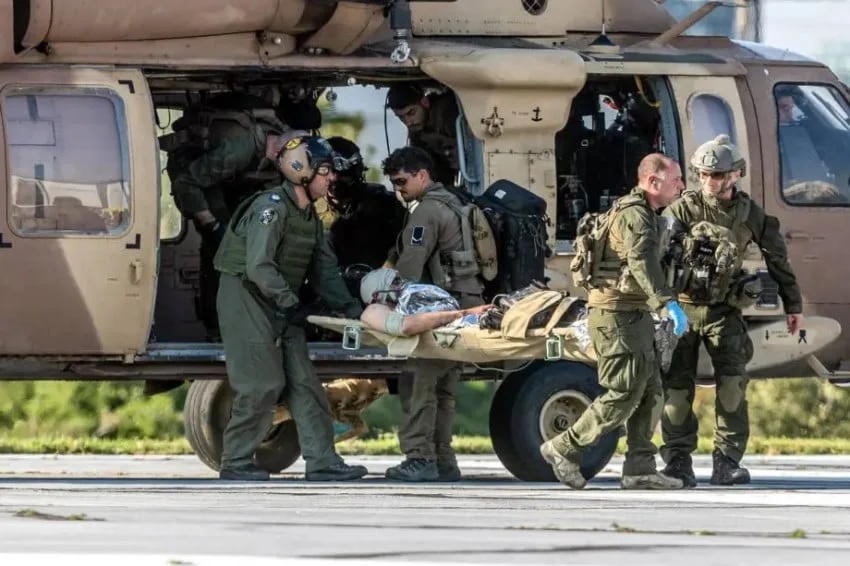
Two Israeli soldiers were killed and several others sustained varying degrees of injuries, including some in critical condition, following a tragic malfunction involving an Israeli military drone within the Gaza Strip on Thursday, September 24, 2026. According to reports from Hebrew-language media outlets, the incident occurred during an active operational deployment, leading to an immediate emergency response by the Israel Defense Forces (IDF). The wounded personnel were swiftly transported to Barzilai Medical Center in Ashkelon for urgent surgical and trauma care, with military helicopters deployed to facilitate rapid medical evacuation from the battlefield to the hospital’s helipad.
While the IDF has officially categorized the event as an operational accident, the scarcity of technical details provided by military spokespeople has fueled ongoing scrutiny regarding the reliability and safety protocols of autonomous and remote-piloted aerial systems currently being utilized in the high-intensity urban combat zones of Gaza.
Chronology of the Incident and Immediate Aftermath
The incident unfolded on the afternoon of September 24, 2026, in a designated sector of the Gaza Strip where intense ground operations have been ongoing. Initial reports suggest that a drone operating in close proximity to an IDF unit experienced a sudden technical failure or an unintended ignition, resulting in an explosion that directly impacted the nearby ground troops.
The tactical response was immediate. Medical teams on the ground provided initial triage, and air support was requested to evacuate the casualties to the nearest trauma center. By the evening, the IDF had confirmed the deaths of two soldiers, whose names were withheld pending notification of their families, in accordance with standard military protocol. The incident serves as a grim reminder of the volatility inherent in the dense, complex, and unpredictable combat environment that has characterized the Gaza conflict for nearly three years.
The Evolution of Drone Warfare in Gaza
The deployment of unmanned aerial vehicles (UAVs) has become a cornerstone of Israel’s military strategy since the outbreak of hostilities on October 7, 2023. These systems are used for a variety of purposes, including persistent intelligence, surveillance, reconnaissance (ISR), and precision strike capabilities. However, the heavy reliance on drone technology in urban warfare presents unique risks, including electronic interference, hardware malfunctions, and the dangers posed by "friendly fire" in environments where combatants are often in extremely close proximity.
Military analysts note that while drone technology has significantly reduced the need for ground-based patrols in some sectors, the catastrophic failure of such systems can lead to significant casualties among friendly forces. This specific incident highlights the "senjata makan tuan" (a weapon consuming its master) phenomenon, where advanced military hardware—intended to project force safely—becomes a source of internal casualties.
Contextualizing the Casualties: A Staggering Toll
The loss of these two soldiers adds to an already heavy toll for the IDF since the inception of the current conflict. Based on current military data, the total number of Israeli soldiers and officers killed since October 7, 2023, has reached 968. Of this figure, 472 have been confirmed as casualties occurring specifically during the ground offensive phase, which began in late October 2023.
These figures illustrate the sustained attrition rate faced by the IDF. The intensity of the fighting in Gaza, characterized by tunnel warfare, improvised explosive device (IED) traps, and close-quarters urban skirmishes, has made this the most significant military engagement for Israel in decades. The accumulation of these losses continues to be a subject of intense domestic debate within Israel, where the public, the political establishment, and the military command face mounting pressure regarding the long-term strategy in the Gaza Strip.
Military Transparency and Internal Investigations
Following the incident, the IDF spokesperson’s office issued a brief statement confirming the event and noting that an investigation has been launched to determine the precise cause of the drone malfunction. Historically, such investigations involve a review of maintenance logs, mission software, and flight telemetry data to determine if the error was caused by mechanical failure, pilot error, or external interference such as jamming or cyber-sabotage.
The lack of specific details regarding the drone model or the mission parameters has led to speculation among defense analysts. Some suggest that the increasing frequency of drone operations in Gaza may be pushing these platforms beyond their intended operational cycles, leading to higher rates of "wear and tear" that manifest as fatal accidents. Furthermore, the IDF has faced criticism in the past for its internal handling of "friendly fire" incidents, with calls from various NGOs for more transparent reporting mechanisms to ensure that tactical failures are rectified before they result in further loss of life.
The Broader Political Climate: A Region in Flux
This incident occurred against a backdrop of significant international diplomatic friction. Just days prior to this event, a major diplomatic incident took place at the United Nations General Assembly in New York, where 77 delegations staged a walkout immediately before Prime Minister Benjamin Netanyahu was set to deliver his speech. The act of protest, which drew global headlines, underscored the deepening isolation of the current Israeli administration on the international stage regarding its policies in Gaza.
The dual pressure of internal military casualties and international diplomatic fallout creates a complex environment for the Israeli government. The continuation of the war in Gaza, despite the heavy human cost, remains a point of contention. While the government maintains that the total dismantling of Hamas’s military and administrative capabilities is the only path to national security, the reality on the ground—exemplified by accidents like the one on Thursday—serves as a persistent narrative of the heavy price paid by the military personnel tasked with executing these objectives.
Analytical Perspective on Operational Risk
In the broader context of 21st-century warfare, the incident in Gaza acts as a case study for the risks associated with the "robotization" of the battlefield. As militaries globally transition toward autonomous systems, the human cost of technical failure becomes a critical metric of success or failure.
- Systemic Reliability: The explosion highlights the necessity for rigorous safety protocols for drones operating in proximity to friendly forces.
- Operational Fatigue: With nearly three years of continuous combat, the state of military hardware and the exhaustion of personnel are factors that likely contribute to such accidents.
- Information Warfare: The swift reporting of these accidents by local sources often forces the military to acknowledge failures that might otherwise have remained obscured, highlighting the role of digital communication in the modern theater of war.
Conclusion
The tragedy of the two fallen soldiers is not an isolated event but a reflection of the high-stakes, high-risk nature of the Gaza conflict. As the IDF continues its operations, the incident will likely trigger a comprehensive review of drone safety and deployment protocols. For the families of the deceased and the wounded, it is a painful reminder of the unpredictable nature of the battlefield. For the Israeli military command, it is an urgent technical and operational challenge that must be addressed to mitigate further casualties.
As the conflict stretches into its third year, the integration of advanced technology and human soldiers remains a volatile equation. The military’s ability to learn from these accidents and implement structural changes will be a critical factor in the months to come. Meanwhile, the public eye remains fixed on both the front lines in Gaza and the shifting diplomatic tides in global forums, waiting to see if the current strategy will yield the security objectives envisioned by the leadership, or if the mounting costs will necessitate a fundamental shift in approach.