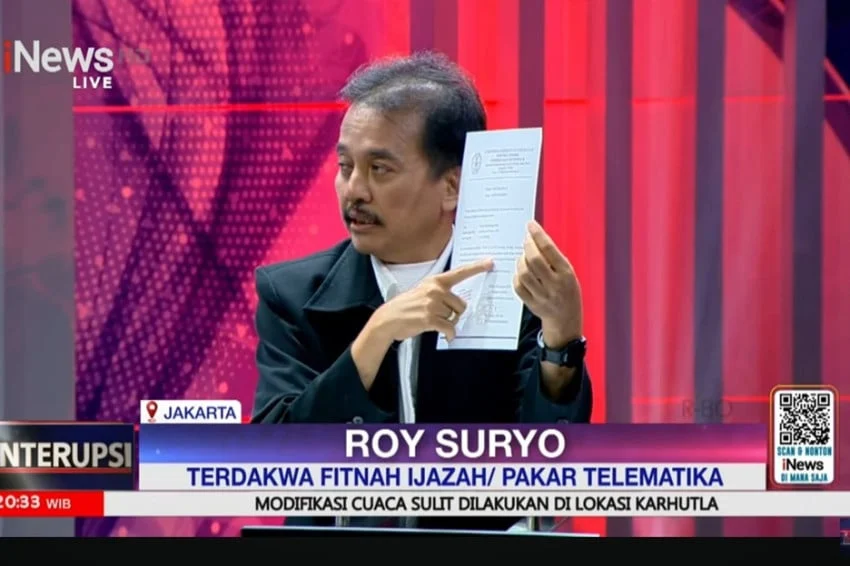
The political and public discourse surrounding the educational background of Indonesian Vice President Gibran Rakabuming Raka has taken a contentious turn following recent claims made by prominent IT expert and former Minister of Youth and Sports, Roy Suryo. In a televised discussion on iNews TV’s program Interupsi, Roy stated that he personally traveled to Australia to investigate Gibran’s academic history at UTS Insearch, a recognized pathway institution associated with the University of Technology Sydney (UTS). According to Roy, his field inquiry yielded no evidence that alumni or former students from the 2004–2007 period recognized or recalled Gibran as a student at the institution.
This revelation has added fuel to an ongoing debate concerning the academic credentials of the nation’s second-highest-ranking official. The legitimacy of Gibran’s educational journey has periodically faced scrutiny from critics and political opponents, particularly regarding the specifics of his transition from secondary education in Indonesia to tertiary institutions abroad. While official documentation and statements from the Jokowi administration have previously maintained that Gibran completed pathway programs in Australia before continuing his studies in Singapore, independent challenges from figures like Roy Suryo continue to keep the topic in the public eye.
Background Context of the Educational Controversy
The scrutiny surrounding Vice President Gibran Rakabuming Raka’s academic history is not an isolated incident but rather part of a broader pattern of skepticism directed at political figures in contemporary Indonesia. In an era where digital verification and public transparency are heavily emphasized by civil society and political opposition, the educational backgrounds of high-ranking officials frequently undergo intense public examination.
Gibran’s academic trajectory has historically been cited as spanning several institutions across different countries. Official biographical details indicate that he attended secondary school in Indonesia before moving abroad for preparatory and undergraduate studies. Specifically, institutions such as UTS Insearch in Australia and Management Development Institute of Singapore (MDIS) have been referenced in official biographies and media reports as key milestones in his academic formation.
However, critics have repeatedly called for more transparent documentary proof, pointing to the complexities of international student mobility records and the challenges of independent verification. The debate gained renewed momentum amid wider legal and political challenges questioning the validity of various leadership credentials across the political spectrum. Consequently, independent investigations conducted by political critics—such as Roy Suryo’s trip to Australia—serve to amplify public curiosity and political friction.
Chronology of Roy Suryo’s Investigation in Australia
According to the account provided by Roy Suryo during the iNews TV broadcast, his inquiry into Gibran’s educational history involved direct field research in Sydney, Australia. The timeline of interest centers around the years 2004 to 2007, which corresponds to the timeframe typically cited for Gibran’s enrollment in UTS Insearch’s diploma and pathway programs.
During his visit to the institution’s operational base, Roy reportedly sought out individuals, former classmates, and alumni who studied at UTS Insearch during that exact window. He claimed to have interviewed multiple former students from the 2004–2007 cohort to determine whether any personal recollection or institutional memory existed of Gibran attending classes on campus.
"I went to Australia, directly to UTS Insearch, and I met with people there who studied during the era when Gibran reportedly went to school, from 2004 to 2007. Not a single person ever knew anyone named Gibran," Roy stated during the program.
Despite the widespread absence of recognition among the alumni he consulted, Roy acknowledged encountering one specific individual who confirmed a connection to Gibran during his time in Australia. This individual was identified as Ikhsan Katonde, an Indonesian expatriate residing in Australia. However, Roy clarified that Ikhsan’s interaction with Gibran was unrelated to any academic enrollment at UTS Insearch. Instead, Roy claimed that Ikhsan’s contact with Gibran occurred during a separate context—specifically, when Gibran was reportedly accompanying his father, Joko Widodo (Jokowi), who was serving in an official capacity as President of the Republic of Indonesia during a state visit.
"Except for one person named Mr. Ikhsan Katonde, who apparently had escorted Gibran when he went to Australia, joining his father, who at that time was already President," Roy added.
Official Responses and Family Clarifications
In response to ongoing challenges regarding the validity of the Vice President’s academic credentials, the administration and family members have previously stepped forward to clarify the timeline and nature of his studies. Former President Joko Widodo has publicly addressed the public curiosity surrounding his eldest son’s educational journey, affirming that Gibran successfully completed his secondary and preparatory education through recognized international pathway programs before earning his degree abroad.
Administration defenders and legal representatives have maintained that all educational certificates possessed by Vice President Gibran are entirely authentic and have met all legal and administrative requirements necessary for public office candidacy. They argue that repeated questioning of academic credentials constitutes a politically motivated effort to undermine the credibility of the executive branch rather than a genuine inquiry into administrative compliance.
Furthermore, academic institutions operating across international jurisdictions are generally bound by strict student privacy laws, such as the Privacy Act in Australia or equivalent data protection regulations. These legal frameworks prevent universities and educational providers from publicly disclosing student enrollment records, academic transcripts, or personal data to independent investigators, journalists, or political actors without explicit consent from the individual concerned. Consequently, informal field inquiries conducted by third parties—such as interviewing former alumni—often yield inconclusive results due to the vast size of student cohorts, high turnover rates among international student populations, and legal constraints preventing official verification by non-institutional actors.
Broader Implications for Political Discourse and Governance
The ongoing public debate over Vice President Gibran Rakabuming Raka’s educational background underscores a broader phenomenon in modern Indonesian politics: the weaponization of personal biographies and credential verification in political contests. As information travels rapidly across digital platforms, claims and counterclaims regarding the qualifications of public officials can significantly influence public perception and political polarization.
From a governance perspective, continuous friction over credentials highlights the growing public demand for absolute transparency from elected officials. Civil society organizations frequently argue that proactive disclosure of verified academic documentation by public figures can preemptively neutralize controversies and maintain institutional trust. Conversely, defenders of public officials caution that prolonged disputes fueled by unverified claims or partisan investigations can distract from substantive policy discussions and governance priorities.
As legal challenges and public commentaries surrounding leadership credentials continue to navigate the Indonesian political landscape, the episode involving UTS Insearch serves as a case study in the complexities of international educational verification. Moving forward, institutional transparency, adherence to legal privacy standards, and official documentation will remain central to resolving disputes over the academic histories of the nation’s leaders.