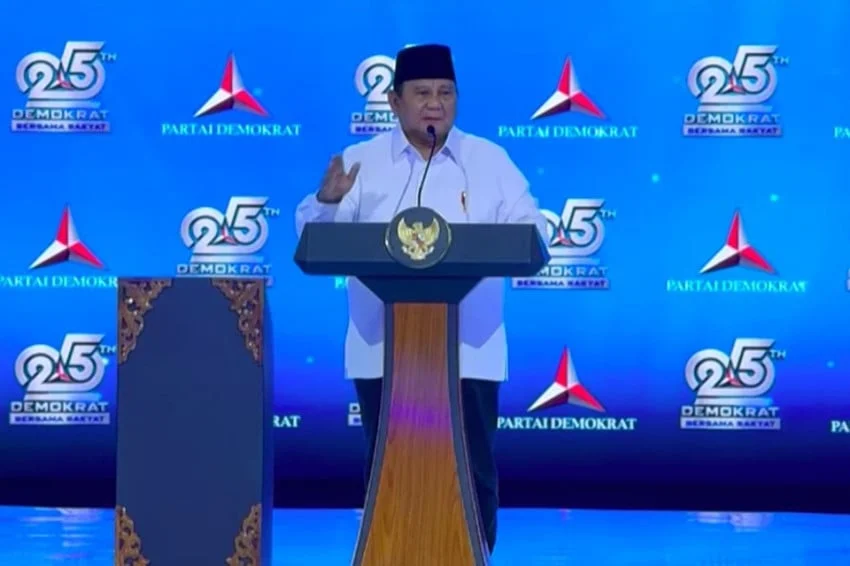
President Prabowo Subianto delivered a significant keynote address during the silver jubilee celebration of the Democratic Party (Partai Demokrat) held at the Indonesia Arena in Central Jakarta on Wednesday, September 9, 2026. The event, which marked a quarter-century of the party’s existence in the Indonesian political landscape, served as a platform for the head of state to reflect on the historical synergy between military service and democratic participation. During his remarks, President Prabowo offered high praise for the sixth President of Indonesia, Susilo Bambang Yudhoyono (SBY), highlighting his role as a foundational figure who demonstrated a principled path from military leadership to civilian governance.
A Legacy of Military-to-Civilian Transition
The ceremony, attended by thousands of party cadres, international observers, and prominent national figures, focused on the theme of "Continuity and Transformation." President Prabowo, who shares a storied history with SBY as a fellow military officer, drew parallels between their respective backgrounds. He emphasized that the transition from a career in the Indonesian National Armed Forces (TNI) to the political arena is not merely a change in profession, but a sustained commitment to public service.
"Mr. SBY and I share the same origins as generals in the TNI," Prabowo stated during his address. "However, we were forged as ‘people’s soldiers.’ We were raised and trained with the fundamental understanding that the military exists to serve the populace. When we transition into politics, that core philosophy remains unchanged. We must navigate the political landscape through the framework of democracy, ensuring that our service is always aligned with the aspirations of the people."
This acknowledgment is seen by political analysts as a strategic reinforcement of the current administration’s alignment with the Democratic Party. By invoking their shared past, President Prabowo effectively bridged the generational and ideological gaps that have historically characterized Indonesian politics, suggesting a unified vision for the nation’s future.
Chronology and Evolution of the Democratic Party
To understand the weight of this milestone, it is essential to look back at the origins of the Democratic Party. Founded on September 9, 2001, the party was born out of the reformasi era, a period defined by the fall of the New Order and the urgent need for a new democratic architecture in Indonesia.
- September 2001: The Democratic Party is officially established.
- 2004: The party achieves a massive electoral victory, propelling SBY to the presidency in the nation’s first direct presidential election.
- 2004–2014: The "Decade of the Democratic Party," marked by significant economic growth, poverty reduction programs such as the Direct Cash Assistance (BLT), and the stabilization of the Indonesian economy following the 1998 crisis.
- 2014–2024: The party navigates a period of opposition, focusing on internal consolidation and the nurturing of new, younger leadership, most notably under the chairmanship of Agus Harimurti Yudhoyono (AHY).
- 2024–2026: The party enters a new phase of governance, forming a strategic coalition with the Prabowo administration, solidifying its role in the current national cabinet.
The 25th anniversary serves as a retrospective on these milestones, underscoring the party’s transition from a nascent organization to a mature political powerhouse that has weathered various electoral cycles and shifts in national sentiment.
Statistical Context: The Party’s Electoral Performance
The Democratic Party’s trajectory has been characterized by its fluctuating but significant influence in the legislative branch. Data from the General Elections Commission (KPU) over the last two decades illustrates the party’s durability:
- 2004 Legislative Election: The party secured approximately 7.45% of the vote, a modest but pivotal start.
- 2009 Legislative Election: In a landmark performance, the party surged to become the dominant force, capturing 20.85% of the vote.
- 2014–2019: The party maintained a consistent presence in the People’s Representative Council (DPR), holding a stable base of voters that allowed it to act as a critical "kingmaker" in coalition politics.
- 2024 Legislative Election: The party maintained a robust parliamentary presence, reinforcing its position as a key partner in the Prabowo-Gibran coalition, holding key ministerial portfolios and contributing to the legislative agenda.
These figures indicate that while the party has experienced the natural ebbs and flows of a maturing democracy, its institutional loyalty and disciplined structure have ensured its longevity, a point that President Prabowo praised during the event.
Official Responses and Coalition Perspectives
The celebration attracted a wide array of political figures, all signaling a desire for continued national stability. Ferry, a representative from the Perindo Party, echoed the sentiment of cooperation during the event, stating, "We are here to celebrate the 25th anniversary of our partners in democracy. Our presence signifies our commitment to ongoing synergy. The challenges ahead—economic volatility and geopolitical shifts—require a unified front among political parties."
The leadership of the Democratic Party, led by Agus Harimurti Yudhoyono, emphasized that the party’s focus for the next decade will be on "inclusive prosperity." AHY noted that the support from President Prabowo is a validation of the party’s ongoing efforts to modernize its internal structure while remaining committed to the welfare of the lower-income segments of society.
Analysis: Implications for National Stability
The warm reception of SBY by President Prabowo carries profound implications for the domestic political climate. Firstly, it signals a "consolidation of the elite." By publicly praising the political path taken by his predecessor, Prabowo is effectively mitigating potential friction between the old guard of the military-political establishment and the current administration.
Secondly, the event highlights the normalization of a "professionalized" political class in Indonesia. The emphasis on the "people’s soldier" ethos serves as a narrative tool to define political ambition not as a quest for power, but as a duty. This framing is particularly resonant in a country where public trust in political institutions is often a matter of intense debate.
Furthermore, the Democratic Party’s alignment with the Prabowo administration ensures a level of legislative continuity. With the party fully integrated into the current governance framework, the likelihood of major policy reversals is significantly reduced. This predictability is viewed positively by international investors and domestic stakeholders alike, who prioritize stability in the mid-term trajectory of the Indonesian economy.
Challenges and Future Outlook
Despite the celebratory mood, the Democratic Party faces the challenge of adapting to a rapidly digitizing electorate. The "silver jubilee" marks a point of departure where the party must reconcile its historical legacy—heavily tied to the SBY era—with the needs of a younger, tech-savvy generation.
President Prabowo’s speech indirectly addressed this by calling for the "internalization of democratic values." He implied that for the party to survive another 25 years, it must remain as adaptable as it has been resilient. The focus moving forward will likely be on strengthening the party’s grassroots network, utilizing digital platforms for constituent engagement, and maintaining its identity as a party of the "center," capable of balancing conservative values with progressive economic policies.
Conclusion
The 25th-anniversary celebration of the Democratic Party at the Indonesia Arena was more than a ceremonial gathering; it was a testament to the endurance of Indonesia’s democratic experiment. Through the endorsement of SBY’s legacy by President Prabowo, the event served to bridge the past and the present, reinforcing a narrative of continuity and service.
As the Democratic Party looks toward its next chapter, the convergence of military discipline and democratic participation—a theme championed by both leaders—remains its defining characteristic. Whether this model will continue to resonate with the evolving demands of the Indonesian public remains to be seen, but for now, the party stands on firm ground, solidified by its deep-rooted institutional history and a clear, cooperative relationship with the current executive branch. The silver jubilee stands as a marker of a quarter-century of impact, signaling that the Democratic Party remains a central pillar in the complex and dynamic structure of Indonesian national politics.