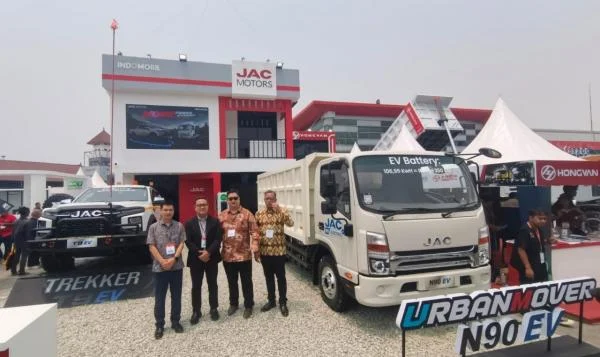
The landscape of Indonesia’s heavy industry is undergoing a significant transformation as JAC Motors, the renowned Chinese automotive manufacturer, unveiled its latest lineup of electric commercial vehicles at the Mining Indonesia 2026 exhibition. Held at the Jakarta International Expo (JIExpo) in Kemayoran from September 9 to 12, 2026, the event served as a high-profile platform for the official introduction of the Trekker T9 EV and the Urban Mover N90 EV. These vehicles represent a strategic pivot toward sustainable mining operations, aiming to reduce the carbon footprint of one of the nation’s most vital economic sectors.
As the Indonesian government intensifies its commitment to the "Net Zero Emission 2060" goal, the integration of electric vehicles (EVs) into industrial supply chains has transitioned from a theoretical concept to an operational necessity. The presence of JAC Motors at this exhibition underscores the increasing confidence that global manufacturers have in the Indonesian market’s readiness to adopt large-scale green energy solutions.
The Strategic Importance of Mining Indonesia 2026
Mining Indonesia is widely regarded as the largest international mining equipment exhibition in Asia, attracting thousands of industry professionals, stakeholders, and technology providers. For JAC Motors, this year’s participation was not merely a showcase of new hardware but a calculated move to position itself as a primary partner in the industrial electrification journey.
Chief Operating Officer of Indomobil JAC, Reggie Kurnia, emphasized during the press conference on September 9 that the debut of these vehicles is a response to the growing demand for durable, efficient, and emission-free transport solutions. "This event acts as a critical bridge between our advanced engineering capabilities and the practical, often grueling, operational needs of the Indonesian mining sector," Kurnia stated. "We recognize that the mining environment is unforgiving, and our EV solutions are designed to handle both the rugged terrains and the high-intensity schedules required by our clients."
Unpacking the New Fleet: Technical Capabilities
The two vehicles introduced at the exhibition address distinct segments of the commercial logistics chain. The Trekker T9 EV is designed specifically for off-road and semi-rugged site environments, featuring high-torque electric motors and robust chassis engineering capable of navigating the challenging topography typical of Indonesian coal and mineral extraction sites.
The Urban Mover N90 EV, by contrast, is optimized for last-mile delivery and site-to-hub logistics. By utilizing a zero-emission platform, the N90 EV is expected to assist companies in meeting internal sustainability targets, particularly for transport operations located near residential or environmentally sensitive areas. Both vehicles utilize high-density battery architectures designed to withstand the heat and humidity of the Indonesian climate, a common concern for the adoption of lithium-ion technology in tropical regions.
A Landmark Handover: Scaling Green Operations
A significant highlight of the exhibition was the formal handover ceremony of 150 units of the Trekker T9 EV to three major mining companies. The recipients, which include enterprises based in Aceh, Berau (East Kalimantan), and Banyuwangi (East Java), have committed to integrating these vehicles into their daily operations immediately.
This transaction serves as a milestone for the adoption of electric heavy-duty vehicles in Indonesia. For decades, the mining sector has been heavily reliant on internal combustion engines, which contribute significantly to scope 1 emissions. The transition of 150 units represents a substantial reduction in tailpipe emissions and a shift in maintenance expenditure, as EVs generally offer lower long-term operational costs due to fewer moving parts and reduced fluid requirements compared to diesel counterparts.
Contextualizing the Energy Transition in Mining
The move toward electric commercial vehicles in Indonesia is supported by a broader national policy framework. The government has been providing various incentives, including tax exemptions and infrastructure development, to encourage companies to move away from fossil-fuel-dependent logistics.

Data from the Ministry of Energy and Mineral Resources (ESDM) suggests that the mining industry accounts for a significant portion of the country’s diesel consumption. By replacing even a fraction of these fleets with battery-electric equivalents, the industry stands to realize significant cost savings while aligning with global Environmental, Social, and Governance (ESG) standards. Global investors are increasingly prioritizing mining firms that demonstrate a verifiable roadmap toward carbon neutrality, making the adoption of JAC Motors’ technology a business imperative rather than just a public relations effort.
Chronology of Adoption and Industry Shifts
The journey toward this launch began years ago, characterized by rigorous testing and pilot projects.
- 2023-2024: Initial discussions between JAC Motors and major Indonesian logistics players regarding the viability of electric light-trucks in remote sites.
- Early 2025: Pilot programs were conducted in East Kalimantan, where the Trekker T9 EV was tested under varying load conditions to ensure battery safety and powertrain reliability.
- September 2026: The official launch at Mining Indonesia 2026, marking the transition from experimental testing to commercial-scale deployment.
The feedback from the initial pilot users has been largely positive, citing the torque-on-demand nature of the electric motors as a significant advantage when climbing steep gradients with heavy loads—a scenario where traditional engines often struggle with overheating and power loss.
Economic and Environmental Implications
The integration of these vehicles is not without challenges. The primary concern among industry operators remains the charging infrastructure. Unlike urban environments, mining sites are often located in remote areas far from the national power grid. To mitigate this, companies are investing in private micro-grid solutions and dedicated fast-charging stations powered by renewable sources or efficient generators.
From an economic perspective, the shift to electric vehicles is expected to buffer mining companies against the volatility of global oil prices. As fuel prices fluctuate, the ability to predict energy costs via electricity grid pricing or private renewable generation provides a stable outlook for long-term budget planning.

Furthermore, the "handover" in Jakarta signals a shift in the competitive landscape. As Chinese manufacturers like JAC gain a foothold in the Indonesian commercial sector, traditional legacy brands are under increased pressure to accelerate their own electric vehicle roadmaps. This competition is expected to drive down prices and improve the feature sets available to Indonesian firms, ultimately benefiting the national economy.
Looking Ahead: The Future of JAC in Indonesia
As the exhibition concludes, the focus shifts to the performance of these 150 units in the field. JAC Motors has committed to providing robust after-sales support, including local technical training for mechanics and the establishment of spare parts depots in key regions such as Kalimantan and Sumatra. This support structure is essential for maintaining high vehicle uptime, which is the most critical metric for any mining operation.
The success of this launch is likely to encourage further investment. Industry analysts anticipate that if the Trekker T9 EV proves its reliability over the next 12 to 24 months, the demand for heavy-duty electric transport will likely expand into other sectors, including construction, plantation logistics, and urban waste management.
In conclusion, the debut of the JAC Trekker T9 EV and Urban Mover N90 EV at Mining Indonesia 2026 is more than a commercial launch; it is a signal of the changing priorities of the Indonesian industrial sector. By combining Chinese manufacturing scale with the specific operational demands of the local market, JAC Motors is positioning itself as a central player in the country’s transition to a more sustainable, efficient, and technology-driven mining future. As the industry watches the performance of these new fleets, the success of this deployment could well serve as the blueprint for the electrification of heavy industries throughout the archipelago.