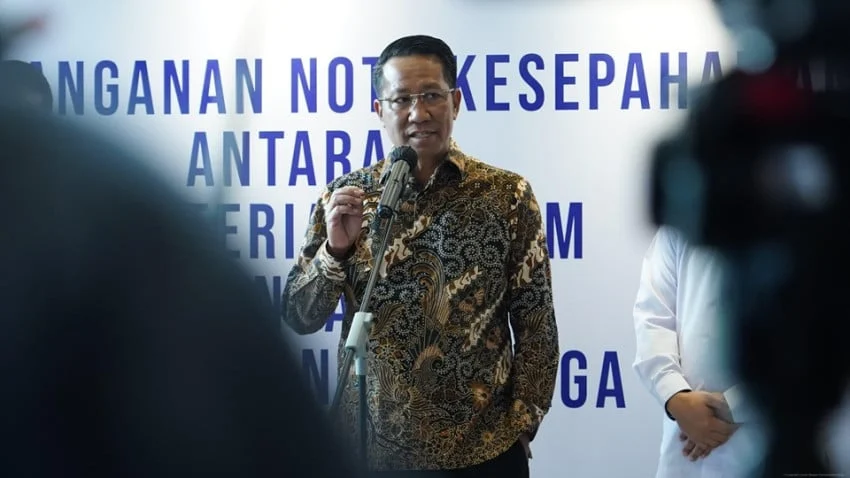
JAKARTA – Minister of Law and Human Rights (Menkumham) Supratman Andi Agtas on Friday, July 24, 2026, unequivocally stated that there is no observable trend indicating an increase in applications for the renunciation of Indonesian citizenship. Speaking from the Graha Pengayoman at the Ministry of Law and Human Rights complex, Minister Agtas clarified that any figures circulating, particularly regarding reports of 300 applications for citizenship renunciation, represent an accumulation of submissions from previous years, rather than a sudden surge in recent times. This statement seeks to allay public concerns that a significant number of Indonesians might be opting to relinquish their national identity, a topic that often draws considerable public and media attention due to its implications for national loyalty and demographics.
Dispelling Misconceptions: Accumulative Data, Not a Surge
Minister Agtas’s remarks directly addressed what appeared to be a misunderstanding stemming from aggregated data. He explained, "There is no increase. What I conveyed was an accumulation. So, those figures I mentioned yesterday are an accumulation, some from a year ago, some from now, and so on." This clarification is crucial in providing an accurate context for the public and policy-makers, distinguishing between ongoing administrative processing and a perceived spike in renunciations. The Ministry’s database naturally compiles applications over time, and reporting a total figure without specifying the period of submission can inadvertently create an impression of a sudden upward trend. The process of renouncing citizenship often involves multiple stages of verification and administrative procedures, meaning applications can remain in the system for extended periods before final approval. Therefore, a reported number at any given point is typically a snapshot of cases at various stages of completion, originating from different submission dates.
The Rigorous Path to Indonesian Citizenship: Naturalization Trends
In stark contrast to the perceived trend of renunciation, Minister Agtas highlighted that the number of foreign nationals seeking to become Indonesian citizens through "pure naturalization" (naturalisasi murni) is substantially higher. This category typically refers to individuals applying for citizenship based on residency, marriage to an Indonesian citizen, or significant contributions to the nation, as opposed to regaining citizenship or citizenship by descent. Despite the high volume of applications, the approval rate remains exceedingly low, underscoring the stringent requirements and selective nature of Indonesia’s naturalization process. For instance, in 2025, out of thousands of naturalization applications received, only a handful were approved. "From thousands of applications, five, if I’m not mistaken," Minister Agtas revealed, emphasizing the selectivity. This rigorous approach reflects the government’s commitment to ensuring that new citizens genuinely integrate into Indonesian society and meet specific criteria deemed beneficial to the nation. The low approval rate for naturalization also indicates a careful balance between attracting talent and investment and preserving national identity and security.
Historical Context and Legal Frameworks Governing Indonesian Citizenship
Understanding Indonesia’s approach to citizenship requires a brief look at its legal foundations. The primary legal instrument governing Indonesian citizenship is Law No. 12 of 2006 concerning Citizenship of the Republic of Indonesia. This law, which replaced previous statutes, aimed to simplify and clarify citizenship issues, particularly addressing concerns related to dual citizenship for children and the status of individuals with mixed parentage. A fundamental principle enshrined in this law is the prohibition of dual citizenship for adult Indonesians, with certain exceptions for children who may hold dual nationality until they reach the age of 18 or marry, at which point they must choose one citizenship. This principle inherently makes the act of renouncing Indonesian citizenship a necessary step for those who wish to acquire foreign citizenship as adults. The law also outlines specific conditions under which an individual can lose Indonesian citizenship, including voluntarily acquiring another nationality, failing to declare their choice of citizenship after holding dual nationality, or serving in a foreign military without presidential permission, as highlighted in a related statement by the Minister.
Why Individuals Renounce or Seek Indonesian Citizenship
The motivations behind an individual’s decision to renounce or seek Indonesian citizenship are multifaceted and often deeply personal. For those renouncing, common reasons include marriage to a foreign national in a country that requires its citizens to hold only one nationality, pursuing career opportunities abroad that necessitate local citizenship (especially in fields requiring security clearances or government employment), or relocating permanently with family to another country where acquiring local citizenship offers better social or economic integration. Tax implications can also play a role, as some individuals might seek to simplify their tax obligations by aligning their citizenship with their primary residence and economic activity. Conversely, individuals seeking Indonesian citizenship often do so due to long-term residency in Indonesia, marriage to an Indonesian spouse, significant investments in the country, or possessing specialized skills (such as in sports or arts) that could benefit Indonesia. The strict vetting process ensures that these motivations are genuine and that applicants are prepared to fully embrace their new national identity and responsibilities.
Enhanced Scrutiny: A Response to Past Incidents
Minister Agtas explicitly linked the current stringent verification process for both renunciation and naturalization applications to "past cases" that revealed vulnerabilities in the system. "Why is it much harder now? Because we’ve had cases. Suddenly there’s someone with a passport who, it turns out, has issues in Indonesia. Now we verify," he explained. This statement underscores a proactive measure taken by the Ministry to prevent the misuse of citizenship status. Such "cases" could involve individuals who acquired foreign citizenship while still having unresolved legal, financial, or criminal issues in Indonesia, or those who attempted to exploit citizenship for illicit gains. The tightening of verification is a direct consequence of learning from these past experiences, aiming to close loopholes and safeguard national interests. This heightened vigilance is particularly evident in the scrutiny applied to applicants with corporate affiliations or those whose family members might have outstanding liabilities, such as tax issues.
Safeguarding National Interests: The Verification Process
The verification process implemented by the Ministry of Law and Human Rights is comprehensive and multi-layered. For individuals seeking to renounce citizenship, the government now meticulously checks for any pending legal cases, tax arrears, or other outstanding obligations in Indonesia. This is to ensure that individuals are not attempting to evade responsibilities by changing their nationality. The Minister specifically mentioned the rigorous checks for children applying for renunciation, particularly when their parents are involved in businesses. "If now it’s the child who is applying, and there are many children [applying] now, we check. Perhaps their parents’ company has issues, perhaps tax problems, all of it must be confirmed," he elaborated. This reflects a holistic approach, recognizing that an individual’s financial and legal standing can often be intertwined with their family or corporate entities. For naturalization applicants, the scrutiny is even more intense, involving background checks, financial reviews, security assessments, and interviews to ascertain their commitment to Indonesia and their potential contribution to the nation. This ensures that new citizens are not only legally eligible but also culturally and ideologically aligned with Indonesian values.
Broader Implications for National Security and Governance
The Ministry’s firm stance on citizenship applications carries significant implications for national security, governance, and demographic planning. By implementing rigorous verification, the government aims to prevent individuals with dubious intentions or unresolved issues from manipulating their citizenship status. This contributes to national security by ensuring that individuals who renounce citizenship do not leave behind a trail of liabilities or potential threats, and that those who acquire citizenship are not a risk to the nation. From a governance perspective, stricter controls help maintain the integrity of national records and ensure compliance with legal and financial obligations. The low approval rate for naturalization, while reflecting selectivity, also signals the government’s careful approach to demographic changes and the preservation of national identity. This policy framework balances the need for openness in a globalized world with the imperative to protect national sovereignty and societal cohesion.
The Future of Citizenship Policy: Balancing Openness and Control
Indonesia’s citizenship policy, as articulated by Minister Supratman Andi Agtas, reflects a cautious yet robust approach to managing national identity in an increasingly interconnected world. While acknowledging global mobility and individual choices, the government prioritizes national interests, security, and the integrity of its legal system. The emphasis on rigorous verification, drawing lessons from past experiences, indicates a proactive strategy to address potential challenges arising from complex citizenship cases. As global migration patterns evolve and economic pressures shift, Indonesia’s Ministry of Law and Human Rights is poised to continually refine its policies, balancing the desire to attract talent and facilitate legitimate transitions with the crucial need to safeguard the nation against potential abuses. The ongoing dialogue around citizenship, renunciation, and naturalization will likely continue to be a significant aspect of national policy, reflecting Indonesia’s commitment to its people and its future.