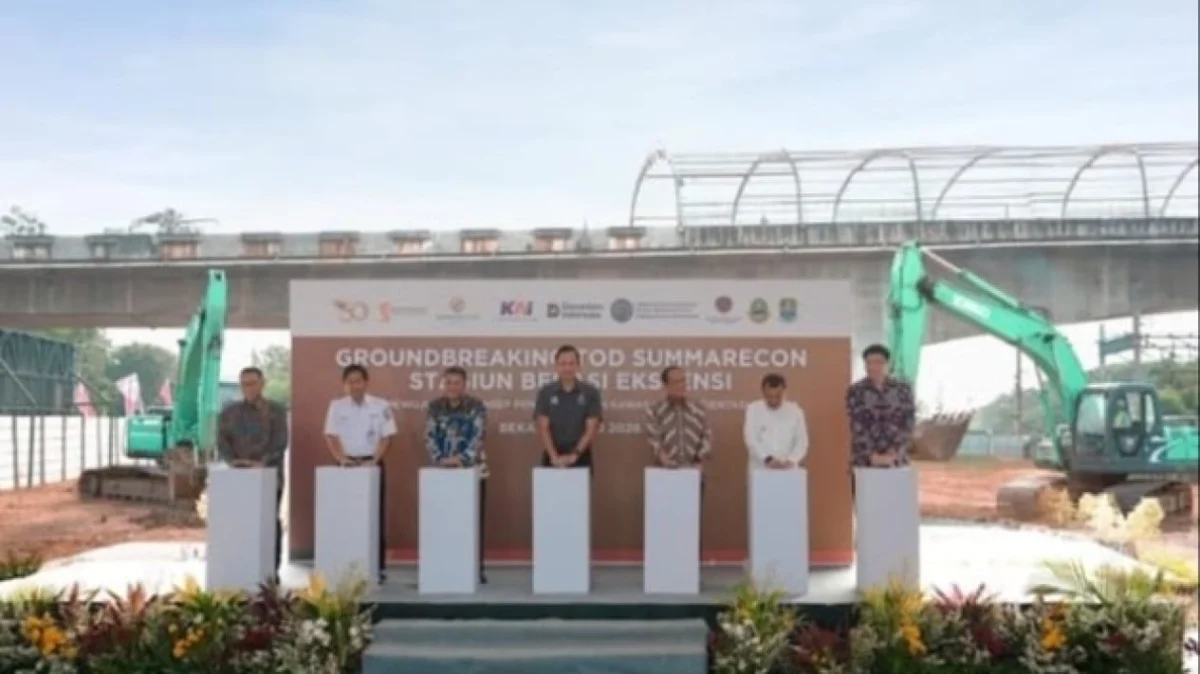
Jakarta, VIVA – In a significant stride towards enhancing urban mobility and fostering sustainable regional development, the Coordinating Minister for Infrastructure and Regional Development, Agus Harimurti Yudhoyono (AHY), led the groundbreaking ceremony for the Stasiun Bekasi Ekstensi project. This ambitious undertaking, officially commenced on Saturday, July 25, 2026, marks a pivotal component of the larger Transit-Oriented Development (TOD) initiative spearheaded by PT Summarecon Agung Tbk in the burgeoning area of Summarecon Bekasi. The ceremony, a testament to robust public-private partnership, signals the beginning of construction for a vital infrastructure enhancement designed to alleviate commuter congestion, improve accessibility, and integrate seamlessly with the existing urban fabric of Bekasi.
A Vision for Integrated Urban Living
Minister AHY articulated the government’s strong endorsement for this project, emphasizing that the Stasiun Bekasi Ekstensi is far more than a mere physical expansion of infrastructure. It represents a strategic investment in creating a more productive and dynamic urban environment, one that actively supports the daily mobility and convenience of its residents. "Our expectation is for this to evolve into an increasingly productive area, supporting mobility, easing community activities, and aligning its development with the principles of Indonesia’s Transit-Oriented Development," Minister AHY stated in his remarks. His vision underscores a national commitment to urban planning that prioritizes public transport, pedestrian-friendly environments, and mixed-use developments to foster liveable and economically vibrant cities.
The concept of Transit-Oriented Development (TOD) has gained considerable traction across Indonesia’s metropolitan areas as a sustainable solution to rapid urbanization, traffic congestion, and environmental concerns. TOD strategies aim to maximize the amount of residential, business, and leisure space within walking distance of public transport. By integrating various urban functions around a central transit hub, TODs reduce reliance on private vehicles, promote public transport ridership, and create more cohesive, accessible, and environmentally friendly communities. The Stasiun Bekasi Ekstensi, integrated within the Summarecon TOD, exemplifies this forward-thinking approach, promising to transform the daily commute and overall urban experience for thousands of Bekasi residents.
Summarecon’s Legacy of Infrastructure Contribution
Adrianto P. Adhi, President Director of PT Summarecon Agung Tbk, highlighted that the Stasiun Bekasi Ekstensi project, as an integral part of the Summarecon TOD, is a tangible manifestation of the synergy between the private sector and government. This collaboration, he noted, is crucial for realizing the full potential of transit-oriented development concepts. Summarecon’s involvement in critical infrastructure for Bekasi is not unprecedented. Adhi recalled the company’s significant contribution in 2010 when, at the inception of Summarecon Bekasi’s development, they constructed the 1-kilometer-long Fly Over K.H. Noer Ali Summarecon Bekasi.
This earlier project, built to span the railway crossing, dramatically improved connectivity for residents living on both the north and south sides of the railway tracks in Bekasi. More importantly, it provided a much-needed solution to the perennial traffic congestion on Jalan Perjuangan, a critical arterial road. "We are grateful that today Summarecon has once again been given the opportunity to play a role in addressing the needs of the Indonesian community, particularly in the Bekasi region," Adrianto P. Adhi remarked, expressing the company’s deep commitment to regional development. He further emphasized Summarecon’s desire to continue partnering with the government to enhance accessibility and service quality for the public, ensuring greater ease and comfort in accessing mass transportation, specifically the railway network.
Addressing Bekasi’s Commuter Challenges
Bekasi, a rapidly expanding satellite city within the Jakarta metropolitan area (Jabodetabek), has experienced exponential population growth over the past two decades. With an estimated population exceeding 2.5 million, it serves as a significant dormitory town for commuters working in Jakarta and other surrounding industrial zones. This rapid urbanization, while indicative of economic vitality, has also brought immense pressure on existing infrastructure, particularly its transportation network. The KRL Commuterline, serving millions daily, is a lifeline for these commuters, but its stations, including the main Stasiun Bekasi, often operate at or beyond capacity during peak hours, leading to significant overcrowding and discomfort for passengers.
The existing Stasiun Bekasi, a crucial hub for the KRL Commuterline, has long struggled with the sheer volume of daily passengers. The introduction of Stasiun Bekasi Ekstensi, envisioned as a complementary facility within the TOD Summarecon, is expected to be a game-changer. Adrianto P. Adhi firmly believes that this new station will significantly alleviate the concentration of passenger build-up at the current Stasiun Bekasi. He elaborated that the Stasiun Bekasi Ekstensi is strategically positioned to primarily serve passengers originating from the western and southern parts of Bekasi. In contrast, the current Stasiun Bekasi will focus on catering to commuters from the northern and eastern regions. This planned distribution of passenger traffic is a sophisticated approach to optimizing station capacity and improving the overall commuter experience.
Enhanced Connectivity and Sustainable Urban Growth
The implications of the Stasiun Bekasi Ekstensi extend beyond mere passenger distribution. This initiative is poised to foster more efficient community mobility, significantly enhance regional connectivity, and contribute to the creation of a more sustainable urban environment. By providing an additional, modern access point to the KRL network, the project aims to reduce travel times, lower transportation costs for residents, and offer a more comfortable and reliable commuting option. This aligns with national efforts to shift commuters from private vehicles to public transport, thereby reducing traffic congestion on Bekasi’s roads, lowering carbon emissions, and improving air quality.
The integration of the station within a TOD framework means that residents will have easier access to various amenities, including residential complexes, commercial centers, retail outlets, and green spaces, all within a walkable distance from the station. This not only adds convenience but also promotes a healthier, more active lifestyle. The project is expected to stimulate local economic activity, attracting further investment into the Summarecon Bekasi area and generating employment opportunities during both its construction and operational phases. Property values within the TOD are also likely to appreciate, reflecting the increased desirability and connectivity of the area.
A Broader National Context: Jabodetabek Urban Development
The groundbreaking of Stasiun Bekasi Ekstensi is not an isolated event but rather a vital piece in Indonesia’s broader strategy for urban development within the Jabodetabek (Jakarta, Bogor, Depok, Tangerang, Bekasi) region. With Jakarta continuing to grow as a mega-city, the surrounding satellite cities play an increasingly crucial role in accommodating its expanding population and economic activities. Projects like the Bekasi Ekstensi and associated TODs are essential for managing this growth sustainably, preventing urban sprawl, and ensuring that development is equitable and efficient.
The Indonesian government, through various ministries, has been actively promoting integrated transportation solutions, including improvements to the KRL Commuterline, development of MRT and LRT systems, and the implementation of TODs. The presence of high-ranking officials at the groundbreaking ceremony – including Deputy Minister of Transportation Suntana, Deputy Governor of West Java H. Erwan Setiawan, and Deputy Mayor of Bekasi Dr. H. Abdul Harris Bobihoe, alongside Minister AHY – underscores the multi-sectoral importance and commitment to this project.
Deputy Minister Suntana, representing the Ministry of Transportation, likely emphasized the project’s alignment with national transportation master plans, which prioritize the development of robust, interconnected public transit networks. Such projects are critical for easing the burden on road infrastructure and fostering a more efficient movement of people and goods across the metropolitan area. From a regional perspective, Deputy Governor H. Erwan Setiawan would have highlighted the benefits for West Java province, noting how improved connectivity in Bekasi contributes to the economic vibrancy and accessibility of the entire region. For the local administration, Deputy Mayor Dr. H. Abdul Harris Bobihoe would have reiterated the immediate and tangible improvements for Bekasi citizens, from reduced travel times to enhanced quality of life.
Chronology of Progress and Future Outlook
The journey towards this groundbreaking has been characterized by strategic planning and collaborative efforts. While the concept of expanding Stasiun Bekasi has been discussed for some time given the city’s rapid growth, the formal partnership between the government and Summarecon for this specific TOD project likely materialized through intensive negotiations and feasibility studies in the preceding years. Summarecon’s track record, evidenced by the 2010 Fly Over K.H. Noer Ali project, established them as a reliable partner in public infrastructure development.
The July 25, 2026, groundbreaking ceremony itself was marked by a symbolic siren blast, jointly performed by Minister AHY, Deputy Minister Suntana, Deputy Governor Setiawan, and Deputy Mayor Bobihoe, signifying the official commencement of construction. While a precise completion date was not specified in the initial announcement, projects of this scale, involving complex railway infrastructure and integrated urban development, typically span several years. Industry experts suggest that the Stasiun Bekasi Ekstensi could reasonably aim for operational readiness within three to five years, subject to construction complexities, land acquisition, and regulatory approvals.
Looking ahead, the Stasiun Bekasi Ekstensi and the Summarecon TOD are expected to serve as a blueprint for future public-private collaborations in urban development across Indonesia. The successful implementation of such integrated projects not only provides much-needed infrastructure but also showcases a viable model for sustainable growth, where economic development goes hand-in-hand with environmental stewardship and improved social welfare. This initiative promises to significantly reshape the urban landscape of Bekasi, positioning it as a more connected, efficient, and liveable city for generations to come. The long-term impact will be closely monitored by urban planners and policymakers, as it sets a precedent for how Indonesia manages its ongoing urbanization challenges and pursues its vision of smart, sustainable cities.