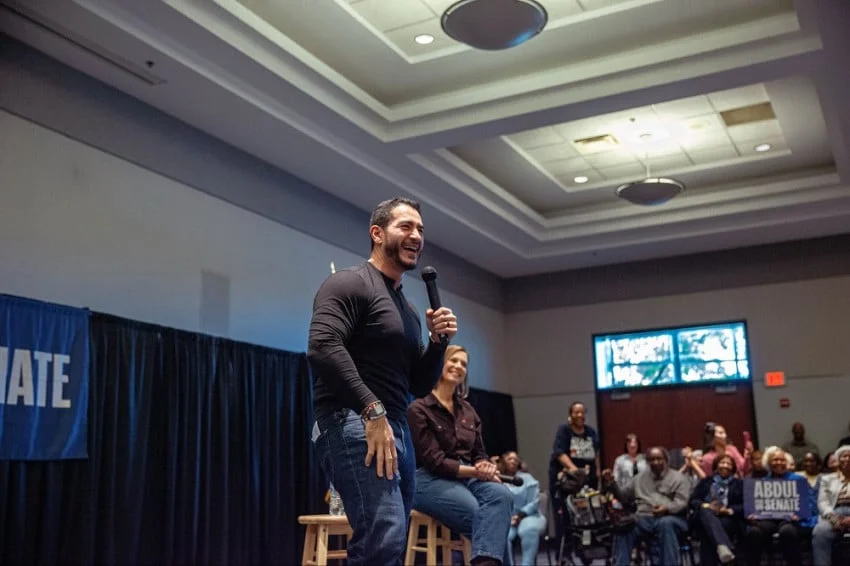
In a watershed moment for American political representation, Abdul El-Sayed, a progressive Democrat, public health expert, and Egyptian-American physician, has secured a historic victory in the United States Senate. Defeating Republican candidate Mike Rogers in a fiercely contested mid-term election in Michigan, El-Sayed’s triumph marks the first time a Muslim has been elected to the upper chamber of the United States Congress.
The closely watched race, which drew national attention and substantial financial investments from both major political parties, centered on critical debates regarding healthcare reform, economic priorities, and foreign policy. El-Sayed’s victory not only flips a crucial seat for the Democratic Party but also shatters a long-standing glass ceiling in American governance, amplifying the political visibility of the nation’s Muslim and Arab-American communities.
The path to this historic milestone was forged through a demanding political landscape characterized by intra-party divisions, shifting voter demographics in the Rust Belt, and intense scrutiny over domestic and international policies. As El-Sayed prepares to take his oath of office in Washington, D.C., political analysts, community leaders, and constituents alike are assessing the profound implications of his ascent for the future of progressive politics and federal legislation.
Chronology of a Historic Campaign
The journey toward this unprecedented Senate victory began long before the formal campaign kickoff, rooted deeply in El-Sayed’s career as a physician, epidemiologist, and public servant. The Senate seat in question became open following the decision of retiring Democratic Senator Gary Peters, who chose not to seek re-election after serving two terms. Peters’ retirement created an immediate power vacuum, triggering a competitive primary season within the Democratic Party.
During the primary phase, El-Sayed navigated significant friction among Democratic factions. The party was deeply divided along ideological lines, with moderate establishment figures clashing with a surging progressive wing. El-Sayed, running firmly on a progressive platform, positioned himself as a champion for systemic reforms. His campaign focused heavily on universal healthcare, wealth inequality, and environmental justice—issues that resonated strongly with younger voters and urban constituencies across Michigan.
The general election pitted El-Sayed against Mike Rogers, a formidable Republican candidate and former U.S. Representative with deep ties to national security circles and establishment conservative networks. The contest quickly evolved into one of the most expensive and polarizing Senate races of the cycle. Outside political action committees poured tens of millions of dollars into Michigan, blanketing television screens and digital platforms with advertisements.
Republicans targeted El-Sayed’s progressive economic policies and attempted to weaponize debates over foreign policy, particularly concerning U.S. involvement in the Middle East. Simultaneously, El-Sayed worked to unify a fractured Democratic base, rallying labor unions, environmental organizations, and diverse community coalitions. On election night, as returns from Wayne, Oakland, and Kent counties were tabulated, El-Sayed pulled ahead, securing a definitive margin of victory that ultimately forced conceding statements from the opposition.
Background and Academic Pedigree
Born in Rochester Hills, Michigan, to Egyptian immigrant parents, Abdul El-Sayed’s trajectory reflects a unique synthesis of rigorous scientific training and civic engagement. His early life in suburban Detroit instilled a deep awareness of community disparities and public health challenges, steering him toward a career dedicated to the intersection of medicine and social policy.
El-Sayed’s academic credentials are extensive. He graduated from the University of Michigan in 2007 with high honors, where he was heavily involved in student leadership and biological research. His commitment to public service and academic excellence earned him a prestigious Rhodes Scholarship, which took him across the Atlantic to the University of Oxford. There, he pursued graduate studies, culminating in a doctorate in public health in 2011.
Following his time at Oxford, El-Sayed returned to the United States to complete his medical education, earning his Doctor of Medicine (M.D.) degree from Columbia University in 2014. His clinical training and research background laid the groundwork for his entry into executive governance.
In 2015, at the age of 30, El-Sayed was appointed as the Executive Director of the Detroit Health Department by then-Mayor Mike Duggan. Taking the helm of a municipal health agency recovering from the city’s historic municipal bankruptcy, El-Sayed confronted severe systemic challenges, including chronic underfunding, decaying infrastructure, and widespread environmental hazards such as lead-contaminated water and high childhood asthma rates. Under his leadership, the department instituted rigorous water safety protocols in public schools, expanded community health clinics, and launched targeted initiatives to combat infant mortality.
Broader Impact, Data, and Demographic Shifts
El-Sayed’s election arrives at a critical juncture in American political demographics. Michigan is home to one of the largest and most politically active Arab-American and Muslim communities in the United States, predominantly concentrated in Wayne County and the Detroit metropolitan area. For decades, these populations contributed significantly to the state’s economic and civic life while remaining largely underrepresented in federal legislative office.
Political scientists note that El-Sayed’s victory signals a maturation of political mobilization among minority populations in the Midwest. According to demographic data compiled during the election cycle, voter turnout among younger demographics and Muslim-American blocks saw notable increases compared to previous midterms. This surge played a pivotal role in overcoming the traditional advantage enjoyed by rural and conservative voting blocs in outstate Michigan.
Furthermore, the election highlights the shifting identity of the Democratic Party in the post-industrial Rust Belt. While traditional manufacturing unions and blue-collar workers have historically formed the backbone of Michigan’s Democratic coalition, the integration of professional-class progressives, public health advocates, and ethnically diverse leaders has reshaped the party’s platform. El-Sayed’s focus on economic populism—championing policies such as Medicare for All, a federal jobs guarantee, and robust investments in green energy—demonstrates the viability of a progressive agenda in a vital swing state.
Official Responses and Stakeholder Reactions
Following the certification of the election results, local, national, and international reactions underscored the historical weight of the moment. Civil rights organizations, interfaith coalitions, and Muslim advocacy groups lauded the election as a monumental step forward for American pluralism.
The Council on American-Islamic Relations (CAIR) released a statement celebrating the milestone, emphasizing that El-Sayed’s victory shatters long-standing barriers and proves that public servants from all backgrounds can achieve the highest levels of elected office through dedicated campaigning and engagement with voters. Representatives from various progressive organizations similarly highlighted the victory as validation of grassroots organizing models that prioritize bold policy platforms over cautious centrism.
Conversely, mainstream political analysts and Republican strategists offered nuanced assessments of the outcome. While acknowledging the historic nature of the win, conservative commentators pointed out that the narrow margins in several key precincts indicate that Michigan remains a fiercely competitive battleground state. Critics of El-Sayed reiterated concerns regarding his left-leaning economic agenda, predicting intense legislative battles on Capitol Hill over federal spending, taxation, and regulatory policy as the new congressional session convenes.
As the political dust settles, attention now shifts to Washington, where El-Sayed will assume his duties as a freshman senator. Observers will be watching closely to see how he navigates the complex power dynamics of the Senate, builds coalitions across the aisle, and balances the distinct interests of his diverse Michigan constituency with the broader national platform that his historic election has afforded him.