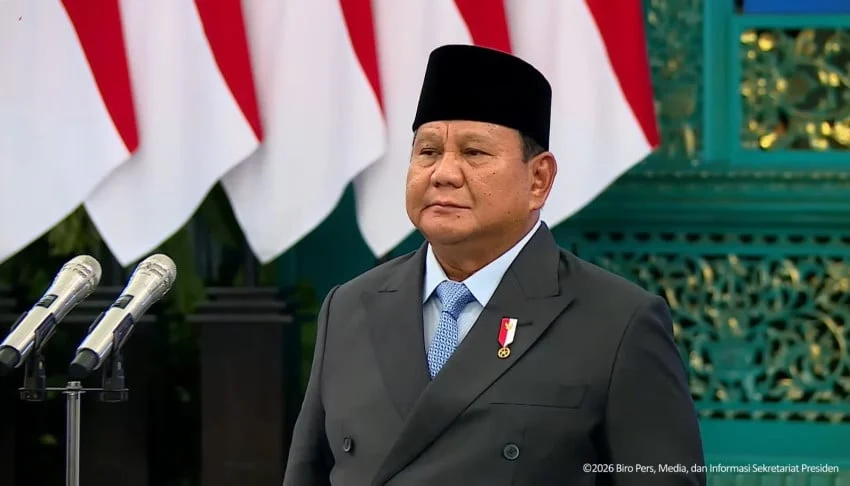
JAKARTA — As the administration of Indonesian President Prabowo Subianto approaches its crucial two-year milestone, political observers and governance analysts are intensifying calls for a rigorous performance evaluation of the executive branch. A prominent political scientist from the Universitas Nasional (Unas), Selamat Ginting, has publicly asserted that a two-year tenure provides an ample window for the head of state to measure executive output, identify systemic bottlenecks, and take decisive corrective action against underperforming cabinet members bearing poor performance records.
Speaking during a political discussion program broadcast on a major national digital platform, Ginting emphasized that the administration must move past the initial phase of political accommodation and transition toward a results-oriented governance model. According to the analyst, ministers and deputy ministers who fail to meet Key Performance Indicators (KPIs) or display administrative inertia should be swiftly replaced to prevent them from becoming structural liabilities to the state budget and the broader political capital of the presidency.
The discourse surrounding cabinet efficiency has gained renewed momentum as Indonesia navigates complex domestic and international socioeconomic landscapes. With the administration tasked with executing ambitious national priority programs—ranging from food and energy security to human capital development—the demand for competent, high-performing leadership across all ministries has never been more critical.
The Two-Year Evaluation Window: Establishing Accountability
In modern presidential systems, the first two years in office traditionally serve as both a stabilization period and a proving ground for executive appointees. During this foundational phase, newly appointed officials are expected to transition from policy conceptualization to effective implementation. Ginting argues that a 24-month period offers sufficient time for any competent public official to understand their bureaucratic ecosystem, align their departmental goals with the president’s vision, and demonstrate tangible outcomes.
When ministers fail to deliver measurable progress within this timeframe, continuing to retain them based on political concessions or coalition dynamics can severely undermine the credibility of the entire administration. The analysis highlights that underperforming officials—often referred to in political vernacular as holding "red marks" on their performance evaluations—pose a distinct hazard to the government’s strategic agenda. Rather than functioning as accelerators of public service delivery, stagnant ministries risk transforming into institutional bottlenecks that delay critical infrastructure projects, stall regulatory reforms, and dampen public trust.
The intersection of political loyalty and professional competence has long been a delicate balancing act for Indonesian administrations. However, as global economic headwinds and domestic financial pressures mount, political analysts argue that the margin for administrative error has narrowed significantly. Consequently, the threshold for ministerial accountability must be raised, signaling to both the bureaucracy and the public that performance remains the ultimate currency in the current administration.
Navigating Coalition Politics and the Push for a Zaken Cabinet
A central theme of the recent policy discourse involves the structural composition of the executive branch, particularly the tension between political representation and technical expertise. President Prabowo Subianto’s current administration, often described as a broad-based coalition government, includes figures nominated by various political parties that supported his electoral victory, alongside several holdover officials from the previous Joko Widodo administration.
Ginting’s commentary explicitly challenges the sustainability of maintaining cabinet positions purely as transactional rewards for coalition partners. He advocates for a decisive pivot toward a zaken cabinet—a professional, merit-based administration staffed by subject-matter experts rather than political proxies. In a governance framework facing multifaceted crises, the specialization and technical acumen of cabinet leaders are viewed as non-negotiable prerequisites for effective policy execution.
The challenge, however, lies in the intricate architecture of Indonesian coalition politics. Maintaining legislative stability in the People’s Representative Council (DPR) traditionally requires accommodating diverse political factions within the executive branch. Historically, excluding major political parties from ministerial portfolios can alter the balance of power in parliament, potentially complicating the passage of crucial state budgets and legislative bills.
Despite these political constraints, analysts suggest that a strategic cabinet reshuffle does not necessarily require a complete rupture with coalition allies. Instead, it demands robust negotiation between the executive branch and political party leaders to replace underperforming partisan appointees with more competent professionals endorsed by the same parties, or to reassign them to non-ministerial advisory roles where their operational impact is minimized.
Furthermore, the presence of approximately 17 ministers and high-level officials retained from the prior administration adds another layer of complexity. While continuity is often cited as a stabilizing factor during transitions of power, retaining officials whose methodologies or performance levels do not align with the current administration’s accelerated pace can create internal friction. Ginting’s assessment underscores that the president must transcend historical hesitations and exercise executive prerogatives independently of past political arrangements.

Quantifying the Burden of Non-Performing Ministries
The economic and administrative implications of retaining underperforming leadership extend far beyond abstract political theory. In a developing economy like Indonesia, government expenditure constitutes a major driver of gross domestic product (GDP) growth. When ministries fail to disburse budgets efficiently or mismanage strategic programs, the macroeconomic consequences are immediate and far-reaching.
Data from financial and developmental oversight bodies frequently highlight chronic issues in budget absorption, particularly during the first and second quarters of a fiscal year. Delayed procurement processes, bureaucratic red tape, and inadequate project management often lead to a concentration of state spending in the final months of the year. This pattern not only compromises the quality of public infrastructure and social assistance programs but also exerts inflationary pressures and reduces the multiplier effect of government spending.
Beyond fiscal metrics, underperforming ministries directly impact sectoral performance indices:
- Economic Sector: Delays in investment licensing, regulatory harmonization, and trade facilitation can hinder foreign and domestic direct investment, directly affecting job creation targets.
- Social Welfare: Inefficiencies in targeting beneficiaries for poverty alleviation, healthcare, and educational subsidies can widen socioeconomic disparities and exacerbate public dissatisfaction.
- Infrastructure and Energy: Slow progress in strategic national projects can disrupt supply chains, increase logistical costs, and undermine long-term national competitiveness.
When these systemic failures accumulate across multiple portfolios, the collective burden inevitably lands on the chief executive. The president becomes politically accountable for policy failures originating from subordinate officials who may lack the administrative capacity, leadership vision, or dedication required to execute complex national mandates.
Chronology of Cabinet Formation and Early Milestones
To understand the current calls for evaluation, it is necessary to examine the timeline of the current administration’s inception and structural evolution:
- October 2024: President Prabowo Subianto officially assumes office alongside Vice President Gibran Rakabuming Raka, followed closely by the inauguration of the large-scale cabinet, widely identified as the "Red and White Cabinet" (Kabinet Merah Putih). The administration introduces a broad structure comprising numerous ministries and state agencies designed to accommodate a wide coalition of supporting political parties.
- Late 2024 to Mid-2025: The administration focuses on initial policy consolidation, legislative alignment, and the rollout of flagship initiatives, such as the free nutritious meal program, food estate developments, and downstreaming industrial policies. During this phase, internal key performance indicators are established, and ministries begin navigating the complexities of merged or newly split institutional structures.
- Late 2025: The first informal performance reviews emerge from think tanks and academic institutions. Public scrutiny intensifies regarding the administrative readiness of certain ministries, particularly those facing budget absorption hurdles and inter-agency coordination challenges.
- Throughout 2026: Mid-term evaluations gain prominence across media platforms and academic circles. Observers begin pointing out specific sectors lagging behind their projected milestones, leading to intensified public debates regarding the necessity of a targeted cabinet reshuffle as the administration approaches its two-year benchmark.
This chronological progression highlights the natural shift from honeymoon periods and structural adjustments to rigorous performance accountability. As the administration enters its second half, the tolerance for administrative learning curves diminishes significantly.
Broader Implications of a Potential Cabinet Reshuffle
Should President Prabowo decide to execute a significant cabinet reshuffle based on performance evaluations, the decision would carry profound political, economic, and administrative ramifications for the remainder of the presidential term.
Political Repercussions
A reshuffle targeting party-affiliated ministers risks testing coalition cohesion. Political parties holding portfolios slated for revocation may express dissatisfaction, potentially leading to parliamentary friction or public posturing. However, if managed through transparent performance metrics rather than arbitrary political maneuvering, the administration can frame the reshuffle as a necessary, objective measure for the public good. This narrative alignment can effectively neutralize political pushback by appealing directly to public demand for clean and efficient governance.
Administrative Optimization
Replacing underperforming officials with seasoned technocrats, career bureaucrats, or proven industry professionals can revitalize stagnant state institutions. A renewed focus on execution capability can streamline bureaucratic procedures, improve inter-ministerial coordination, and accelerate the digitalization of public services. Furthermore, a clear signal that ministerial positions are contingent upon measurable results serves as a powerful deterrent against complacency across the entire civil service apparatus.
Market and Investor Confidence
International and domestic financial markets closely monitor governance indicators, political stability, and administrative competence in emerging economies. A proactive stance by the executive branch against bureaucratic inefficiency sends a reassuring signal to investors. Demonstrating that the government is willing to self-correct and prioritize economic pragmatism over political patronage enhances predictability, reduces regulatory uncertainty, and strengthens Indonesia’s investment climate.
Conclusion
The debate surrounding the performance of President Prabowo Subianto’s cabinet reflects the high stakes of contemporary Indonesian governance. As political analysts and civil society stakeholders continue to advocate for rigorous evaluations, the upcoming period will test the administration’s ability to balance political alliances with the uncompromising demands of national development.
Whether the executive branch chooses to implement a sweeping structural overhaul or targeted ministerial replacements, the underlying message remains consistent: sustainable governance in a complex global environment requires an unwavering commitment to competence, accountability, and results. The decisions made in the wake of this two-year milestone will undoubtedly shape the trajectory of the administration and its legacy in fulfilling the aspirations of the Indonesian public.