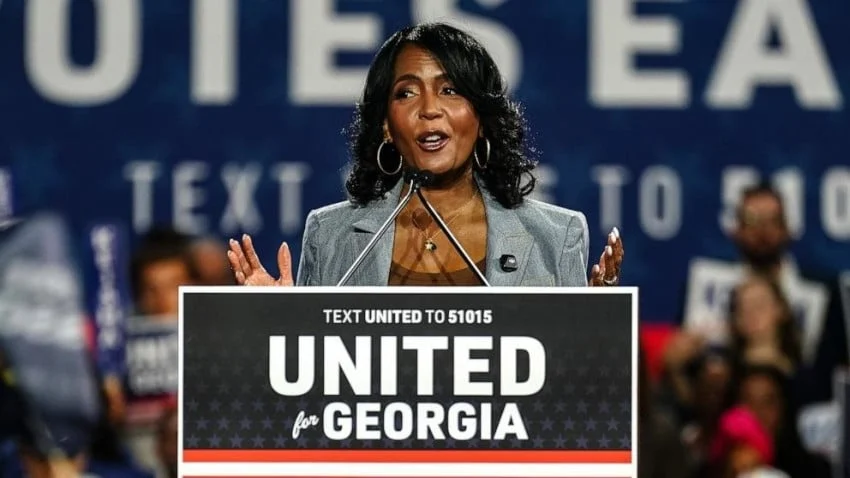
WASHINGTON — In a monumental election that reshapes the American political landscape, Democrat Keisha Lance Bottoms secured a historic victory on Tuesday, defeating Republican challenger Rick Jackson in the fiercely contested Georgia gubernatorial race. With this decisive win, Bottoms shatters a centuries-old political glass ceiling, becoming not only the first Black female governor in the history of the United States, but also the first woman and the first person of color ever elected to lead the state of Georgia.
The breakthrough victory carries immense national and regional significance. Bottoms will succeed outgoing Republican Governor Brian Kemp, who was constitutionally barred from seeking a third consecutive term due to state term limits. Her victory officially returns the Georgia governorship to Democratic control for the first time since 2003, concluding more than two decades of Republican stewardship in the heart of the American South. The outcome signals a profound demographic and political shift within Georgia, a state that has evolved in recent years into one of the nation’s most critical and closely watched political battlegrounds.
The Path to Victory: Chronology of the 2024 Georgia Gubernatorial Race
The road to this historic election night was paved by years of shifting political dynamics, intensive voter mobilization efforts, and a high-stakes campaign cycle that attracted national attention and hundreds of millions of dollars in campaign expenditures.
The primary season established the framework for a polarized general election. Keisha Lance Bottoms, leveraging her high national profile as the former Mayor of Atlanta and a former senior advisor to President Joe Biden in the White House, consolidated support across the Democratic base early in the cycle. Her campaign focused heavily on coalition-building, uniting urban progressive voters in Atlanta with suburban moderates in the surrounding metropolitan counties, while also making deliberate inroads into rural communities.
On the Republican side, Rick Jackson emerged from a competitive primary field, positioning himself as a candidate dedicated to preserving conservative economic policies, expanding school choice, and maintaining strict regulatory standards across the state. Jackson sought to tie Bottoms to national Democratic policies, attempting to mobilize conservative rural and exurban voters who have historically formed the backbone of the state’s Republican majority.
As the general election progressed through the autumn months, public and private polling consistently indicated a statistical dead heat. Both campaigns poured unprecedented resources into television advertising, digital outreach, and grassroots organizing. Election day turnout reached record levels for a midterm or off-year cycle, driven by intense engagement from both parties. As returns trickled in on Tuesday evening, early leads by the Republican ticket in rural counties gradually gave way to overwhelming margins for Bottoms as urban and suburban precincts—particularly in Fulton, DeKalb, Gwinnett, and Cobb counties—reported their totals. By late Tuesday night, major news networks projected Bottoms as the winner, triggering celebratory rallies in downtown Atlanta and widespread national acclaim.
From Atlanta City Hall to the National Stage: The Background of Keisha Lance Bottoms
To understand the trajectory of Keisha Lance Bottoms’ political career is to understand the modern evolution of Atlanta’s political and social fabric. Born and raised in Atlanta, Georgia, Bottoms navigated a childhood shaped by both the vibrant culture of the city and significant personal challenges. She is the daughter of the late R&B singer Major Lance, whose soulful music defined an era, and Sylvia Robinson.
Bottoms has frequently spoken about how her early life experiences profoundly shaped her worldview and commitment to public service. Growing up, her family experienced financial instability, and the incarceration of her father introduced severe economic hardships. These formative experiences instilled in her a deep empathy for marginalized populations and a commitment to systemic reform.
Her educational pursuits laid a rigorous foundation for her legal and political career. After graduating from Frederick Douglass High School—a historic institution in Atlanta—she earned her Bachelor of Arts degree from Florida A&M University, one of the nation’s premier historically Black universities (HBCUs). She subsequently pursued her Juris Doctor degree from the Georgia State University College of Law.
Bottoms spent years practicing law before entering public service, working in various legal capacities that deepened her understanding of municipal governance, civil litigation, and public policy. Her formal entry into elected office began when she served on the Atlanta City Council, representing districts that experienced rapid commercial development alongside persistent socioeconomic disparities.
In 2017, Bottoms achieved a major political milestone when she was elected the 60th Mayor of Atlanta. Her tenure as mayor, which spanned from 2018 to 2022, was defined by extraordinary trials and historic triumphs. She steered the city through the unprecedented global disruption of the COVID-19 pandemic, navigated profound civil unrest following the murder of George Floyd in 2020, and worked diligently to address affordable housing shortages, criminal justice reform, and economic inequality within the capital city.
In recognition of her leadership capabilities on the national stage, President Joe Biden appointed Bottoms as a Senior Advisor to the President and Director of Public Engagement at the White House in 2022. In this federal role, she acted as a crucial liaison between the administration and local leaders, businesses, and civil rights organizations across the country. This dual experience in municipal crisis management and federal policymaking provided her with a robust administrative resume that she leveraged throughout her gubernatorial campaign.
Broader Impact and National Implications
The election of Keisha Lance Bottoms as the first Black female governor in United States history reverberates far beyond the borders of Georgia. Political analysts suggest that her victory holds significant implications for the future of American politics, particularly in the Southern United States.
First, the return of the Georgia governorship to Democratic hands for the first time in over two decades solidifies the state’s status as a bona fide political swing state. While the 2020 presidential election and the subsequent 2021 U.S. Senate runoffs demonstrated the growing political power of a diverse coalition of voters in Georgia, the 2024 gubernatorial result proves that these electoral shifts were not a temporary anomaly. Bottoms’ ability to win statewide office highlights the efficacy of multi-ethnic, multi-racial coalition politics in the deep South.
Second, Bottoms’ victory represents a historic milestone for descriptive representation in American governance. For generations, executive mansions across the United States—and particularly in Southern states with legacies marked by segregation and racial disenfranchisement—have been occupied almost exclusively by white men. By breaking this barrier, Bottoms joins a very small, pioneering group of women of color who have achieved statewide executive office, serving as a powerful symbol of progress and inspiring a new generation of diverse leaders across the country.
Third, the policy implications for the state of Georgia are expected to be substantial. During her campaign, Bottoms outlined an agenda centered on expanding access to affordable healthcare, investing heavily in public education, raising teacher salaries, protecting voting rights, and fostering sustainable economic development that benefits both urban tech hubs and rural agricultural communities. However, navigating these policy priorities will require significant legislative maneuvering. Although Bottoms secured the executive mansion, she will face a state legislature where Republican lawmakers retain considerable influence, necessitating a bipartisan approach to governance if her administration is to achieve its major legislative goals.
Official Responses and Public Reactions
Reactions to the historic outcome poured in swiftly from political figures, civil rights organizations, and community leaders from across the political spectrum.
National Democratic leaders lauded the outcome as a watershed moment for the party and the nation. President Joe Biden released a statement praising Bottoms’ lifelong dedication to public service, characterizing her victory as a testament to her exceptional leadership and a proud moment for American democracy. Party strategists emphasized that her campaign model—focusing on economic opportunity, healthcare access, and inclusive governance—provides a viable roadmap for Democratic candidates competing across the American South.
Conversely, Republican leaders acknowledged the disappointment of the loss while emphasizing the importance of maintaining strong legislative oversight. Rick Jackson issued a gracious concession speech late Tuesday night, urging his supporters to remain engaged in the civic process and wishing the governor-elect success in addressing the state’s pressing economic and infrastructural needs. State-level Republican leaders signaled that while the executive branch has shifted parties, the General Assembly remains committed to fiscal conservatism, business-friendly tax policies, and the protection of individual liberties.
Civil rights advocates and historical preservation organizations focused on the profound cultural and symbolic weight of the evening. Representatives from organizations such as the NAACP highlighted that Bottoms’ election is a fulfillment of the long-fought promises of the Civil Rights Movement, many of whose defining moments occurred on the very streets of Atlanta where Bottoms grew up and served as mayor.
Looking Ahead: The Transition to the Governor’s Mansion
As the celebrations subside, attention now turns to the practical realities of governance and the gubernatorial transition. Keisha Lance Bottoms will assemble a transition team tasked with filling key agency director positions, drafting the administration’s initial legislative priorities, and preparing the state budget for the upcoming fiscal year.
The challenges awaiting the incoming governor are manifold. Bottoms will need to address the state’s ongoing rural healthcare crises, manage infrastructure demands driven by rapid population growth in the Atlanta metropolitan area, and foster economic resilience in an uncertain national economic climate.
Yet, as she prepares to take the oath of office later this year, Keisha Lance Bottoms stands at the center of American political history. Her journey from the daughter of an R&B singer navigating financial hardship in Atlanta to the chief executive of the Peach State underscores a remarkable personal narrative—and marks a transformative chapter in the evolving story of American democracy.