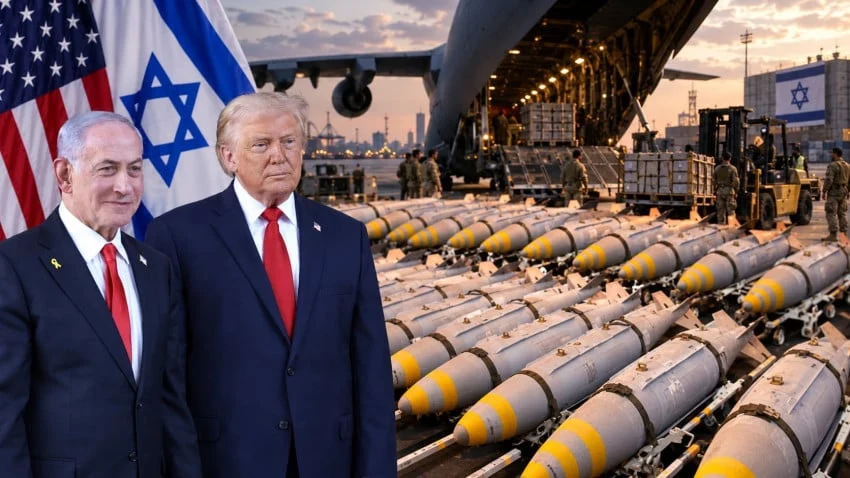
WASHINGTON — In a monumental move that underscores the enduring strategic alliance between Washington and Tel Aviv, the administration of United States President Donald Trump is currently preparing a massive military assistance package valued at approximately $2.8 billion, or roughly Rp49 trillion. According to authoritative reports emerging from the United States capital, this unprecedented arms transfer involves the provision of 40,000 heavy-duty aerial bombs destined for the Israeli military. Described by defense analysts and commentators as the largest single conventional explosive transfer in modern history, the deal has immediately drawn intense global scrutiny, reopening fierce debates within American political circles regarding foreign military aid, congressional oversight, and the ongoing humanitarian toll of the conflict in the Middle East.
The details of this sprawling procurement initiative reveal a carefully orchestrated effort by the executive branch to rapidly accelerate military supply lines to Israel. As cited in prominent journalistic investigations, specifically highlighted by The Washington Post following disclosures from anonymous American defense and administrative officials, the package comprises an astonishing inventory of heavy ordnance. Specifically, the shipment includes 20,000 MK-84 general-purpose bombs, 20,000 BLU-117 thermal-resistant blast fragmentation bombs, and an additional procurement of 20,000 I-2000 penetrator warheads designed to breach reinforced structures and subterranean fortifications.
Chronology of the Arms Transfer Initiative
The trajectory of this multi-billion-dollar military package did not materialize overnight; rather, it represents the culmination of prolonged logistical planning and high-level bilateral negotiations between American defense planners and Israeli military officials. The genesis of such large-scale munitions requests typically stems from intensive operational assessments conducted by the Israel Defense Forces during high-intensity combat phases. Following the depletion of standard-issue precision-guided munitions and heavy bunker-busting capabilities, Tel Aviv formally submitted requests to Washington for replenishment.
In the weeks leading up to the public disclosure of the package, the executive branch undertook the preliminary steps required by American law for foreign arms sales. The administration formally submitted the transfer plan through informal notification channels to the relevant committees within the United States Congress. By utilizing informal reviews, the White House and the Department of Defense sought to gauge legislative sentiment and expedite the formal approval process. Simultaneously, administration officials engaged in active lobbying efforts with key lawmakers, urging swift bipartisan or administrative sign-off to ensure that the munitions could enter the active supply chain without facing prolonged legislative bottlenecks.
Funding Mechanism and Financial Architecture
A critical dimension of this $2.8 billion military transfer lies in its financial architecture. While frequently categorized in diplomatic nomenclature as a "foreign military sale," the operational reality of the transaction means that the Israeli government is not utilizing its own treasury reserves to purchase the weaponry. Instead, the procurement is heavily subsidized—if not entirely funded—through the United States Foreign Military Financing (FMF) program.
Under the FMF framework, Washington annually allocates billions of dollars in grants to select foreign allies, primarily Israel and Egypt, which the recipient governments are legally mandated to spend almost exclusively on American-manufactured defense articles and services. Consequently, the $49 trillion equivalent financial package represents a direct transfer of American taxpayer funds back into the industrial base of the United States defense manufacturing sector. Major defense contractors, aerospace corporations, and munitions plants across the American domestic landscape stand to reap substantial financial windfalls from the production and delivery of these 40,000 bombs.
Unprecedented Scale and Public Reactions
The sheer magnitude of the shipment has separated this transaction from standard annual military assistance packages. Commenting on the revelations, prominent conservative political commentator and media figure Tucker Carlson took to the social media platform X to express deep alarm over the unprecedented scale of the munitions movement.
"Questo sembra essere il più grande trasferimento di munizioni esplosive convenzionali dagli Stati Uniti nella storia moderna," Carlson wrote, emphasizing that the sheer volume of 40,000 heavy bombs—many weighing upwards of 2,000 pounds—far exceeds historical baselines for peacetime or even crisis-era military resupplies. The public critique by conservative voices highlights a growing ideological fracture within American politics, where traditional interventionist support for foreign allies increasingly collides with populist skepticism regarding the open-ended expenditure of national resources on foreign conflicts.
Strategic and Geopolitical Implications
The decision to dispatch tens of thousands of heavy munitions to Israel carries profound geopolitical and humanitarian implications. Military analysts note that 2,000-pound bombs, such as the MK-84 and BLU-117, are among the most destructive conventional weapons in modern aerial arsenals. Designed to inflict massive structural damage and generate devastating blast radii, their deployment in densely populated urban environments has historically sparked severe international condemnation due to high rates of collateral damage and civilian casualties.
From a strategic perspective, the Trump administration’s willingness to approve such a massive transfer signals an unyielding commitment to maintaining Israel’s qualitative military edge in the Middle East. Proponents of the arms package argue that maintaining a robust and fully resourced Israeli military is essential for deterring hostile regional actors, maintaining regional stability, and fulfilling long-standing bilateral security commitments made by successive American administrations.
Conversely, international human rights organizations and progressive lawmakers have consistently argued that the continuous flow of offensive heavy weaponry without stringent end-use monitoring or adherence to international humanitarian law implicates the United States in civilian suffering. Critics point out that supplying weapons of this scale during periods of active urban warfare undermines diplomatic efforts aimed at securing durable ceasefires and negotiated political settlements.
Domestic Political Landscape in Washington
Inside the beltway, the rollout of the $2.8 billion package serves as a major test of congressional oversight and executive authority. While the executive branch possesses substantial discretionary power in managing foreign military assistance, the involvement of congressional committees ensures that fierce partisan debates will accompany the transaction. Members of Congress who advocate for stricter human rights conditions on foreign aid are expected to challenge the administration’s expedited approval strategy, utilizing legislative resolutions of disapproval or committee holds to voice their opposition.
At the same time, the powerful domestic lobbying apparatus supporting strong U.S.-Israel ties continues to exert considerable influence on Capitol Hill, ensuring that a critical mass of lawmakers remains steadfast in backing the resupply effort. This political tug-of-war reflects a deeply polarized domestic environment where foreign policy decisions regarding the Middle East remain among the most contentious issues in American governance.
Looking Ahead: The Delivery Timeline and Operational Horizon
As the administrative hurdles are systematically cleared, attention will inevitably shift toward the logistical execution of the transfer. Transporting 40,000 heavy bombs—totaling tens of thousands of tons of high explosives—requires a complex coordination of maritime shipping, secure military logistics, and defense infrastructure management. The phased delivery of the MK-84s, BLU-117s, and I-2000 penetrators is expected to span several months, feeding directly into the operational stockpiles of the Israeli Air Force.
Ultimately, the revelation of this historic $49 trillion military package cements President Donald Trump’s legacy as an administration deeply committed to cementing unbreakable defense ties with Israel, regardless of the domestic political friction or international diplomatic fallout it may generate. As these munitions begin their journey from American manufacturing plants to military depots in the Middle East, the global community will be watching closely to see how this massive influx of conventional firepower shapes the future security landscape of the region.