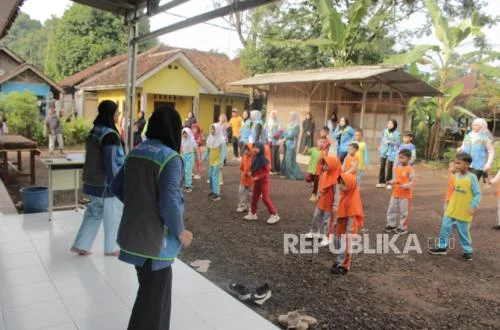
The tranquil morning in Kalimanggis Village, Manonjaya District, Tasikmalaya Regency, West Java, was punctuated by a symphony of sounds: the rhythmic tap of hammers, the joyful laughter of children, and the warm hum of conversation among volunteers. This vibrant scene on June 23, 2026, marked the culmination of the Binar Asa program, an initiative by Alazka Care, the social arm of Yayasan Al-Azhar Kelapa Gading (ALAZKA). Far from a grand ceremony, the day was a testament to the power of direct action, where thirty dedicated volunteers, alongside local residents, transformed learning spaces and fostered a renewed sense of community-driven progress, embodying a simple yet profound belief: that fundamental educational change can blossom from the heart of local communities.
The Heart of Kalimanggis: A Day of Transformation
On that pivotal day, the focus was squarely on tangible improvements and direct engagement. Volunteers, a diverse group comprising ALAZKA educators, administrative staff, parents of students, and local community members, worked in unison. Some meticulously painted classroom walls, breathing new life into once-faded spaces. Others thoughtfully arranged learning areas, creating environments conducive to curiosity and engagement. Meanwhile, lively discussions unfolded between volunteers and local teachers, exploring innovative pedagogical approaches designed to captivate young minds and make learning a more dynamic experience. The absence of a large stage or elaborate festivities underscored the program’s ethos: genuine impact over ostentatious display. What permeated the air was a collective determination, driven by a singular conviction that sustainable educational improvement begins with hands-on effort and collaborative spirit at the grassroots level. This collaborative energy extended beyond physical renovations, encompassing health support for the community. Volunteers distributed nutritious baby porridge, a critical intervention aimed at bolstering the nutritional intake of toddlers, directly addressing a common health challenge in rural areas and demonstrating the program’s holistic approach to child well-being.
Introducing Binar Asa: A Vision for Sustainable Change
Binar Asa, meaning "Spark of Hope," is more than just a project; it is a community empowerment movement championed by Alazka Care. Operating under the inspiring motto "Guru Berdaya, Siswa Juara" (Empowered Teachers, Champion Students), the program is strategically designed to strengthen the pillars of education, health, and overall community capacity. It achieves this through a collaborative framework that meticulously weaves together the efforts of schools, families, the business sector, and local residents. This multi-stakeholder approach is fundamental to Binar Asa’s philosophy, recognizing that lasting change requires a unified front and shared responsibility. The program’s comprehensive scope acknowledges the interconnectedness of these sectors; an educated child thrives in a healthy environment supported by an engaged community. By fostering robust partnerships, Binar Asa aims to create a self-sustaining ecosystem where improvements in one area naturally reinforce others, leading to a more resilient and empowered community.
The National Education Landscape: Challenges and Opportunities
Binar Asa’s emergence is particularly pertinent against the backdrop of Indonesia’s national educational landscape. While the government, through initiatives like "Merdeka Belajar" (Freedom to Learn), is actively pursuing comprehensive transformation, significant disparities in educational quality persist, presenting a collective challenge for the nation. National education data consistently indicates remarkable progress in expanding access to education, with near-universal enrollment rates at the primary level. However, this progress in quantity often masks underlying issues in quality. According to various national surveys and international assessments like the Programme for International Student Assessment (PISA), Indonesian students, particularly those in rural and remote areas, often lag behind their global peers in core competencies such as reading, mathematics, and science.
Several critical areas demand urgent attention: the enhancement of teacher competency, the equitable distribution of modern learning facilities, and the strengthening of cross-sectoral collaboration. Many rural schools, including those in regions like Tasikmalaya, struggle with outdated infrastructure, limited access to digital learning tools, and a shortage of highly qualified and motivated teachers. Professional development opportunities for educators are often concentrated in urban centers, leaving rural teachers with fewer avenues for continuous improvement. Furthermore, socioeconomic factors in rural communities, such as poverty and limited parental education, often compound these challenges, impacting student attendance, nutrition, and overall learning outcomes. It is within this complex environment that Binar Asa strategically positions itself, not merely to provide temporary relief but to construct a more robust educational ecosystem from the ground up, addressing these systemic issues directly and sustainably. The program aligns seamlessly with the United Nations Sustainable Development Goal 4 (Quality Education), which emphasizes inclusive and equitable quality education and lifelong learning opportunities for all, highlighting the critical role of community-led initiatives in achieving broader national and international development targets.
A Journey of Listening: The Binar Asa Chronology
Unlike traditional aid models that often begin with predefined solutions, Binar Asa’s journey in Tasikmalaya commenced with a principle of profound humility: listening. This crucial initial phase began in November 2025, when the Alazka Care team embarked on a thorough needs assessment. Their focus was on understanding the specific requirements and aspirations of the community surrounding TK (Kindergarten), TPQ (Quranic Education Park), and PAUD (Early Childhood Education) Insan Kamil in Kalimanggis Village. This in-depth engagement involved extensive dialogue with teachers, parents, local leaders, and children themselves, allowing the program designers to gain firsthand insights into the daily realities, challenges, and existing strengths of the community. This participatory approach ensured that all subsequent interventions were not only relevant but also genuinely responsive to the community’s unique context and priorities.
From this meticulous assessment process, a series of tailored programs were conceived and subsequently implemented in a phased manner, extending through June 2026. The phased approach allowed for continuous feedback and adaptation, ensuring that each intervention built upon the previous one, fostering a sense of ownership and sustained engagement within the community. This methodical timeline underscores Binar Asa’s commitment to thoughtful, long-term impact rather than superficial, short-lived assistance.
Comprehensive Interventions: Beyond the Classroom Walls
The programs rolled out by Binar Asa were multifaceted, designed to address various interconnected aspects of community well-being and educational quality. The initial phases focused on enhancing learning infrastructure and resources. This included the strategic distribution of essential learning materials, ranging from textbooks and educational toys to art supplies, ensuring that children had access to the tools necessary for engaging and effective learning. Simultaneously, a critical component was the digital literacy empowerment for educators. Teachers at TK, TPQ, and PAUD Insan Kamil received comprehensive training in digital learning media. This initiative aimed to equip them with modern pedagogical tools, enabling them to create more interactive and stimulating lessons, thereby bridging the digital divide often prevalent in rural educational settings.
Beyond the classroom, Binar Asa extended its reach into public health, recognizing its profound impact on a child’s ability to learn. Health education sessions were conducted for parents and children, covering topics such as hygiene, nutrition, and common childhood illnesses. This was complemented by the strengthening of Posyandu (Integrated Health Service Post) services, a vital community-based health facility. Volunteers worked to improve the infrastructure and operational capacity of the local Posyandu, ensuring that essential health services, including immunizations and maternal and child health check-ups, were more accessible and effective. The program also directly tackled nutritional deficiencies, particularly among infants, through the distribution of baby porridge, a simple yet impactful intervention designed to improve the health and cognitive development of the youngest members of the community.
Finally, the program culminated in light renovations of classroom spaces and the beautification of the learning environment. This involved not just repainting walls but also creating vibrant, child-friendly spaces adorned with educational murals and comfortable seating, transforming drab classrooms into inspiring hubs of learning. These interventions, while seemingly simple, collectively created a profound shift. For the children who daily inhabit these spaces, these changes translated into a vastly different and more enriching learning experience, fostering greater engagement, comfort, and pride in their educational journey.
Voices from the Field: Impact and Perspectives
The tangible improvements brought by Binar Asa have resonated deeply with all stakeholders. Syahidin, one of the dedicated volunteers and an ALAZKA educational staff member, shared his profound reflections. "This is an experience I will never forget," he remarked, his voice tinged with emotion. "I am grateful for the opportunity to be a Binar Asa volunteer and to help improve the learning environment and share with the children at TK Quran, Taman Pendidikan Quran, and PAUD Insan Kamil Manonjaya." He emphasized that his participation provided a new perspective on social contribution. "From this activity, I learned that everyone, regardless of their profession, can contribute to advancing education if it is done sincerely and collaboratively." His experience underscored a fundamental truth: education is not solely built within classroom walls by teachers, but flourishes through the collective care and commitment of an entire community willing to dedicate time, energy, and thought to create better learning environments for children.
A representative from Alazka Care further elaborated on the program’s strategic vision. "Our goal with Binar Asa is not just to provide temporary assistance, but to cultivate a sustainable model of community empowerment," stated Ms. Fitriani, Head of Social Programs at Alazka Care (inferred). "We believe that by investing in teachers, improving learning environments, and addressing holistic needs like health, we are building a stronger foundation for the future of these children and their entire community. The ‘Guru Berdaya, Siswa Juara’ motto is our guiding principle, recognizing that empowered educators are the key catalysts for student success."
Local educators expressed immense gratitude for the program’s comprehensive support. "Before Binar Asa, our resources were very limited, and the learning environment needed significant improvement," explained Ibu Siti Aisyah, Head of PAUD Insan Kamil (inferred). "The digital media training has transformed how we teach, making lessons more engaging for the children. And the renovated classrooms, they are not just brighter; they inspire our students to come to school with more enthusiasm. We are incredibly thankful for Alazka Care’s collaborative approach and for truly listening to our needs."
Parents and community members also voiced their appreciation. "Seeing the volunteers work side-by-side with us, it gave us a great sense of pride and ownership," said Mr. Budi Santoso, a parent and local community leader (inferred). "Our children are happier in school, and the health support from the Posyandu strengthening has made a real difference to our families. This program has brought us closer together and given us hope for our children’s future."
From a broader governmental perspective, initiatives like Binar Asa serve as crucial complements to national efforts. A local government official from the Manonjaya District Education Office (inferred), speaking on condition of anonymity due to protocol, acknowledged the invaluable contribution of private social organizations. "The challenges in equitable education, especially in rural areas, are significant and require multi-sectoral solutions. Alazka Care’s Binar Asa program is an excellent example of how non-governmental organizations can effectively partner with local communities to drive meaningful change. Their integrated approach, from teacher development to health and infrastructure, sets a commendable standard and aligns with our regional development goals. We hope to see more such collaborative models emerge to accelerate educational transformation across Tasikmalaya and beyond."
The Ripple Effect: Broader Implications and Future Outlook
The Binar Asa program in Kalimanggis Village offers profound implications beyond the immediate beneficiaries, serving as a compelling model for sustainable community-led development in education. Its success underscores the efficacy of shifting from a top-down, purely aid-based approach to one that prioritizes grassroots empowerment and collaborative ownership. This model demonstrates that lasting change is forged through deep community engagement, needs-based assessments, and integrated interventions that address education, health, and social capacity in concert.
One of the most significant implications is its potential as a blueprint for other regions facing similar educational disparities. By showcasing how a relatively modest investment, coupled with strategic planning and dedicated volunteerism, can yield transformative results, Binar Asa provides actionable insights for other NGOs, corporate social responsibility programs, and even government agencies. It highlights the power of partnerships – between civil society, local government, schools, and families – in overcoming complex development challenges.
Furthermore, Binar Asa contributes directly to national education goals, particularly those articulated within the "Merdeka Belajar" framework, which emphasizes student-centered learning, teacher autonomy, and the importance of a supportive learning environment. By empowering teachers with digital skills and improving learning spaces, the program directly enhances the quality of instruction and prepares students for a rapidly evolving world. The focus on early childhood education (PAUD) is also critical, as robust early learning experiences are foundational for lifelong academic success and cognitive development.
The program’s holistic approach also addresses broader societal well-being. By strengthening Posyandu services and promoting child nutrition, Binar Asa recognizes that healthy children are better learners. This integrated strategy has a ripple effect, improving not only educational outcomes but also public health indicators and overall community resilience. The increased parental involvement and community engagement fostered by the program lead to strengthened social capital, a vital asset for any community’s long-term development.
Looking ahead, the success of Binar Asa in Kalimanggis could inspire its replication or expansion to other underserved areas. The long-term sustainability of such initiatives often depends on the ability to cultivate local leadership and build intrinsic community capacity, ensuring that improvements continue even after the initial external support phases out. Alazka Care’s emphasis on training and empowering local stakeholders suggests a deliberate effort towards this long-term vision. The intangible benefits, such as renewed hope, increased self-reliance, and stronger community bonds, are perhaps the most enduring legacies of programs like Binar Asa. They demonstrate that true progress is measured not just in renovated classrooms or distributed supplies, but in the empowered spirits and brighter futures of the children and communities they serve.