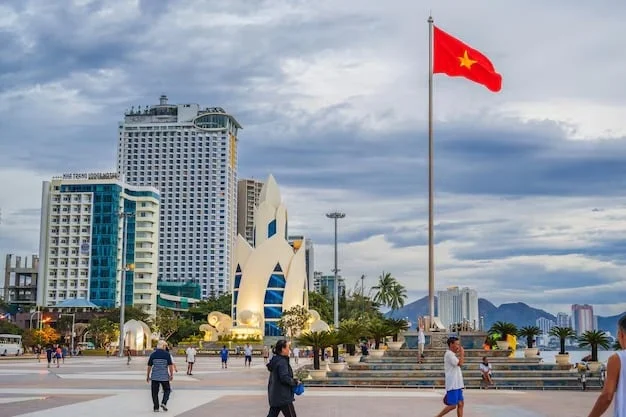
HANOI — The National Assembly of Vietnam has officially ratified an ambitious socio-economic development plan for 2027, setting a formidable target of at least 10% economic growth. This bold legislative move, approved by an overwhelming 93.4% of lawmakers during a plenary session this Saturday, signals a decisive shift toward high-velocity expansion, aiming to elevate the nation’s status within the global supply chain and accelerate its journey toward becoming a high-income economy.
Beyond the headline growth figure, the resolution establishes a clear macroeconomic framework. The government is tasked with achieving a Gross Domestic Product (GDP) per capita of approximately USD 6,100, while simultaneously maintaining a disciplined inflation ceiling of 4.5%. This balancing act between rapid expansion and price stability forms the cornerstone of Hanoi’s strategy for the next three years, reflecting a confidence bolstered by consistent foreign direct investment (FDI) inflows and a robust manufacturing sector.
Chronology of Economic Ascent
Vietnam’s journey toward this 10% target did not occur in a vacuum; it is the culmination of years of targeted industrial policy. Following the global economic turbulence of the early 2020s, Vietnam emerged as a preferred destination for multinational corporations looking to diversify their manufacturing footprints away from traditional hubs.
In 2023, the Vietnamese economy grew by 5.05%, a respectable figure given the global slowdown, but one that fell short of the government’s initial expectations. Recognizing the need for a more aggressive trajectory, the National Assembly began drafting the 2027 roadmap earlier this year. The resolution follows a series of legislative reforms enacted in late 2024, which streamlined land use laws and simplified administrative procedures for foreign investors. By establishing the 2027 target now, the government provides a clear signal to both domestic industries and international partners regarding its commitment to infrastructure development and market liberalization.
Supporting Data and Structural Pillars
To achieve a double-digit growth rate, the Vietnamese government has outlined a multi-faceted approach to resource mobilization. The resolution mandates a rigorous overhaul of fiscal management, prioritizing the optimization of state budget expenditures. Specifically, the government is directed to reduce routine, non-essential spending to free up capital for public investment in critical infrastructure projects, such as the North-South Expressway and ongoing improvements to port logistics.
Financial experts note that the 10% goal requires a significant increase in capital formation. Consequently, the resolution calls for the strategic issuance of sovereign bonds and the more efficient utilization of Official Development Assistance (ODA). Vietnam has historically maintained a strong relationship with international development banks, and the current plan emphasizes leveraging these low-interest loans to bridge the funding gap for large-scale energy and digital transformation projects.
Furthermore, the government is prioritizing the "financialization" of the economy to support productive sectors. The resolution mandates that the State Bank of Vietnam calibrate interest rates and exchange rate policies to favor the manufacturing and export sectors. By reducing credit costs for businesses in priority industries—such as high-tech electronics, green energy, and semiconductors—Hanoi intends to stimulate private sector participation in the national growth agenda.
Official Directives and Policy Shifts
The National Assembly has placed a heavy burden on the government to remove structural bottlenecks. One of the most significant directives involves the expansion of foreign ownership limits (FOL). By proposing a relaxation of caps in sectors not deemed vital to national security, the government is signaling a more open stance toward international capital. This is expected to trigger a fresh wave of mergers and acquisitions, particularly in the financial services, logistics, and retail sectors.
Energy security has also been elevated to a top-tier priority. The resolution mandates that the government ensure uninterrupted electricity and fuel supplies, acknowledging that rapid industrialization is impossible without a stable power grid. This directive follows a series of regional power shortages in previous years, which prompted a government-wide audit of the national power development plan (PDP8). The 2027 resolution requires the immediate completion of stalled energy infrastructure projects, including renewable energy integrations, to sustain the industrial base.
Analysis of Global and Domestic Implications
The decision to aim for 10% growth presents both significant opportunities and substantial risks. Economists observing the region suggest that while Vietnam’s manufacturing sector remains competitive, global demand remains volatile. The 4.5% inflation target is particularly ambitious given the potential for imported energy costs to fluctuate.
"The target is undeniably aggressive," says a senior economist based in Singapore. "To reach 10%, Vietnam must move beyond low-value assembly and capture more of the value chain. If they succeed in increasing the localization rate of their electronics and machinery exports, the target is feasible. However, the domestic banking sector must also be prepared to manage the risks associated with rapid credit expansion, particularly within the real estate sector."
The resolution explicitly addresses the real estate market, which has faced liquidity challenges in recent years. By focusing on creating a "healthy and sustainable" property market and resolving long-standing "zombie" or stalled projects, the government aims to prevent the real estate sector from becoming a drag on overall growth. This suggests a transition toward more regulated, transparent market practices that could boost investor confidence in the long term.
Challenges and Future Outlook
Despite the optimism, the path to 2027 is fraught with hurdles. Vietnam faces demographic shifts, including a rapidly aging population that could eventually impact labor availability. Furthermore, the country is increasingly vulnerable to climate change, which threatens its agricultural heartland in the Mekong Delta.
The government’s plan to optimize the national budget and increase the efficiency of state-owned enterprises (SOEs) is intended to provide the fiscal buffer necessary to mitigate these risks. By focusing on "economic balance," the National Assembly aims to ensure that growth is not just rapid, but also inclusive and geographically distributed across the country’s various provinces.
The international community, particularly Vietnam’s key trading partners—the United States, China, the European Union, and South Korea—will be watching the implementation of these policies closely. The successful realization of the 2027 goals would cement Vietnam’s position as one of Asia’s most dynamic emerging markets.
Summary of Strategic Objectives
As the administration moves to implement the resolution, the focus will shift to execution. The primary objectives can be summarized as follows:
- Capital Mobilization: Increasing the efficiency of state spending and optimizing ODA usage.
- Market Liberalization: Raising foreign ownership limits to attract high-quality FDI.
- Monetary Policy: Maintaining a flexible exchange rate while lowering credit costs for the production sector.
- Infrastructure Resilience: Resolving stalled energy and construction projects to ensure supply chain stability.
- Macroeconomic Stability: Keeping inflation below 4.5% while fostering a sustainable property market.
In the coming months, the government is expected to issue a series of decrees detailing the roadmap for these initiatives. For businesses operating in or entering the Vietnamese market, the 2027 resolution serves as a definitive policy compass. While the 10% target is high, the legislative backing and the structural reforms accompanying it indicate that Vietnam is prepared to make the necessary sacrifices to ensure its continued rise in the global economic hierarchy.
The world is witnessing a nation at a crossroads, choosing the path of rapid, high-impact growth. Whether this ambitious target serves as a catalyst for a new era of prosperity or a test of economic resilience remains to be seen. However, one thing is clear: Vietnam has set its sights on the next level of development, and it is moving with a level of legislative coordination that few other nations in the region can currently match. The success of this 2027 plan will likely define the country’s socio-economic landscape for the next decade.