
In the contemporary global landscape, the terms "economic growth" and "economic development" are frequently utilized by policymakers, academics, and the media to describe the progress of a nation. However, despite their superficial similarities, these two concepts represent distinct facets of a country’s socio-economic trajectory. While economic growth is primarily concerned with the quantitative expansion of a nation’s output, economic development encompasses a broader, more qualitative transformation of the social and economic structures that define the quality of human life. Distinguishing between these two is essential for understanding how nations transition from emerging markets to advanced economies and how the benefits of industrialization are distributed across a population.
Defining the Core Parameters of Economic Progress
Economic growth is defined as the increase in the capacity of an economy to produce goods and services, compared from one period of time to another. It is a narrow metric, often measured through the lens of Gross Domestic Product (GDP) or Gross National Product (GNP). When an economy grows, it signifies that the total market value of all finished goods and services produced within a country’s borders has risen. This is typically driven by increases in the labor force, capital stock, or the efficiency of production. In essence, economic growth is an increase in the "size of the pie."
In contrast, economic development is a multi-dimensional process involving major changes in social structures, popular attitudes, and national institutions, as well as the acceleration of economic growth, the reduction of inequality, and the eradication of poverty. Development is not merely about how much a country produces, but about how that production impacts the standard of living, literacy rates, life expectancy, and environmental sustainability. If economic growth is the increase in the size of the pie, economic development is the improvement in the nutritional quality of the pie and the fairness with which it is shared among the population.
The Quantitative Metric: Gross Domestic Product (GDP)
The primary indicator used to track these phenomena is the Gross Domestic Product (GDP). In a strictly growth-oriented perspective, a rising GDP is the ultimate sign of success. It indicates that factories are producing more, consumers are spending more, and the government is investing more. However, economists argue that GDP is a "blind" indicator because it does not distinguish between productive and destructive activities, nor does it account for the distribution of wealth.
For instance, a country may experience a 7% annual GDP growth due to a boom in oil exports. If the resulting wealth remains concentrated in the hands of a small elite while the majority of the population lacks access to clean water or education, the country has achieved economic growth but has failed in economic development. This disparity highlights why development metrics must look beyond the PDB (Produk Domestik Bruto) to include indicators such as the Human Development Index (HDI), which tracks health, education, and income.
A Comparative Analysis of Growth and Development Indicators
To better understand the divergence between these two concepts, it is necessary to examine four critical indicators: the rate of GDP increase, the relationship between production and population, the role of technological advancement, and the resulting welfare of the citizenry.
1. The Focus on GDP Increase
Economic growth is strictly focused on the increase in PDB. It is a numerical target. If the PDB increases from $1 trillion to $1.1 trillion, growth has occurred. Economic development, however, views the PDB as a means to an end rather than the end itself. In development, the focus is on whether the increase in PDB is accompanied by structural changes—such as moving from an agrarian economy to a service-based or high-tech economy—that improve the long-term resilience of the nation.
2. The Interplay Between PDB and Population Growth
A significant distinction lies in how each concept treats population dynamics. Economic growth does not necessarily account for the rate of population increase. If a country’s GDP grows by 3%, but its population grows by 4%, the average citizen is actually poorer than they were the year before.
Economic development, conversely, is deeply concerned with per capita income and the "real" experience of the individual. For development to be considered successful, the rate of economic expansion must significantly outpace the rate of population growth, ensuring that there is a surplus of resources to invest in social infrastructure, such as hospitals and schools.
3. Technological Advancement and Innovation (IPTEK)
The role of Science, Technology, and Engineering (known in Indonesia as IPTEK) serves as a catalyst for both, but is prioritized differently. Economic growth can occur through "extensive" means—simply adding more workers or using more raw materials. However, economic development requires "intensive" growth driven by innovation.
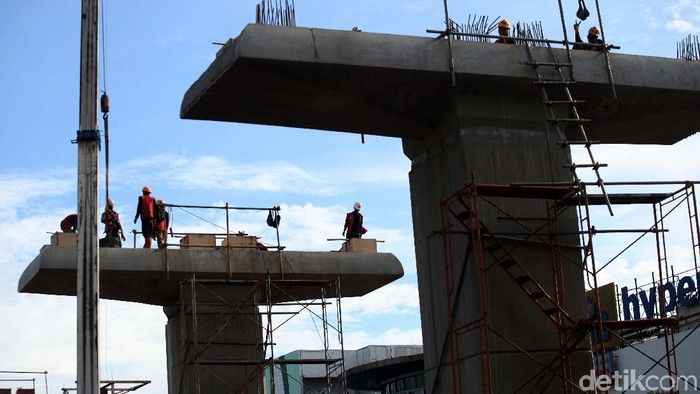
A prime example is the construction of massive transportation projects like the Light Rail Transit (LRT) and Mass Rapid Transit (MRT) systems in Jakarta. While the investment of approximately Rp 29.9 trillion into the LRT Jabodebek project contributes to GDP growth through construction activity and job creation, its true value lies in economic development. By utilizing modern technology to reduce traffic congestion, lower carbon emissions, and increase urban productivity, these projects represent a qualitative shift in how a city functions, thereby fostering development.
4. Public Welfare and Income Distribution
The most critical difference is the focus on welfare. Economic growth is "indifferent" to inequality. A country can grow while the gap between the rich and the poor widens. Economic development, however, is predicated on the idea of "growth with equity." It asks: Is the poverty rate falling? Is the Gini coefficient (a measure of income inequality) improving? Are more people gaining access to the middle class?
Case Study: Infrastructure as a Driver of Development
The transition of a vacant lot into a Regional General Hospital (RSUD) or a transit hub serves as a microcosm of economic development. When a government decides to replace a defunct minimarket with a state-of-the-art medical facility, it is making a developmental choice.
From a growth perspective, the construction adds to the year’s economic output. From a development perspective, the hospital provides long-term value by improving the health of the workforce, which in turn leads to higher productivity and a better quality of life. This reflects the "normative value" of development; it is tied to the values and needs of the human beings within the system, rather than just the figures on a balance sheet.
The LRT and MRT projects in the Jakarta-Bogor-Depok-Bekasi (Jabodebek) area further illustrate this. The determination of ticket prices involves a careful balance between covering operational costs (growth/inflation concerns) and ensuring the service remains affordable for the public (welfare/development concerns). If the government subsidizes these tickets, they are prioritizing economic development—ensuring that the lower and middle classes can access efficient transport to reach their jobs, thereby stimulating further economic activity.
Chronology of Economic Thought: From Output to Human Capability
The shift from focusing on growth to focusing on development has evolved over decades. In the post-World War II era, the "Harrod-Domar" model suggested that high levels of savings and investment were the primary drivers of progress. This led to a hyper-focus on industrial output.
However, by the 1970s and 80s, economists like Amartya Sen began to argue that "development" should be seen as the expansion of human capabilities—the freedom to lead a life that one has reason to value. This shift in thinking led to the creation of the Millennium Development Goals (MDGs) and later the Sustainable Development Goals (SDGs) by the United Nations. These frameworks officially recognized that a nation’s success cannot be measured by PDB alone, but must include environmental protection, gender equality, and access to justice.
Implications for Policy and National Strategy
For a developing nation, focusing solely on economic growth can be a dangerous trap. Rapid growth without development often leads to "jobless growth," where the economy expands but employment remains stagnant, or "ruthless growth," where the benefits only reach the wealthy.
Policymakers must therefore design "pro-poor" and "pro-environment" growth strategies. This involves:
- Investing in Human Capital: Prioritizing education and vocational training to ensure the workforce can handle new technologies (IPTEK).
- Institutional Reform: Reducing corruption and improving the "ease of doing business" to ensure that growth is sustainable and not reliant on temporary commodity booms.
- Infrastructure for Connectivity: Building roads, ports, and digital networks that connect rural areas to urban markets, ensuring that development is geographically inclusive.
Conclusion: The Symbiotic Relationship
Ultimately, economic growth and economic development are two sides of the same coin. Growth provides the necessary financial resources to fund development initiatives; without a growing PDB, a government lacks the tax revenue to build hospitals, schools, or rail systems. Conversely, without development, economic growth will eventually stall, as an uneducated or unhealthy workforce cannot sustain high levels of productivity in a competitive global market.
Understanding the nuances between these two concepts allows citizens and students of economics to look beyond the headlines of "GDP Growth" and ask deeper questions about the direction of their country. As evidenced by the evolving landscape of infrastructure and technology in emerging economies, the goal is not just to become a bigger economy, but to become a better, more equitable society for all.