
The global economic landscape is frequently defined by two terms that are often used interchangeably in casual conversation but remain distinct in the realms of macroeconomics and national policy: economic growth and economic development. While both concepts are essential indicators of a nation’s health, they represent different dimensions of progress. Economic growth is primarily a quantitative measure of an economy’s expansion, typically reflected in the increase of goods and services produced. In contrast, economic development is a qualitative and multi-dimensional process that encompasses structural changes, technological advancements, and improvements in the overall quality of life for the citizenry. Understanding these nuances is critical for policymakers, investors, and the general public as nations strive to balance industrial output with social welfare.
The Fundamental Framework: Quantitative vs. Qualitative Progress
At its core, the distinction between these two concepts lies in their scope. Economic growth is a narrower metric. It focuses on the numerical increase in a country’s Gross Domestic Product (GDP) or Gross National Product (GNP) over a specific period. It is concerned with the "how much" of an economy—how many more cars were manufactured, how much more grain was harvested, and how many more services were rendered compared to the previous year. This growth is often driven by the optimization of the factors of production: land, labor, capital, and entrepreneurship.
Economic development, however, is a much broader paradigm. It is rooted in normative values and the lived experience of the individual. While growth looks at the "size of the pie," development looks at how the pie is made, what it consists of, and how it is distributed among the population. Development is inherently linked to the reduction of poverty, the narrowing of inequality, and the enhancement of human capabilities. It asks whether the economic activities of a nation are leading to better healthcare, higher literacy rates, and more robust infrastructure. In the context of national planning, growth is often seen as a necessary precursor to development, yet growth can occur without development if the wealth generated does not translate into social progress.
The Role of Gross Domestic Product (GDP) as a Divider
The most common benchmark used to differentiate these two concepts is the Gross Domestic Product (GDP), known in Indonesia as Produk Domestik Bruto (PDB). GDP measures the total market value of all final goods and services produced within a country’s borders in a specific timeframe.
In the context of economic growth, the focus is strictly on the percentage increase of this figure. If a nation’s GDP rises from $1 trillion to $1.05 trillion, the economy has grown by 5%. This figure is vital for tracking inflation and market health. For instance, the valuation of stocks, the stability of the currency, and the attractiveness of a nation to foreign investors are often tied to these growth percentages.
Conversely, economic development examines the implications of GDP growth. It analyzes whether the increase in production is accompanied by a rise in the standard of living. Development indicators look beyond the raw numbers to see if the GDP growth is sustainable and if it is being driven by improvements in institutional frameworks. For example, if a country’s GDP grows solely due to the extraction of natural resources while its education system fails and its poverty rate remains stagnant, that country is experiencing growth without development.
Demographic Dynamics: GDP and Population Growth
A critical indicator used by economists to separate growth from development is the relationship between GDP and population size. Economic growth can be recorded even if the population is increasing at a faster rate than the economy itself. However, from a developmental standpoint, this scenario is problematic.
Economic development specifically monitors the percentage increase in GDP relative to the percentage increase in the population. For true development to occur, the rate of economic expansion must outpace the rate of population growth. This ensures that the "per capita" income is rising, providing individuals with more purchasing power and a higher quality of life. If a population grows by 3% while the GDP grows by only 2%, the average citizen is effectively becoming poorer, regardless of the fact that the total economy is "growing." Therefore, development-oriented policies often include family planning and human capital investment to ensure that the demographic trajectory aligns with economic goals.
Technological Advancement and the Infrastructure Dividend
The evolution of Science and Technology (IPTEK) serves as another major differentiator. Economic development is characterized by structural shifts—moving from an agrarian economy to an industrial one, or from an industrial economy to a service- and technology-based one. This requires a fundamental change in how a society operates.
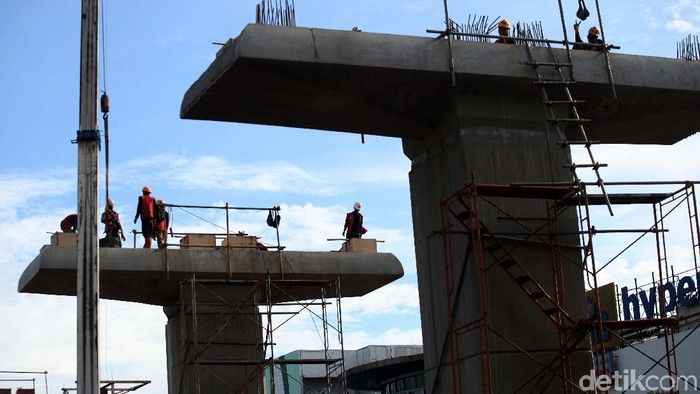
A prime example of economic development in action can be seen in the massive infrastructure projects undertaken in metropolitan hubs, such as the Light Rail Transit (LRT) and Mass Rapid Transit (MRT) systems in the Jakarta-Bogor-Depok-Bekasi (Jabodebek) area. These projects, which saw investments reaching approximately Rp 29.9 trillion for the LRT alone, are more than just additions to the national balance sheet. They represent a qualitative shift in urban mobility, environmental sustainability, and technological integration.
While the construction of these systems is a sign of development because it introduces new technology and improves societal efficiency, the subsequent management of these systems—such as the adjustment of ticket prices based on inflation and market demand—falls under the umbrella of economic growth. Growth ensures the financial viability of the service, while development ensures that the service exists to improve the lives of the citizens.
Social Welfare and the Human Development Index
The final and perhaps most significant indicator is the impact on public welfare. Economic development is explicitly concerned with whether the increase in national wealth is followed by an increase in the well-being of the people. This is often measured through the Human Development Index (HDI), which tracks life expectancy, education, and per capita income.
In a growth-centric model, a rise in the production of luxury goods might boost GDP significantly. However, a development-centric model would prioritize whether that wealth is being utilized to build hospitals (RSUD), schools, and public utilities. The transition of a vacant lot into a regional general hospital is a quintessential example of development. It provides a long-term social benefit that enhances the productivity and health of the workforce, which in turn fuels future growth.
Comparative Analysis: A Summary of Differences
To provide a clear overview, the differences can be categorized into four primary dimensions:
- Emphasis on PDB: Economic growth focuses on the numerical increase in PDB. Economic development focuses on the structural changes and the quality of that PDB.
- Demographic Focus: Economic growth does not necessarily account for population increases. Economic development requires that PDB growth exceeds population growth to ensure improved per capita welfare.
- Scientific and Technological Progress: Economic development is driven by and results in advancements in IPTEK. Economic growth can occur within existing technological frameworks without requiring innovation.
- Public Welfare: Economic growth tracks market values and inflation. Economic development tracks the distribution of wealth and the improvement of living standards.
Implications for Future Economic Policy
The distinction between these two concepts is not merely academic; it has profound implications for how a country manages its future. In the modern era, there is an increasing shift toward "Sustainable Development." This concept suggests that growth must not only be qualitative but also environmentally and socially responsible.
Experts argue that a singular focus on growth can lead to "boom and bust" cycles, where rapid expansion is followed by environmental degradation and social unrest due to inequality. By focusing on development, governments can create a more resilient economy. For instance, investing in green energy technology is an act of development that may have high initial costs (potentially slowing short-term growth) but ensures long-term stability and a higher quality of life.
Conclusion: The Symbiotic Relationship
Ultimately, economic growth and economic development are two sides of the same coin. A nation cannot achieve significant development without the resources generated by growth, and growth cannot be sustained indefinitely without the structural improvements provided by development.
As observed in the development of transportation infrastructure like the LRT or the construction of public health facilities, the goal of modern economics is to harmonize these two forces. By understanding that growth provides the means and development provides the end, a society can move toward a future where "progress" is measured not just by the numbers on a ledger, but by the health, happiness, and opportunity available to every citizen. The challenge for the next generation of economists and leaders will be to ensure that as the GDP climbs, the dignity and welfare of the population climb along with it.