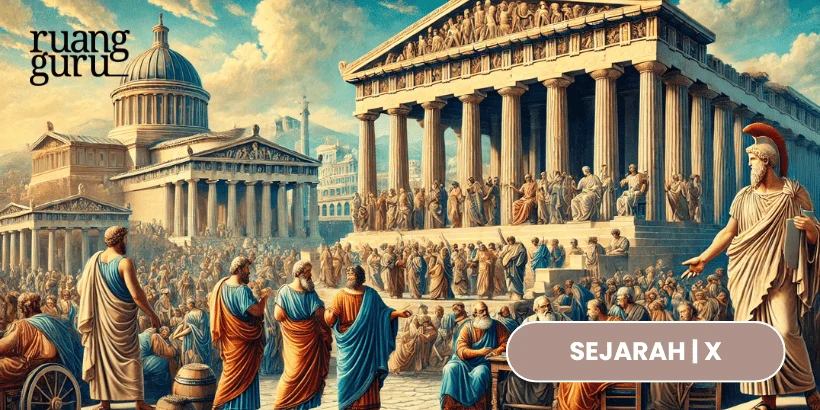
Ancient Greece stands as one of the most influential civilizations in human history, serving as the primary foundation for Western political systems, philosophical inquiries, scientific methodologies, and artistic standards. Developing in the Mediterranean basin around 3000 BCE and reaching its zenith during the Classical period, this civilization did not exist as a unified empire for much of its history but rather as a collection of independent city-states known as poleis. These entities, though frequently in conflict, were bound by a shared language, religion, and cultural identity. From the early maritime dominance of the Minoans to the sprawling conquests of Alexander the Great, the trajectory of Ancient Greece illustrates a profound evolution in human governance and intellectual pursuit that continues to resonate in the 21st century.
The Genesis of Greek Civilization: The Minoan and Mycenaean Eras
The origins of Greek civilization are rooted in the Bronze Age, specifically within the Minoan and Mycenaean cultures. The Minoan civilization, which flourished on the island of Crete from approximately 2700 BCE to 1450 BCE, is widely regarded as the first advanced civilization in Europe. Centered around the grand palace of Knossos, the Minoans were a maritime powerhouse, establishing extensive trade networks with Egypt and the Levant. Their society was characterized by sophisticated urban planning, vibrant frescoes, and a unique writing system known as Linear A, which remains undeciphered. Archaeological evidence suggests that the Minoans were a relatively peaceful, trade-oriented society until their decline, which historians attribute to a combination of natural disasters—specifically the volcanic eruption at Thera—and subsequent invasions.
Following the decline of the Minoans, the Mycenaean civilization emerged on the Greek mainland, dominant from roughly 1600 BCE to 1100 BCE. Unlike their predecessors, the Mycenaeans were a militaristic society governed by a warrior elite. They developed Linear B, an early form of the Greek language, and built massive, fortified citadels such as Mycenae and Tiryns. The Mycenaean era is immortalized in the epic poems of Homer, the Iliad and the Odyssey, which chronicle the legendary Trojan War. This period represents the "Age of Heroes" in Greek mythology, but it ended abruptly around 1100 BCE during the Bronze Age Collapse, leading into a period of stagnation known as the Greek Dark Ages.
The Rise of the Polis and the Archaic Renaissance
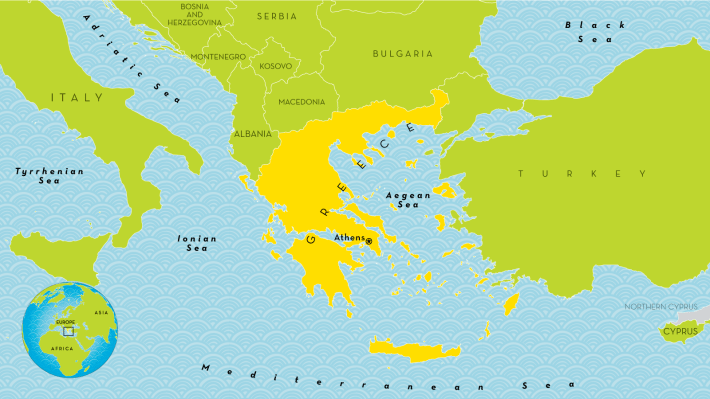
The recovery from the Dark Ages began during the Archaic Period (800 BCE – 500 BCE). This era was marked by a significant population surge and the emergence of the polis, or city-state. The unique geography of Greece—rugged mountains and isolated valleys—encouraged the development of these independent political units. Two of the most prominent poleis, Athens and Sparta, developed vastly different social and political structures that would define the Classical era.
During this time, the Greeks began to look outward, establishing colonies across the Mediterranean and Black Seas. This expansion facilitated a "renaissance" of Greek culture, including the adoption of the Phoenician alphabet, which made literacy more accessible. It was also the period when the first Olympic Games were held (776 BCE), serving as a pan-Hellenic festival that united the disparate city-states through athletic competition and religious devotion to Zeus.
The Classical Period: The Golden Age of Intellectual and Political Prowess
The Classical Period (500 BCE – 323 BCE) is considered the pinnacle of Greek achievement. It began with the Greco-Persian Wars, a series of conflicts where the outnumbered Greek city-states successfully repelled the invasions of the massive Persian Empire. The victories at Marathon, Salamis, and Plataea prevented the subjugation of Greece and allowed for the flourishing of Athenian democracy.
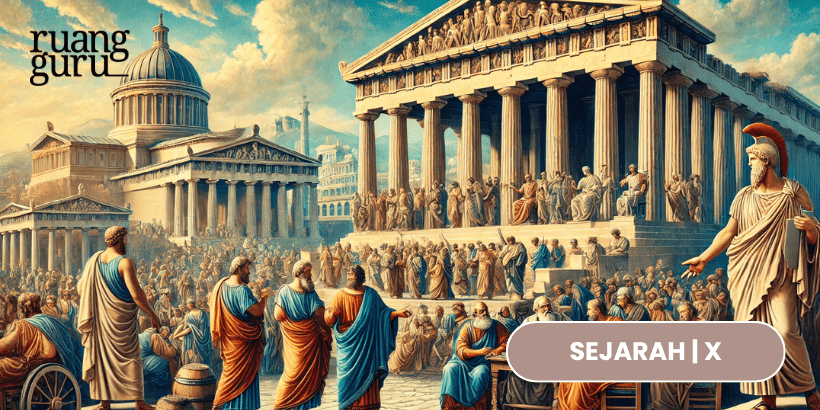
Under the leadership of Pericles, Athens entered a "Golden Age." The city became the center of arts, drama, and philosophy. The Parthenon, a temple dedicated to Athena, was constructed on the Acropolis, showcasing the perfection of Doric architecture. However, the rivalry between the democratic, naval-based Athens and the oligarchic, land-based Sparta eventually led to the Peloponnesian War (431–404 BCE). This protracted conflict exhausted the Greek city-states, eventually allowing the northern kingdom of Macedonia to rise to power.

The Hellenistic Era and the Global Spread of Culture
The death of Alexander the Great in 323 BCE marked the transition from the Classical to the Hellenistic Period. Alexander, the son of Philip II of Macedon, had conducted an unprecedented military campaign, conquering the Persian Empire and extending Greek influence as far as the Indus River. Upon his death, his empire was divided among his generals, resulting in the creation of several Hellenistic kingdoms, including the Ptolemaic Kingdom in Egypt and the Seleucid Empire in the Near East.
The Hellenistic era was characterized by the synthesis of Greek culture with Eastern traditions. The city of Alexandria in Egypt became the world’s preeminent center of learning, housing the Great Library and the Musaeum. This period saw monumental advancements in science and mathematics, with figures like Euclid and Archimedes pushing the boundaries of human knowledge. The era concluded in 31 BCE with the Battle of Actium, leading to the Roman annexation of Egypt and the integration of the Greek world into the Roman Empire.
Notable Rulers and Military Commanders
The history of Ancient Greece was shaped by several key figures whose leadership styles varied from mythical kingship to strategic military genius:
- King Minos: The legendary ruler of Crete, associated with the Labyrinth and the Minotaur. He represents the peak of Minoan naval power and administrative organization.
- Agamemnon: The King of Mycenae and commander of the Greek forces during the Trojan War. He symbolizes the warrior-king era of the Bronze Age.
- Leonidas I: The Spartan king who led the 300 Spartans at the Battle of Thermopylae in 480 BCE. His sacrifice against the Persian army remains a global symbol of courage and tactical discipline.
- Philip II of Macedon: A brilliant strategist who reformed the Macedonian phalanx and unified the Greek city-states under the League of Corinth, setting the stage for his son’s conquests.
- Alexander the Great: Arguably the greatest military commander in history, Alexander never lost a battle. His legacy is the "Hellenization" of the known world, which created a common cultural and linguistic framework that lasted for centuries.
The Foundation of Western Thought: Philosophy and Logic
Perhaps the most enduring gift of Ancient Greece is its philosophical tradition. Greek thinkers moved away from mythological explanations of the world toward rational inquiry.
- The Pre-Socratics: Thinkers like Thales and Heraclitus sought to identify the "arche" or primary substance of the universe, laying the groundwork for natural science.
- Socrates: He shifted the focus to ethics and human behavior. Through the Socratic Method—a form of cooperative argumentative dialogue—he challenged citizens to examine their beliefs.
- Plato: A student of Socrates, Plato founded the Academy and wrote The Republic, exploring the nature of justice and the ideal state. His Theory of Forms posited that the physical world is a shadow of a higher, abstract reality.
- Aristotle: A student of Plato and tutor to Alexander the Great, Aristotle was a polymath who categorized human knowledge. His work on logic (syllogism), biology, and physics remained the standard in Western and Islamic thought for nearly two millennia.
Scientific and Architectural Innovations
The Greeks made groundbreaking contributions to science and medicine. Hippocrates, the "Father of Medicine," revolutionized the field by asserting that diseases had natural rather than supernatural causes. The Hippocratic Oath remains a cornerstone of medical ethics today. In mathematics, Pythagoras and Euclid established the principles of geometry that are still taught in modern classrooms.
In architecture, the Greeks developed three distinct orders: the sturdy Doric, the elegant Ionic, and the ornate Corinthian. These styles influenced Roman architecture and were later revived during the Renaissance and Neoclassical periods. The ruins of Greek theaters and stadiums also demonstrate an advanced understanding of acoustics and civil engineering.
Religion and Mythology as Social Framework
Ancient Greek religion was polytheistic, centered on the twelve Olympian gods who resided on Mount Olympus. Unlike many modern religions, Greek mythology was not based on a single sacred text but on oral traditions, poetry, and festivals. Zeus, Hera, Poseidon, Athena, and Apollo were seen as powerful beings with human flaws, reflecting the complexities of the human condition.
Religious life was deeply integrated into the state. Festivals like the Dionysia in Athens birthed the tradition of Western drama, where playwrights like Sophocles and Aristophanes used theater to explore moral dilemmas and political satire. The Oracle of Delphi served as a vital institution where leaders sought divine guidance, illustrating the intersection of faith and geopolitics.

Broader Impact and Modern Implications
The legacy of Ancient Greece is not merely a subject of historical study but a living influence on modern society. The Athenian concept of demokratia (rule by the people) is the direct ancestor of modern representative government. The Greek emphasis on individualism and critical thinking provided the intellectual spark for the Enlightenment and the scientific revolution.
Furthermore, the Greek language has left an indelible mark on modern English and other European languages, particularly in the realms of science, medicine, and philosophy. Terms such as "biology," "democracy," "philosophy," and "physics" all derive from Greek roots. Historians and political analysts often point to the "Thucydides Trap"—a term derived from the historian Thucydides’ account of the Peloponnesian War—to describe the inherent friction when a rising power threatens to displace an established one, showing that Greek historical analysis remains relevant to contemporary international relations.
In conclusion, the civilization of Ancient Greece was a multifaceted phenomenon that transformed the human experience. By prioritizing reason, civic engagement, and artistic excellence, the Greeks created a blueprint for civilization that has endured for over two thousand years. Their history serves as a testament to the power of human intellect and the enduring quest for knowledge and justice.