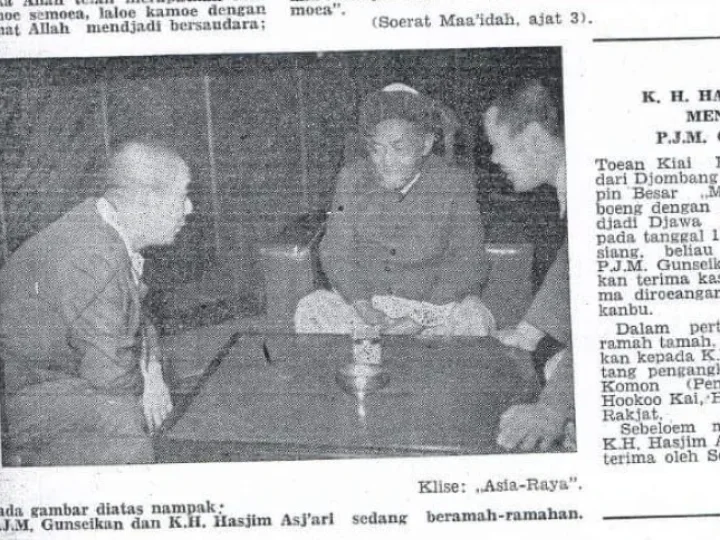
Among the millions of archival documents meticulously preserved at the National Archives of the Republic of Indonesia (ANRI), a single newspaper page stands as a poignant silent witness to Indonesia’s tumultuous journey during the Japanese occupation. The Asia Raya newspaper, in its edition dated March 20, 2604 (corresponding to March 20, 1944), featured a prominent photograph of Hadratussyekh KH. Hasyim Asy’ari on its front page. At first glance, the image merely depicts an elderly Islamic scholar seated serenely, his hands gently folded in his lap, his face radiating tranquility, devoid of any visible signs of distress. However, beneath this calm exterior lies a profound narrative of struggle, unwavering spiritual conviction, and the immense physical suffering he endured for upholding his beliefs against the might of the Japanese military administration. This photograph, more than a mere visual record, encapsulates a pivotal moment in the complex relationship between the occupying power and the deeply revered religious leaders of the archipelago.
For historians and scholars, this particular photograph transcends its visual simplicity, serving as an invaluable primary source that meticulously records the dramatic shifts in the relationship between the Japanese occupational government and Indonesia’s powerful clerical class, known as the ulama or kyai. The archive strikingly illustrates how a religious leader who had been imprisoned and subjected to torture for his staunch refusal to comply with Japanese policies was, just two years later, prominently featured in the official propaganda organ of the very government that had persecuted him. This stark contrast—from imprisonment and torture to public veneration in an official newspaper—endows the photograph with immense historical value, making it a subject of continuous fascination and intense scrutiny for researchers attempting to unravel the intricate layers of collaboration and resistance during this dark chapter of Indonesian history. The image forces a re-evaluation of the strategies employed by both the occupiers and the occupied, highlighting the nuanced interplay of power, faith, and political expediency.
The Japanese Occupation and the Role of Ulama
The Japanese invasion of Indonesia in early 1942, following the swift defeat of the Dutch colonial forces, marked a dramatic turning point for the archipelago. Initially, many Indonesians, weary of Dutch rule, harbored hopes that the Japanese, propagating the "Asia for Asians" rhetoric under the banner of the Greater East Asia Co-Prosperity Sphere, would bring genuine liberation. However, these hopes quickly dissipated as the Japanese military administration imposed a far more brutal and exploitative regime than their Dutch predecessors. Their primary objective was to exploit Indonesia’s vast natural resources, particularly oil and rubber, to fuel their war machine in the Pacific.
The Japanese quickly recognized the immense influence wielded by the ulama and kyai, particularly in Java, where Islamic boarding schools ( pesantren) served as centers of religious learning, social cohesion, and often, quiet resistance against foreign rule. These religious leaders commanded deep respect and loyalty from millions of followers, making them both potential allies and dangerous adversaries for the occupiers. Initially, the Japanese sought to integrate the ulama into their administrative structure, hoping to leverage their influence to mobilize the population for war efforts, including the recruitment of romusha (forced laborers) and the collection of food and resources. They established religious affairs offices and attempted to control religious education, but their policies often clashed with deeply held Islamic principles.
KH. Hasyim Asy’ari: A Pillar of Indonesian Islam
Hadratussyekh KH. Hasyim Asy’ari (1871-1947) was arguably the most revered and influential kyai of his time. As the founder of Nahdlatul Ulama (NU) in 1926, the largest Islamic organization in Indonesia, he was a towering figure in both religious and nationalist circles. His pesantren in Tebuireng, Jombang, East Java, was a spiritual and intellectual hub, training generations of ulama who would go on to shape the future of Indonesian Islam. Known for his profound scholarship, moral integrity, and unwavering commitment to Islamic teachings and the welfare of the Indonesian people, KH. Hasyim Asy’ari held an unparalleled moral authority. His pronouncements carried significant weight, capable of swaying public opinion across Java and beyond.
During the Dutch colonial era, KH. Hasyim Asy’ari had consistently advocated for religious freedom and national dignity. His leadership of NU provided a platform for Islamic scholars to address contemporary issues, maintain traditional Islamic education, and subtly resist colonial pressures. When the Japanese arrived, he initially adopted a cautious stance, observing their policies. However, his steadfast adherence to Islamic principles soon brought him into direct conflict with the new occupiers.
The Seikerei Incident and Hasyim Asy’ari’s Arrest (1942)
The most notorious point of contention between the Japanese and the ulama was the imposition of the seikerei, a ritual act of bowing towards Tokyo in the direction of the Emperor of Japan, believed to be a living deity. The Japanese military administration mandated that all Indonesians, including Muslims, perform the seikerei daily as a sign of respect and loyalty to the Emperor and the Japanese state. For devout Muslims like KH. Hasyim Asy’ari, this ritual was anathema, a clear act of shirk (polytheism) that violated the fundamental Islamic tenet of tawhid (the oneness of God). Bowing to anyone other than Allah was considered an unforgivable sin.
KH. Hasyim Asy’ari, with characteristic courage, openly refused to perform the seikerei and instructed his followers and students at Tebuireng pesantren to do likewise. His defiance was a direct challenge to Japanese authority, and it resonated deeply within the Muslim community, inspiring others to resist. The Japanese, who tolerated no insubordination, swiftly reacted. In September 1942, Japanese troops stormed Tebuireng, arrested KH. Hasyim Asy’ari, along with his son KH. Wahid Hasyim and several other kyai.
He was then subjected to brutal interrogation and torture in prison, first in Jombang, then in Mojokerto, and finally in Surabaya. Accounts from his family and students reveal the severity of his ordeal. Despite his advanced age and frail health, he endured physical abuse, including beatings, for weeks. This act of cruelty by the Japanese ignited widespread outrage and protests among his followers across Java, who recognized the profound injustice inflicted upon their revered leader. The arrest and torture of such a prominent figure highlighted the Japanese regime’s ruthlessness and their complete disregard for local religious sensitivities, inadvertently fueling nationalist sentiment and solidifying resistance among the religious masses.
The Asia Raya Newspaper: Propaganda and Historical Record
Asia Raya was a major Indonesian-language newspaper published in Batavia (present-day Jakarta) during the Japanese occupation, beginning in 1942. It operated under the strict supervision of the Sendenbu, the Japanese Military Government’s Propaganda Department. Every piece of news, every article, and every photograph published in Asia Raya was meticulously curated and edited to serve the objectives of the Japanese Empire. Its primary functions were to cultivate a positive image of Imperial Japan, disseminate propaganda for the Greater East Asia Co-Prosperity Sphere, and manipulate Indonesian public opinion to garner support for the occupying government’s policies, especially its war efforts against the Allied powers. The newspaper often featured articles extolling Japanese military prowess, criticizing Western imperialism, and promoting the concept of a unified Asian front under Japanese leadership.
Despite its clear role as a propaganda tool, Asia Raya has paradoxically become an indispensable primary source for historical research. Its pages contain a wealth of information regarding the social, political, economic, and cultural dynamics of Indonesian society under Japanese rule. Historians analyze its content not for its direct truth, but for what it reveals about Japanese propaganda strategies, the issues the occupiers deemed important, and the prevailing sentiments they sought to influence. The articles, even those heavily biased, offer glimpses into daily life, official decrees, and the individuals whom the Japanese either supported or sought to neutralize. It is within this context that the March 20, 1944, edition, featuring KH. Hasyim Asy’ari, gains exceptional significance.
The Unveiling of the Photo: March 20, 1944
The publication of KH. Hasyim Asy’ari’s photograph on the front page of Asia Raya on March 20, 1944, marked a dramatic shift in the Japanese administration’s approach to the ulama. By this point, the tide of World War II had begun to turn against Japan. Their initial rapid successes in Southeast Asia were being challenged by increasingly fierce Allied counter-offensives. The Japanese leadership in Indonesia realized that their heavy-handed tactics and reliance on force were counterproductive, alienating the very population they needed to mobilize for defense against an impending Allied invasion. They desperately needed to consolidate internal support and maintain stability.
This realization led to a strategic pivot: an attempt to co-opt and appease influential figures, particularly religious leaders like KH. Hasyim Asy’ari, whose immense spiritual authority could not be easily suppressed. After his release from prison in late 1942, largely due to intense pressure and petitions from his followers and other prominent religious figures, Hasyim Asy’ari had maintained his influential position, albeit under close Japanese surveillance. His very existence, even in a state of quiet defiance, was a symbol of spiritual resistance.
The Asia Raya photograph, therefore, was not merely a news item; it was a carefully calculated propaganda move. It aimed to signal a supposed reconciliation between the Japanese authorities and the revered kyai. By portraying him calmly seated, his face serene, the image sought to convey an impression of peaceful cooperation and mutual understanding. The caption accompanying the photo, though not explicitly detailed in the provided snippet, would have undoubtedly framed his appearance in a manner beneficial to Japanese interests, perhaps emphasizing his supposed support for the "New Order" or his role in fostering harmony. This public display was designed to reassure the Indonesian Muslim population that their leaders were respected and that the Japanese were not entirely hostile to Islam, thereby hoping to neutralize potential religious-based resistance.
Japanese Shifting Strategies: Co-optation and Control
The Japanese administration’s decision to feature KH. Hasyim Asy’ari in Asia Raya was part of a broader shift in their strategy towards the ulama in 1943-1944. Recognizing the failure of outright suppression, they began to pursue a policy of co-optation. This involved:

- Establishment of Masyumi (Majelis Syuro Muslimin Indonesia): In October 1943, the Japanese established Masyumi as a consultative council for Indonesian Muslims. This was an attempt to unify and control various Islamic organizations under a single, Japanese-supervised umbrella. KH. Hasyim Asy’ari, despite his past suffering, was persuaded to become the chairman of Masyumi, a position he accepted with strategic foresight. While ostensibly a Japanese creation, Masyumi provided a legitimate platform for Muslim leaders to communicate, organize, and subtly pursue their own nationalist agenda, often under the guise of supporting Japanese war efforts.
- Religious Training and Propaganda: The Japanese organized courses and seminars for ulama, ostensibly to teach them about Japanese culture and wartime objectives, but also to indoctrinate them. They also promoted certain interpretations of Islam that aligned with Japanese interests, such as the concept of "jihad" being directed against the Western Allies.
- Financial and Material Support: In some instances, the Japanese offered financial aid or material support to pesantren and ulama, hoping to buy their loyalty or at least secure their passive cooperation.
- Public Rehabilitation of Figures like Hasyim Asy’ari: The Asia Raya photo was a prime example of this "rehabilitation." By publicly acknowledging and ostensibly honoring a figure who had openly defied them, the Japanese aimed to win over his vast following and signal a more conciliatory stance.
However, this co-optation was a double-edged sword. While the Japanese believed they were controlling the ulama, figures like KH. Hasyim Asy’ari were masters of strategic maneuvering. They understood that engaging with the occupiers, even on their terms, could provide opportunities to protect their communities, preserve Islamic teachings, and subtly advance the cause of Indonesian independence. His acceptance of the Masyumi leadership, for instance, allowed him to shield his followers from more severe Japanese demands and to lay the groundwork for future nationalist actions.
Hasyim Asy’ari’s Enduring Influence and Strategic Resilience
KH. Hasyim Asy’ari’s decision to appear in Asia Raya and engage with the Japanese-established Masyumi was a testament to his profound strategic acumen and his unwavering commitment to the Indonesian nation. His actions were not a sign of capitulation but rather a calculated form of resilience. He recognized that outright, constant confrontation might lead to the destruction of pesantren and the severe persecution of his community. Instead, he chose a path of "tactical accommodation" to preserve the core of Islamic education and nationalist spirit.
By participating in Japanese-sanctioned bodies, he could:
- Protect the ummah (Muslim community): He could advocate for the rights and welfare of Muslims, mitigate harsh Japanese policies, and prevent the complete erosion of Islamic identity.
- Maintain Religious Authority: His continued public presence, even under Japanese oversight, reaffirmed his leadership and prevented the rise of alternative, Japanese-backed religious figures who might genuinely collaborate.
- Foster Unity: Masyumi, despite its origins, inadvertently became a platform where various Islamic groups could meet, discuss, and subtly coordinate their efforts, fostering a sense of unity that would prove crucial during the Indonesian National Revolution.
- Subtly Instill Nationalist Sentiments: Within the framework of Japanese-approved activities, ulama could still subtly inject nationalist messages and maintain the flame of independence, often through religious sermons and educational content.
His dignified composure in the Asia Raya photograph, despite the recent history of abuse, projected an image of moral strength and unwavering faith, qualities that deeply resonated with the Indonesian people and undercut the Japanese narrative of complete submission.
The Photo’s Historical Significance and Interpretation
The Asia Raya photograph of KH. Hasyim Asy’ari remains a powerful symbol and a rich subject for historical interpretation:
- Evidence of Japanese Policy Shift: It unequivocally demonstrates the Japanese military administration’s recognition of the failure of their initial repressive policies and their subsequent pivot towards co-option and psychological warfare. They understood that legitimacy, even if manufactured, was essential for control.
- Symbol of Resilience and Strategic Resistance: For Indonesians, the photo, seen through the lens of history, symbolizes the resilience of their spiritual leaders. It showcases KH. Hasyim Asy’ari’s ability to navigate treacherous political waters, enduring immense suffering yet emerging with his moral authority intact, ultimately using the enemy’s own platform for his strategic objectives.
- The Nuances of Collaboration and Resistance: The image complicates simplistic narratives of "collaboration" or "resistance." It illustrates the complex grey areas where leaders had to make difficult choices, engaging with an oppressive regime to protect their people and lay groundwork for future freedom. His participation was a form of strategic compromise, not surrender.
- A Window into Propaganda: It serves as a prime example of how colonial and occupying powers utilized media for propaganda, attempting to shape public perception and control narratives. The photo, stripped of its original propagandistic intent, now reveals the desperation of the Japanese regime.
- Enduring Legacy: The photograph contributes to the enduring legacy of KH. Hasyim Asy’ari as not just a religious scholar but a national hero who suffered for his convictions and strategically fought for his people’s dignity and independence. His actions during the occupation, including his later issuance of the Resolusi Jihad (Jihad Resolution) in 1945, which called on all Muslims to fight for Indonesian independence against the returning Dutch, cement his place in Indonesian history.
Legacy and Conclusion
The photograph of Hadratussyekh KH. Hasyim Asy’ari in the March 20, 1944, edition of Asia Raya is far more than a simple archival image. It is a profound historical document that captures a critical juncture in Indonesia’s struggle for independence. It encapsulates the brutality of the Japanese occupation, the unwavering spiritual fortitude of a national hero, and the complex, often contradictory, strategies employed by both the occupiers and the occupied.
The image reminds us that history is rarely black and white. It is filled with the difficult choices made by individuals under immense pressure, navigating the fine line between survival and defiance, collaboration and resistance. KH. Hasyim Asy’ari’s serene yet powerful presence in that propaganda newspaper stands as a testament to the enduring power of faith, moral courage, and strategic leadership in the face of overwhelming oppression, a legacy that continues to inspire generations of Indonesians. It underscores the vital role that religious leaders played in shaping the nationalist movement and in preserving the identity and spirit of a nation destined for freedom.