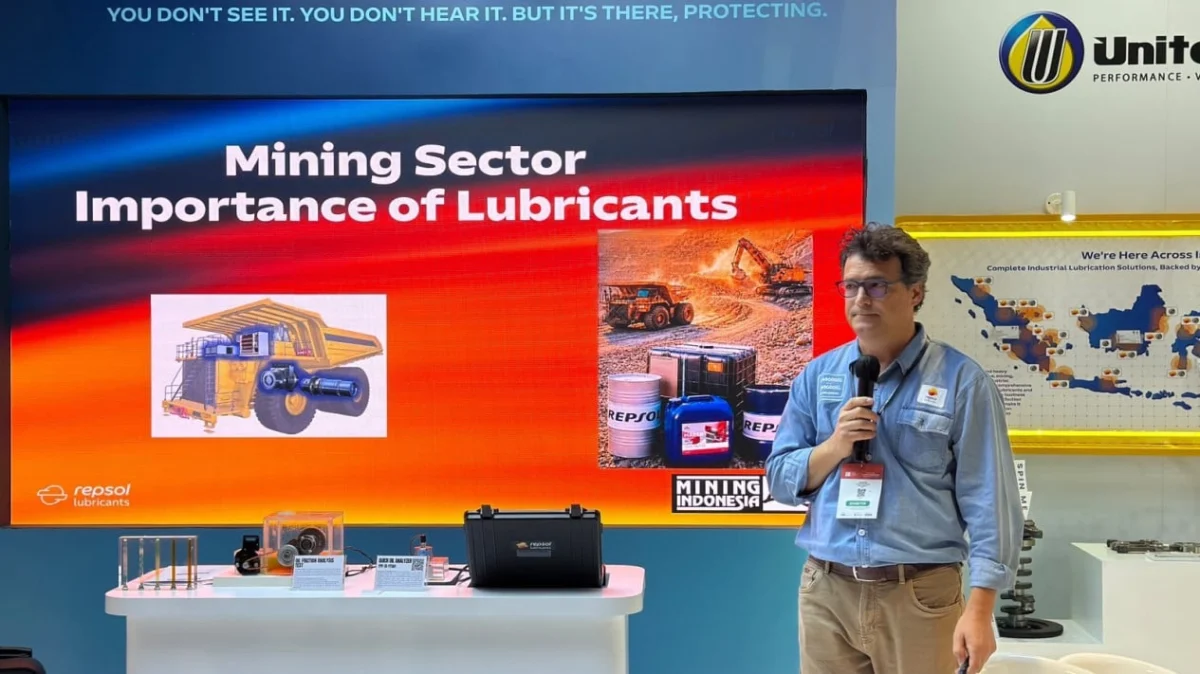
Jakarta — The ongoing evolution of Indonesia’s national energy policy toward higher biodiesel blend mandates is profoundly transforming operational dynamics across heavy industries, particularly within the energy and mining sectors. As equipment operators transition to fuel formulations featuring elevated palm oil methyl ester concentrations—such as the increasingly prevalent B50 standard—the maintenance regimes governing heavy-duty diesel engines are undergoing a critical reassessment. This paradigm shift took center stage during the Mining Indonesia 2026 exhibition, held from September 9 to September 12, 2026, at the Jakarta International Expo (JIExpo) in Kemayoran, Central Jakarta.
Amidst the massive display of earthmoving machinery, drilling rigs, and haul trucks, Repsol Lubricants Indonesia, in strategic collaboration with United Oil, used the prominent industrial platform to address the complex lubrication challenges introduced by modern fuels. The company drew heavy industry attention to its specialized heavy-duty diesel engine oil portfolio, spearheaded by the Repsol DXR 8 SAE 15W-40 API CI-4, engineered specifically to withstand the grueling operational conditions typical of remote mining sites while simultaneously mitigating the distinct chemical byproducts of high-blend biodiesel combustion.
Background and Context of Mining Indonesia 2026
Marking its milestone 24th edition, Mining Indonesia 2026 stands as one of Southeast Asia’s largest and most influential international mining equipment exhibitions. The annual four-day trade convergence successfully brought together a vast ecosystem of global industry stakeholders, ranging from original equipment manufacturers (OEMs) and heavy machinery giants to specialized component suppliers, technology providers, and thousands of operational end-users.
The 2026 installment arrived at a crucial juncture for the Indonesian mining sector. Mining companies face mounting dual pressures: the necessity to ramp up operational productivity and output to meet global mineral demands, and the regulatory mandate to comply with aggressive environmental standards, including the gradual nationwide adoption of higher biodiesel blends.
While these green energy policies successfully reduce greenhouse gas emissions and lower national dependency on imported fossil fuels, they inherently alter the chemical and physical environment inside internal combustion engines. Consequently, traditional lubrication strategies that sufficed under lower biodiesel mixtures or pure petroleum diesel are no longer fully adequate. Fluid engineering must now adapt to unique combustion behaviors, increased moisture affinity, and higher particulate loading characteristic of fuels containing up to 50 percent fatty acid methyl esters (FAME).
The Technical Challenge of Biodiesel Blends in Heavy-Duty Engines
The core issue facing fleet managers in the mining sector revolves around the chemical and combustion characteristics of higher biodiesel blends, colloquially observed through scenarios involving B30, B40, and the forward-looking B50 mandates. Biodiesel inherently possesses different solvent properties, a higher flash point, and distinct combustion profiles compared to conventional diesel fuel.
When high-blend biodiesel is injected into heavy-duty diesel engines operating under extreme, continuous loads—such as those encountered by 100-ton haul trucks or massive excavators in open-pit mines—it can lead to accelerated lubricant degradation. Specifically, the combustion process tends to generate higher levels of soot, carbonaceous deposits, and acidic byproducts. If left unmanaged, these contaminants can agglomerate, significantly increasing oil viscosity, accelerating abrasive wear on critical engine components like piston rings, liners, and valve trains, and ultimately leading to premature engine failure or catastrophic downtime.
To combat these severe operational threats, modern heavy-duty lubricants must possess advanced chemical formulations capable of neutralizing contaminants before they can form damaging varnish or sludge.
Repsol DXR 8 SAE 15W-40 API CI-4: Engineering for Extremes
Addressing these technical hurdles at JIExpo Kemayoran, Repsol showcased its flagship heavy-duty lubricant solution tailored for demanding industrial applications: the Repsol DXR 8 SAE 15W-40 API CI-4.
Alejandro Werd Alonso, Head of Marketing at Repsol Lubricants Indonesia, emphasized that the mining industry demands a specialized approach to lubrication that transcends standard automotive maintenance parameters.
"The mining industry has highly specific operational needs, especially when equipment must operate in grueling conditions and requires exceptionally high reliability," Alonso stated in an official release issued on Saturday, September 12, 2026. "Choosing a lubricant is no longer just about selecting a basic product off the shelf; it requires meticulous alignment with the specific application, environmental stressors, and operational duty cycles of heavy equipment."
The technical efficacy of the Repsol DXR 8 formulation lies in its sophisticated balance of detergent and dispersant additives. While both components work in tandem within the fluid matrix, they serve distinctly separate yet complementary functions inside a running engine.
Detergent additives are chemically engineered to neutralize acidic combustion byproducts and actively scrub high-temperature metal surfaces clean. They prevent the formation of lacquer and high-temperature deposits on piston crowns and cylinder walls, thereby maintaining optimal thermal transfer and sealing efficiency.
Conversely, dispersant additives perform a vital suspension role. They envelop microscopic solid contaminants—primarily soot and carbon particles generated during the combustion of biodiesel—and keep them uniformly suspended within the body of the oil rather than allowing them to clump together into large, abrasive agglomerates. Once securely suspended, these neutralized particulates are successfully routed through the engine’s full-flow oil filtration system, where they are safely removed before they can score metal bearings or accelerate mechanical wear.
The Critical Role of API CI-4 Specifications in the Era of B50
As fleet operators navigate the operational realities of B50 fuel, matching oil specifications to fuel chemistry has become a primary pillar of preventative maintenance. The API CI-4 specification, which governs the performance standards of the Repsol DXR 8 formulation, holds particular relevance in this shifting technological landscape.
API CI-4 oils are specifically formulated for high-speed, four-stroke engines designed to meet 2004 exhaust emission standards, implemented to handle severe-duty applications utilizing diesel fuels with varying sulfur and biofuel content. These oils are exceptionally effective at sustaining engine durability where exhaust gas recirculation (EGR) and other emission-control technologies are deployed, and they provide superior control over soot thickening, high-temperature piston deposits, oxidative wear, and corrosive ring wear.
"API CI-4 serves as a crucial performance benchmark that fleet managers and maintenance engineers must pay close attention to, particularly within the context of utilizing high-blend biodiesel such as B50," Alejandro Werd Alonso explained. "By maintaining proper viscosity stability and exceptional soot-handling capabilities, this specification helps protect capital-intensive mining assets against the accelerated degradation risks associated with alternative fuel deployment."
Broader Industry Implications and Future Outlook
The proactive positioning by lubricant manufacturers at Mining Indonesia 2026 reflects a broader, highly necessary evolution across Indonesia’s heavy industrial landscape. As the government continues to refine and advance its mandatory biofuel roadmap, the mechanical interface between fuel, lubricant, and metallurgy will face unprecedented scrutiny.
For mining corporations operating in remote, high-altitude, or tropical rainforest environments across the archipelago, unplanned equipment downtime translates directly into catastrophic financial losses. A single disabled haul truck can paralyze an entire production shift, delaying the transport of thousands of tons of coal, nickel, gold, or copper. Consequently, maintenance departments are shifting away from reactive repair models toward highly sophisticated predictive and preventative strategies, where lubricant condition monitoring and advanced fluid selection play the starring role.
Furthermore, the insights shared during the four-day exhibition underscore the vital importance of cross-sector collaboration. Original Equipment Manufacturers, fuel distributors, and lubricant chemists must work in lockstep to ensure that machinery designed years ago can successfully bridge the gap to future fuel mandates without sacrificing operational efficiency, fuel economy, or asset lifespan.
As Mining Indonesia 2026 concluded on Saturday evening, September 12, 2026, the overarching takeaway for the industrial community was clear. The energy transition is not merely a policy shift confined to fuel depots and government decrees; it requires a holistic, deeply technical recalibration of every mechanical component that touches the fuel supply chain. Through advanced fluid technologies like Repsol DXR 8, the lubricant sector is demonstrating its readiness to support heavy industry through the complex challenges of the B50 era, ensuring that productivity, reliability, and mechanical longevity remain uncompromised in the face of rapid environmental evolution.