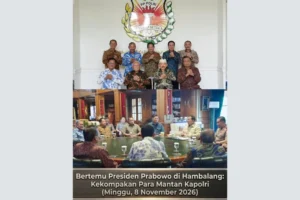
President Prabowo Subianto convened a high-level strategic meeting with ten former Chiefs of the Indonesian National Police (Kapolri) at his private residence in Hambalang, Bogor Regency, West Java. The gathering, which took place on Sunday evening, November 8, served as a crucial forum for cross-generational leadership dialogue, strategic consultation, and the exchange of perspectives on pressing national and international developments.
The meeting occurred against the backdrop of a massive, unprecedented national security investigation: an alleged illegal wiretapping and unauthorized electronic transaction syndicate that has rocked the upper echelons of the country’s law enforcement apparatus. The scandal has dramatically implicated several high-ranking police generals, most notably former Kapolri Listyo Sigit Prabowo, who has since been named a primary suspect by the Criminal Investigation Agency (Bareskrim).
According to an official press release issued by the Bureau of Press, Media, and Information of the Presidential Secretariat, the meeting was structured to leverage the accumulated wisdom and institutional memory of former police commanders. Current National Police Chief General Suyudi Ario Seto was also in attendance, alongside key members of President Prabowo’s inner security circle, including Minister of Defense Sjafrie Sjamsoeddin, Minister of State Secretary Prasetyo Hadi, Cabinet Secretary Teddy Indra Wijaya, and Indonesian National Armed Forces (TNI) Commander General Agus Subiyanto.
A Gathering of Police Luminaries Across Decades
The guest list at the Hambalang residence represented a comprehensive cross-section of modern Indonesian law enforcement history. Ten former Kapolri figures attended the closed-door summit, bringing together decades of collective institutional experience.
The esteemed group of former police chiefs included:
- General (Ret.) Roesmanhadi
- General (Ret.) Roesdihardjo
- General (Ret.) Surojo Bimantoro
- General (Ret.) Da’i Bachtiar
- General (Ret.) Sutanto
- General (Ret.) Bambang Hendarso Danuri
- General (Ret.) Timur Pradopo
- General (Ret.) Sutarman
- General (Ret.) Badrodin Haiti
- General (Ret.) Tito Karnavian, who currently serves in President Prabowo’s cabinet as the Minister of Home Affairs.
Political analysts note that assembling such a formidable cohort of former security leaders underscores the gravity of the institutional crisis currently facing the Indonesian National Police (Polri). By engaging these senior figures, the administration aims to reinforce institutional stability, maintain internal cohesion within the paramilitary police force, and project a unified front during a period of acute vulnerability.
The Epicenter of the Crisis: High-Level Wiretapping Scandal
While the official readout of the Hambalang meeting emphasized broad strategic consultations and cross-generational leadership exchanges, diplomatic and political observers widely acknowledge that the timing of the summit was directly linked to the burgeoning wiretapping scandal unfolding within Bareskrim.
The investigation came to light following the discovery of a sophisticated, systemic unauthorized interception operation targeting high-profile public officials, state ministers, prominent political figures, business moguls, media executives, and influential community leaders. Investigators confirmed that President Prabowo Subianto himself was among the primary targets of this illicit surveillance network.
The magnitude of the breach has sent shockwaves through Indonesia’s political establishment, raising serious concerns regarding national security, cyber intelligence vulnerabilities, and the abuse of state apparatus resources for unauthorized surveillance. The involvement of top-tier active and retired law enforcement officials has transformed the investigation into one of the most severe institutional crises in the modern history of the Indonesian police force.
Criminal Charges and Detentions
Following extensive forensic digital analyses and intelligence gathering, Bareskrim formally announced the designation of several high-ranking officers as suspects in the illegal wiretapping and electronic information manipulation case.
At the center of the criminal allegations is former Kapolri Listyo Sigit Prabowo. Alongside him, investigators named three other high-ranking police officers as suspects:
- Irjen Pol Ahrie Sonta Nasution, serving as the Head of the Legal Division (Kadivkum) of the National Police.
- Irjen Eko Hadi Santoso, holding the position of Principal Police Educator TK1 at Sespim Lemdiklat Polri.
- Irjen Slamet Uliandi, former Head of the Information and Communication Technology Division (Kadiv TIK) of the National Police.
Legal proceedings moved swiftly following the announcement. Bareskrim confirmed that former Kapolri Listyo Sigit Prabowo, Irjen Ahrie Sonta, and Irjen Eko Hadi Santoso have been placed in formal detention at the Mobile Brigade (Mako Brimob) detention center in Kelapa Dua, Depok, West Java.
Meanwhile, Irjen Slamet Uliandi has not been detained due to ongoing medical treatments for a serious health condition, though police investigators have stressed that his legal status remains unchanged and he will be subjected to standard detention protocols upon medical clearance.
Statutory Violations and Penalties
The legal framework applied by Bareskrim reflects the severity of the offenses, which span national security statutes, criminal code provisions, and electronic transaction laws. The suspects face multiple severe charges under Indonesian law:
- Article 258 of Law Number 1 of 2023 concerning the Criminal Code (KUHP): Addressing unauthorized acts against state secrets and systemic intelligence breaches, carrying a maximum penalty of 10 years imprisonment.
- Article 332 Paragraph (1) and/or Paragraph (2) of the KUHP: Pertaining to the unlawful intrusion into restricted communication channels and privacy violations, carrying a maximum sentence of 6 years imprisonment.
- Article 31 Paragraph (1) of Law Number 19 of 2016 amending Law Number 11 of 2008 on Information and Electronic Transactions (ITE Law): Specifically governing the illegal interception, wiretapping, and alteration of electronic information and documents, carrying an alternative maximum penalty of 8 years imprisonment.
Legal experts point out that the cumulative nature of these charges could result in substantial prison terms if convictions are secured in a court of law, setting a formidable legal precedent for accountability regarding state surveillance powers.
Broader Implications for State Security and Institutional Reform
The convergence of a presidential consultation with former police chiefs and the simultaneous arrest of a former Kapolri highlights a critical juncture for Indonesian statecraft. The scandal tests the resilience of the nation’s democratic checks and balances, the integrity of its law enforcement institutions, and the absolute necessity of civilian oversight over intelligence and surveillance capabilities.
For President Prabowo’s administration, navigating this crisis requires a delicate balancing act. On one hand, the government must demonstrate an uncompromising commitment to the rule of law, ensuring that no individual—regardless of past rank or institutional prominence—is immune from criminal prosecution. On the other hand, the administration must insulate the broader operational capacity of the National Police from political destabilization, ensuring that frontline public safety and national security remain uncompromised.
The advisory role played by the ten former police chiefs in Hambalang may provide the strategic scaffolding necessary to implement internal reforms, restore public trust in the police force, and establish rigorous safeguards against the future weaponization of intelligence assets. As the legal proceedings in Bareskrim progress toward trial, the nation watches closely to see how institutional accountability will reshape the future of Indonesia’s security architecture.