The investigation into a catastrophic traffic accident in Bekasi has intensified as local authorities confirmed the detention of the driver involved in a collision that claimed the lives of six pedestrians. The incident, which occurred on the afternoon of Sunday, November 1, 2026, on Jalan Cut Mutia in the Sepanjang Jaya sub-district of Rawalumbu, has sent shockwaves through the local community and prompted a high-level review of road safety protocols for heavy vehicles in urban corridors.
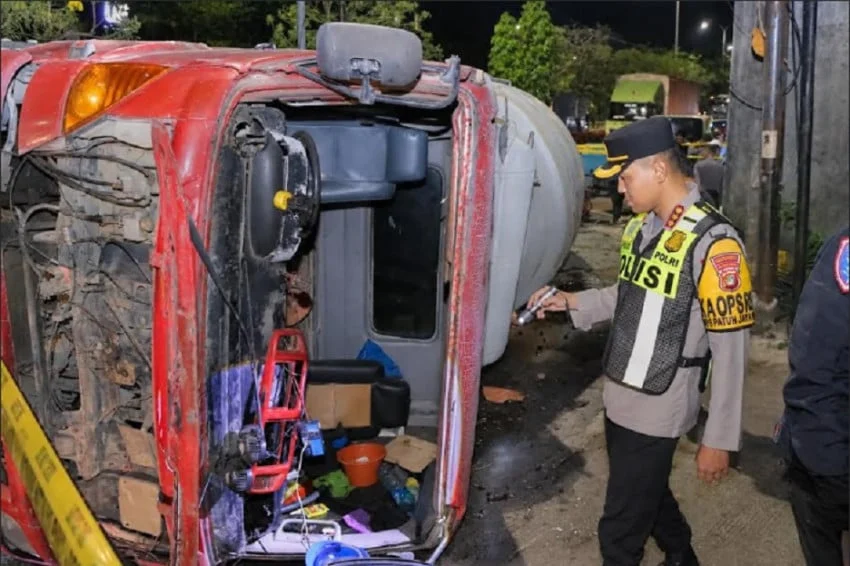
According to official reports from the Polres Metro Bekasi Kota (Bekasi City Metropolitan Police), the driver, identified by the initials TM, was taken into custody shortly after the incident. The truck, a large cement mixer, reportedly experienced a mechanical failure—specifically identified by initial findings as a brake system malfunction—before losing control, overturning, and plowing into a crowd of bystanders. The collision resulted in a high casualty count, with six individuals declared dead at the scene and an additional six suffering from varying degrees of injuries, requiring immediate transport to local medical facilities.
Chronology of the Incident
The sequence of events began on Sunday afternoon as the cement mixer was traversing the busy thoroughfare of Jalan Cut Mutia. This specific route is a major arterial road frequently used by heavy transport vehicles moving between industrial zones and construction sites. Witnesses at the scene reported hearing the sound of grinding metal followed by the heavy vehicle swerving erratically before it tipped onto its side.
The momentum of the heavy truck carried it into a pedestrian area where a group of people had gathered. Emergency responders from the Bekasi City Fire and Rescue Department and the local police force arrived shortly after the distress calls were placed at approximately 4:00 PM. Paramedics worked to stabilize the survivors, while police cordoned off the area to manage the resulting traffic gridlock and begin the preliminary investigative work.
By Sunday evening, the truck had been secured as primary evidence, and the driver, TM, was moved to the police station for interrogation. On Monday morning, November 2, 2026, the investigation moved into a more technical phase, with the arrival of the Traffic Accident Analysis (TAA) team from the Jakarta Metropolitan Police (Polda Metro Jaya).
Scientific Investigation and Official Response
Kapolres Metro Bekasi Kota, Kombes Pol Putu Kholis Aryana, emphasized that the police force is committed to a rigorous and transparent investigation. "The Unit for Law Enforcement (Gakkum) of the Bekasi City Traffic Police has apprehended the driver and secured the vehicle as evidence," Putu Kholis stated during a press conference held on Monday.
The police are currently employing "scientific crime investigation" methods to reconstruct the incident. This approach includes:
- Digital Forensic Analysis: Reviewing closed-circuit television (CCTV) footage from surrounding businesses and traffic monitoring cameras to determine the velocity of the vehicle leading up to the mechanical failure.
- Technical Inspection: A comprehensive audit of the truck’s braking system and maintenance logs to determine whether the "rem blong" (brake failure) was caused by a lack of routine maintenance, systemic mechanical defects, or driver negligence.
- Witness Statements: Corroborating testimonies from survivors and bystanders who witnessed the vehicle’s behavior in the moments preceding the crash.
"This tragedy will be investigated thoroughly and transparently," said Putu Kholis. "Every decision we make will be grounded in the facts revealed by our technical teams. This is a matter of public accountability, both to the victims’ families and to the wider community that utilizes these roads daily."
The Persistent Threat of Heavy Vehicles in Urban Areas
The tragedy in Rawalumbu serves as a grim reminder of the risks posed by heavy machinery in dense urban environments. Bekasi, as a satellite city to Jakarta, serves as a logistics hub, meaning thousands of cement mixers, dump trucks, and cargo vehicles share the road with motorcycles, public transportation, and pedestrians daily.
Data from the Indonesian National Police (Polri) Traffic Corps (Korlantas) indicates that mechanical failure, particularly brake malfunction, remains one of the leading causes of fatal accidents involving heavy vehicles. Often, these failures are linked to "over-dimension and over-loading" (ODOL) practices, where vehicles are pushed beyond their engineering limits to maximize logistical output. While it is yet to be determined if the truck involved in this incident was carrying an excessive load, the incident has reignited the public debate regarding the enforcement of vehicle weight limits and the frequency of mandatory roadworthiness inspections (KIR).
Public Safety and Infrastructure Implications
The accident has triggered calls from urban planning experts and community advocates for stricter zoning and operational hours for heavy vehicles. Residents of the Sepanjang Jaya area have long expressed concerns about the heavy traffic volume on Jalan Cut Mutia, which serves as a vital artery but lacks physical barriers or adequate buffer zones to separate heavy transport from pedestrian zones.
"When a vehicle of that mass experiences mechanical failure, the consequences are almost always catastrophic," noted a local transportation analyst. "We need to look beyond the individual driver’s responsibility. We must ask whether our infrastructure can safely accommodate such high-tonnage vehicles during peak hours and whether the surveillance of vehicle maintenance standards is sufficiently robust."
In response to the public outcry, the Bekasi City administration is expected to collaborate with the transportation department to conduct a review of existing traffic management policies. This may include stricter enforcement of the prohibition of heavy trucks on specific roads during high-density hours and a potential audit of regional logistics companies operating within the city limits.
Legal Status and Future Proceedings
As of Tuesday, November 3, the legal status of the driver, TM, remains under evaluation. Police officials have indicated that while the driver is in custody, a formal determination of charges will follow the completion of the TAA reconstruction. Under Indonesian law, particularly the Law on Traffic and Road Transportation (UU LLAJ), drivers involved in fatal accidents due to negligence or failure to maintain vehicle roadworthiness can face severe criminal penalties, including multi-year prison sentences.
The TAA team’s report is expected to be a decisive factor in the prosecutor’s final assessment. The report will likely categorize the event as either an unavoidable mechanical failure or a consequence of preventable neglect. If negligence—such as ignoring signs of mechanical degradation—is found, it could lead to charges against not only the driver but potentially the maintenance supervisors or the company responsible for the vehicle’s operation.
Supporting the Victims
The local government and social services agencies have mobilized to assist the families of the victims. Counseling services are being provided to the survivors, and discussions regarding compensation and funeral arrangements are currently underway. The sudden loss of six lives has devastated the local community, and vigils were held near the site of the crash on Monday night, with citizens calling for improved safety measures to prevent a recurrence of such a tragedy.
"Our focus remains on justice for the families affected by this terrible event," said a representative from the local district office. "We are coordinating with the police to ensure that all administrative and legal support is provided to the victims’ relatives throughout this difficult time."
Conclusion
The Rawalumbu tragedy stands as a sobering case study on the intersection of logistics, urban safety, and mechanical maintenance. As the investigation progresses under the watchful eye of the public and the media, the findings from the scientific analysis of the truck’s wreckage will be pivotal.
For the residents of Bekasi, the incident serves as a stark call to action. The demand for safer roads, more stringent enforcement of transport regulations, and a re-evaluation of how heavy industry integrates with residential life has reached a critical juncture. While the legal process will eventually determine the culpability of those involved, the long-term impact of this event will be measured by whether it prompts the systemic changes necessary to ensure that such a disaster does not happen again. The police investigation continues, and further updates are expected as the TAA findings are processed and the legal case moves toward the courts.