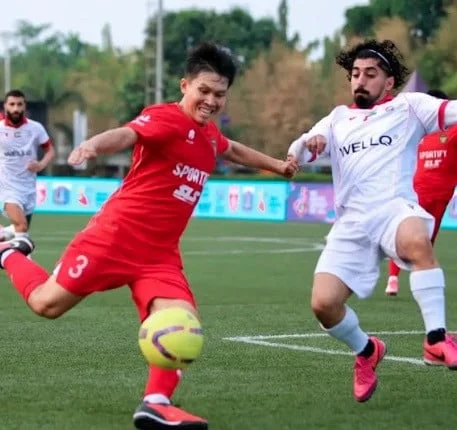
The Indonesian National Minifootball Team has officially shifted its strategic focus toward the upcoming World Minifootball Federation (WMF) World Championship 2027, following a commendable yet challenging campaign at the Asian Minifootball Championship (AMNC) Asia Cup 2026. Although the Garuda squad missed out on a podium finish after a 0-3 defeat to the United Arab Emirates in the third-place playoff at the ASIOP Stadium in Jakarta on Friday, September 18, 2026, the tournament served as a vital stepping stone for the nation’s emergence in the global minifootball landscape.
By securing a berth in the tournament’s semi-finals, Indonesia successfully achieved its primary objective: qualification for the 2027 WMF World Championship, which is scheduled to take place in the Czech Republic. The accomplishment marks a historic milestone for Indonesian minifootball, validating the domestic development programs and setting the stage for rigorous preparations ahead of the global showcase.
Main Facts and Tournament Conclusion
The conclusion of the AMNC Asia Cup 2026 in Jakarta highlighted both the immense potential and the remaining competitive gaps within the Indonesian squad. In the third-place playoff held at ASIOP Stadium, the host nation faced a formidable opponent in the United Arab Emirates. Despite strong tactical organization and fervent support from local supporters, the Indonesian team struggled to convert their scoring opportunities, ultimately falling 0-3.
Nevertheless, finishing fourth among Asia’s elite minifootball nations represents a notable achievement for the program. The continental tournament gathered top-tier teams from across Asia, providing a fierce competitive environment that tested the physical endurance, tactical adaptability, and mental resilience of every participating roster. More importantly, the qualification for the Czech Republic-bound World Cup ensures that Indonesian athletes will gain invaluable exposure against traditional powerhouses from Europe, the Americas, and Africa.
Chronology of the Garuda Campaign
Indonesia’s journey throughout the AMNC 2026 tournament was characterized by dominant performances in the group stage, followed by high-stakes encounters in the knockout rounds. The Garuda squad commenced their Group A campaign with an emphatic statement, dismantling Bangladesh by a score of 8-1. The comprehensive victory immediately established Indonesia as a serious contender in the tournament, showcasing fluid offensive transitions and clinical finishing.
In their second fixture, Indonesia was awarded a walkover victory (5-0) against Iraq after the opposing team failed to arrive at the venue. While unconventional, the administrative win added crucial points to Indonesia’s group standing. Momentum continued to build in the third fixture, where the Red and White squad produced their most dominant offensive display of the tournament, routing India 9-0. The resounding victory effectively secured Indonesia’s progression to the knockout stages ahead of schedule.
However, the final match of the group stage presented a significant hurdle. Facing regional rivals Thailand, the Indonesian side encountered a well-drilled defensive block that neutralized their usual attacking threats. Thailand narrowly edged past Indonesia with a 1-0 victory, claiming the top spot in Group A with a flawless 12 points, while Indonesia settled for second place with nine accumulated points.
Finishing as the Group A runner-up set up a challenging semi-final showdown against a tactically disciplined Uzbekistan side. Although the details of the semi-final encounter tested the physical and strategic limits of the Indonesian players, the broader implication of reaching that stage—securing the WMF World Championship ticket—remained the defining achievement of the tournament.
Technical Evaluation and Strategic Adjustments
Following the conclusion of the tournament, Head Coach Indra Kurnia Purnomo emphasized the necessity of a comprehensive and rigorous evaluation process. Speaking to media representatives in Jakarta on Friday, September 18, 2026, Indra underscored that the coaching staff would not limit their assessments to basic tactical refinements, but would instead conduct a deep-dive analysis of all structural elements within the team.
"Evaluation is a certainty, yes, and it is not just related to set pieces. There are many elements that we must evaluate in order to elevate our level for the 2027 World Cup," Indra stated.
The technical staff’s focus on holistic improvement stems from the recognition that the global stage demands a higher standard of execution. Minifootball, played with high-intensity small-sided rules, requires exceptional aerobic capacity, rapid decision-making, and specialized tactical setups that differ significantly from traditional eleven-a-side association football. Areas identified for potential improvement include defensive transition speed, high-press resistance, spatial awareness in compact defensive blocks, and psychological composure during high-pressure knockout matches.
Broader Context of Minifootball in Indonesia
The growth of minifootball in Indonesia has accelerated significantly over recent years, driven by structured domestic competitions and increased institutional backing from the national governing body. Unlike traditional football, which operates under FIFA’s massive global infrastructure, minifootball is governed globally by the World Minifootball Federation (WMF) and regionally by the Asian Minifootball Confederation (AMC). The sport typically features matches played with six to seven players per side on artificial turf pitches surrounded by boards or touchlines, creating a fast-paced viewing experience that has captured the interest of urban sports enthusiasts across the archipelago.
Hosting the AMNC Asia Cup 2026 in Jakarta served as a crucial catalyst for promoting the sport domestically. The tournament not only provided local athletes with competitive international experience without leaving home soil, but it also raised public awareness regarding the distinct rules, culture, and competitive ecosystem of professional minifootball.
Broader Impact and Implications for WMF World Championship 2027
The qualification for the 2027 WMF World Championship in the Czech Republic carries profound implications for the future of the sport in Indonesia. Competing against the world’s best minifootball nations will provide an unprecedented benchmark for the country’s athletic development.
From an administrative perspective, the extended preparation window leading up to 2027 allows the national federation to design a comprehensive roadmap. This preparation phase is expected to include centralized training camps, international friendly fixtures against other continental qualifiers, and science-based conditioning programs designed to mitigate fatigue during tournament play.
Furthermore, strong performances on the global stage can attract increased corporate sponsorship, governmental support, and grassroots participation. As Indonesia transitions from a regional competitor to a global participant, the lessons learned from the AMNC 2026 campaign—particularly the tactical vulnerabilities exposed by teams like Thailand and the UAE—will serve as invaluable lessons. With a clear roadmap, dedicated coaching leadership, and a confirmed ticket to the Czech Republic, the Indonesian National Minifootball Team enters a new era of international ambition.