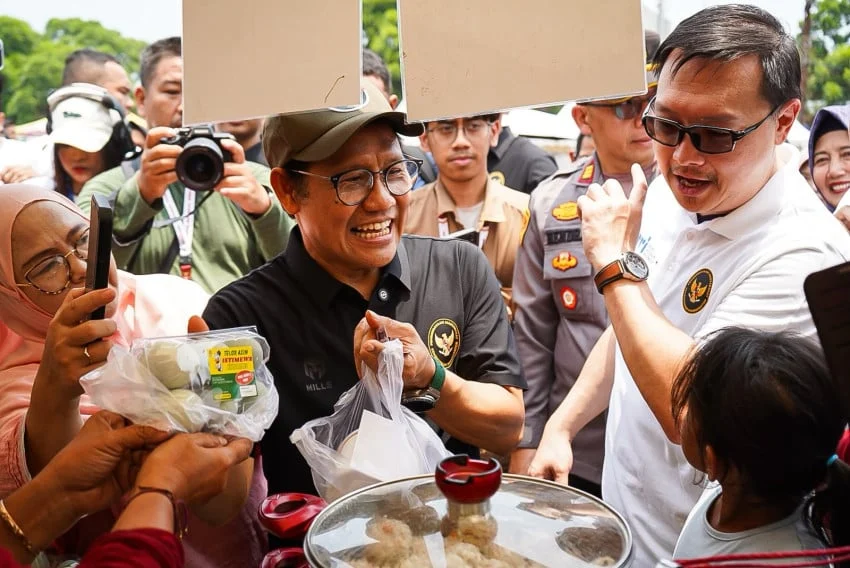
The Coordinating Ministry for Community Empowerment (Kemenko PM) has officially forged a strategic partnership with the State-Owned Public Broadcasting Institution Radio Republik Indonesia (LPP RRI) to expand market accessibility and fortify the capacity of local micro, small, and medium enterprises (MSMEs). This collaborative initiative was officially unveiled during the RRI Fest held in Bogor Regency, West Java, featuring the flagship "1001 Pasar Rakyat" program alongside an intensive Social Media Optimization Workshop. The comprehensive event successfully engaged dozens of local entrepreneurs, marking a critical milestone in the government’s ongoing crusade to drive national economic resilience from the grassroots level up.
The high-profile event, which took place on Saturday, September 19, 2026, brought together key government officials, media executives, and regional business owners. At its core, the initiative seeks to bridge the persistent gap between small-scale producers and broader consumer markets by leveraging the extensive public broadcasting network and community reach of RRI. By transforming traditional media platforms into active commercial catalysts, the government aims to ensure that promotional events translate directly into tangible, long-term economic benefits for local business operators.
Chronology and Implementation of the RRI Fest Empowerment Initiative
The genesis of this collaborative program stems from months of coordinated planning between the Coordinating Ministry for Community Empowerment and various public service agencies aiming to revitalize post-pandemic local commerce. Leading up to the Saturday event, regional committees conducted a rigorous curation process to identify high-potential MSMEs within Bogor Regency and its surrounding areas.
On the day of the event, the initiative was bifurcated into two primary operational tracks: a curated commercial bazaar and a targeted capacity-building workshop. Out of a vast applicant pool, exactly 55 meticulously curated MSME operators were granted prime booth space to showcase and sell their products directly to the public. Concurrently, a separate cohort of 100 local business owners participated in a specialized workshop dedicated to digital marketing, e-commerce integration, and social media optimization.
This structured rollout was intentionally designed to reflect a holistic approach to enterprise development. Rather than merely offering a temporary sales venue, the program linked theoretical digital training with immediate practical execution, allowing participants to apply newly acquired online marketing strategies to customers visiting the physical bazaar.
Strategic Vision and Official Statements
Coordinating Minister for Community Empowerment A. Muhaimin Iskandar, who personally oversaw the launch of the program in Bogor, emphasized the philosophical shift in how the government approaches grassroots economic empowerment. According to the Minister, public platforms—particularly those managed by state media institutions—must evolve beyond mere entertainment or news dissemination to actively serve as commercial meeting grounds for local producers and consumers.
"We want the stages and platforms already owned by media institutions to serve as rooms where community products meet the market," Minister Muhaimin stated during his keynote address at the event. "Therefore, it is not just about the event being lively and crowded, but ensuring there is a real, measurable economic benefit felt directly by the business actors."
Minister Muhaimin further elaborated on the sequential framework required for sustainable economic development. He underscored that a commercial bazaar should never be viewed as an isolated event, but rather as the ultimate culmination of a rigorous developmental pipeline.
"The bazaar is the estuary of empowerment," Muhaimin explained. "After the community is trained, mentored, and guided in production standards, we must ensure that their products actually have a market destination. It is precisely at that intersection where empowerment successfully generates true economic independence."
Addressing the broader structural challenges faced by Indonesian enterprises, the Minister highlighted that the synergy with RRI represents an invaluable asset. With RRI stations operating in virtually every corner of the archipelago, the public broadcaster possesses the localized infrastructure necessary to replicate and scale the 1001 Pasar Rakyat model nationwide.
Broader Context and Alignment with National Development Goals
The launch of the 1001 Pasar Rakyat program in Bogor does not occur in a vacuum; it is part of a broader, synchronized policy framework spearheaded by the Coordinating Ministry for Community Empowerment. In recent months, the ministry has rolled out complementary initiatives—such as the Perintis Berdaya Connect program—designed to accelerate the graduation of grassroots enterprises into higher tiers of commercial viability.
Data from national economic agencies consistently highlight that MSMEs form the backbone of the Indonesian economy, contributing significantly to the Gross Domestic Product (GDP) and absorbing the vast majority of the national workforce. However, structural impediments—such as limited digital literacy, restricted access to formal financing, and narrow distribution channels—have historically hindered these enterprises from scaling up.
By integrating traditional community spaces with modern digital marketing workshops, the Kemenko PM and RRI initiative directly targets these structural bottlenecks. The Social Media Optimization Workshop component, in particular, addresses the digital divide that prevents rural and semi-urban businesses from tapping into the lucrative e-commerce ecosystem. Through targeted instruction on algorithmic visibility, content creation, and online customer engagement, participants are equipped to transcend geographical limitations and market their goods to a national, if not global, audience.
Implications and Future Outlook for Indonesian MSMEs
The long-term implications of the Kemenko PM and RRI collaboration extend far beyond the immediate commercial success of the Bogor bazaar. Analysts and economic observers note that utilizing state media as an economic development engine creates a highly cost-effective and scalable model for regional growth.
By embedding economic empowerment into the operational mandate of public broadcasting, the government ensures continuous institutional support for local businesses. The strategy relies on a continuous feedback loop: identifying local economic potential, providing intensive capacity-building workshops, optimizing digital outreach, and finally securing physical and virtual market access.
Moving forward, the Coordinating Ministry for Community Empowerment intends to evaluate the metrics from the Bogor pilot project to refine the curriculum and logistical framework of the 1001 Pasar Rakyat program. Success will be measured not merely by the short-term transaction volume recorded during event days, but by the sustained growth in revenue, asset accumulation, and digital adoption rates among participating enterprises over a six-to-twelve-month horizon.
Ultimately, the initiative underscores a renewed governmental commitment to fostering self-reliance at the community level. As state institutions continue to pool their resources and infrastructural reach, programs like 1001 Pasar Rakyat offer a promising blueprint for transforming Indonesia’s vibrant informal economy into a resilient, digitized, and globally competitive commercial force.