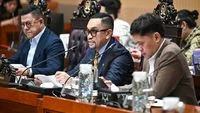
The political landscape in Jakarta continues to experience dynamic shifts as legislative factions navigate complex debates surrounding executive governance, electoral integrity, and high-profile state officials. Ahmad Sahroni, Treasurer-General of the NasDem Party, has formally responded to an initiative proposed by the Prosperous Justice Party (PKS) regarding inter-party communications over the ongoing controversy concerning the educational credentials of Vice President Gibran Rakabuming Raka. Speaking at the Parliament Complex in Jakarta, Sahroni clarified that the party leadership has not issued any instructions to engage in discussions regarding the high-profile debate, emphasizing that internal directives remain strictly focused on executive support and urgent legislative priorities.
The overture from PKS represents the latest maneuver in a broader legislative conversation concerning compliance, institutional transparency, and electoral standards. As political parties calculate their positions ahead of upcoming parliamentary sessions, the divergence in strategic priorities underscores the complex interplay between oversight duties, coalition politics, and the legislative agenda in the world’s third-largest democracy.
Background and Context of the Controversy
The ongoing discourse regarding the qualifications and background of high-ranking government officials stems from a series of contested legal and administrative milestones that defined the 2024 Indonesian presidential election cycle. The scrutiny intensified following a series of legal challenges and public debates regarding constitutional requirements for executive candidates. Central to the current discourse is the enforcement of statutory prerequisites for presidential and vice-presidential candidates, specifically concerning educational equivalence and the constitutional framework governing eligibility.
Critics and opposition elements have increasingly utilized parliamentary channels to demand greater transparency regarding official credentials and the institutional processes that enabled contested candidacies. The controversy gained renewed momentum following judicial reviews and public statements from various political figures, transforming what began as social media skepticism into a formalized inter-party talking point within the House of Representatives (DPR).
Chronology of Recent Political Developments
The sequence of events leading to the current inter-party maneuvering involves several key developments across multiple political factions:
- The 2024 Electoral Cycle and Constitutional Review: The foundation of the current political friction was laid during the constitutional adjustments and subsequent candidate registrations for the 2024 national elections, notably highlighted by judicial interpretations concerning candidate requirements.
- PKS Initiative for Inter-Party Communication: Seeking to address public concerns, PKS Secretary-General Muhammad Kholid announced that the party leadership, under President Al Muzammil Yusuf, instructed parliamentary members to initiate dialogues with other factions to review the implications of the controversy surrounding the vice-presidential credentials.
- NasDem Response: On Wednesday, October 28, NasDem Treasurer-General Ahmad Sahroni publicly addressed the PKS proposal, stating that party Chairman Surya Paloh has not authorized participation in discussions regarding the issue.
- PDIP Stance and Broader Opposition: Simultaneously, Indonesian Democratic Party of Struggle (PDI-P) Secretary-General Hasto Kristiyanto voiced openness to inter-party dialogue, expanding the scope of criticism to include ethical standards, constitutional compliance, and executive accountability.
NasDem Position: Prioritizing the Asset Forfeiture Bill
During his address at the parliamentary complex, Ahmad Sahroni elaborated on the specific directives issued by NasDem Chairman Surya Paloh. According to Sahroni, the party leadership has instructed all members to concentrate their efforts on fulfilling existing coalition commitments and advancing critical legislative measures that directly impact the public interest.
"Coincidentally, within NasDem itself, the General Chairman has ordered us to continue working in accordance with applicable regulations and to provide support to the government. There are no orders for other matters," Sahroni stated.
Sahroni emphasized that the party’s primary legislative focus is the Asset Forfeiture Bill (RUU Perampasan Aset), a long-discussed anti-corruption measure that advocates view as crucial for strengthening state governance and recovering illicitly acquired wealth.
"We do not have any directives from the general chairman whatsoever; our focus is working to complete the Asset Forfeiture Bill, which is the most urgent matter," he added. By emphasizing this legislative priority, NasDem has signaled a deliberate effort to distance itself from contentious political debates that could strain its working relationship with the broader government coalition.
PKS Strategy: Bridging Public Aspirations and Electoral Evaluation
The outreach initiated by PKS reflects a calculated attempt by the opposition-leaning party to position itself as a responsive conduit for public grievances. PKS Secretary-General Muhammad Kholid explained that the party’s decision to open communication channels with other parliamentary factions stems from a desire to address public inquiries regarding institutional transparency.
According to Kholid, the discussions are intended to serve as a bridge for societal aspirations concerning governance standards. Furthermore, PKS maintains that controversies surrounding candidate qualifications should serve as a constructive catalyst for comprehensive evaluations of the national electoral system’s administrative framework. By advocating for institutional review, PKS aims to leverage the debate to promote long-term electoral reforms without necessarily forcing an immediate constitutional crisis.
PDI-P Perspective: Ethical Implications and Governance Standards
While NasDem has opted to maintain a strict focus on legislative duties, the Indonesian Democratic Party of Struggle (PDI-P) has adopted a more receptive stance toward inter-party dialogue regarding executive accountability. PDI-P Secretary-General Hasto Kristiyanto confirmed that his party is open to engaging in formal discussions with other political entities to examine the broader implications of the controversy.
Hasto broadened the critique by referencing historical milestones from the previous electoral cycle, notably Constitutional Court Decision No. 90/PUU-XXI/2023, which modified the minimum age requirements for presidential and vice-presidential candidates. Hasto asserted that the process surrounding the decision reflected underlying elements of institutional overreach.
Furthermore, Hasto connected the age-requirement controversy to statutory provisions governing educational prerequisites. He contended that public scrutiny over compliance with constitutional minimums touches upon fundamental questions of integrity.
"When these two matters have been violated—both from the aspect of age and the fulfillment of the minimum requirement for educational certificates—this already touches upon aspects of ethics, morality, and the exemplary conduct of a state official in the public eye," Hasto stated.
Broader Impact and Implications for the Indonesian Political Landscape
The divergent responses from NasDem, PKS, and PDI-P highlight the delicate balance of power and strategic positioning within the Indonesian parliament. As political parties look ahead to future electoral cycles and administrative milestones, the management of controversial topics serves as an indicator of alliance cohesion and opposition strategy.
- Coalition Dynamics: NasDem’s refusal to engage in the credential debate underscores its commitment to maintaining stability within the broader government support framework. By prioritizing economic and anti-corruption legislation like the Asset Forfeiture Bill, the party seeks to project an image of constructive governance rather than partisan confrontation.
- Parliamentary Oversight: The efforts by PKS and PDI-P to foster inter-party dialogue illustrate the ongoing utilization of legislative forums to challenge executive narratives. While formal parliamentary inquiries face structural hurdles due to the composition of the governing coalition, sustained public discourse keeps administrative scrutiny alive.
- Public Trust and Institutional Integrity: The debate over educational credentials and constitutional compliance reflects deeper public sensitivities regarding the moral authority of state officials. As civil society organizations and political factions continue to monitor governance standards, the pressure for transparent administrative procedures remains a permanent fixture of national discourse.
Conclusion
The exchange between major political parties regarding the inquiries into the vice president’s background demonstrates the multifaceted nature of contemporary Indonesian politics. While opposition and critical factions seek to leverage administrative controversies to promote electoral reform and ethical oversight, governing coalition members like NasDem remain focused on legislative output and executive support. As discussions continue within parliamentary corridors, the ultimate impact of these debates will depend on the willingness of political elites to reconcile institutional transparency with legislative productivity.