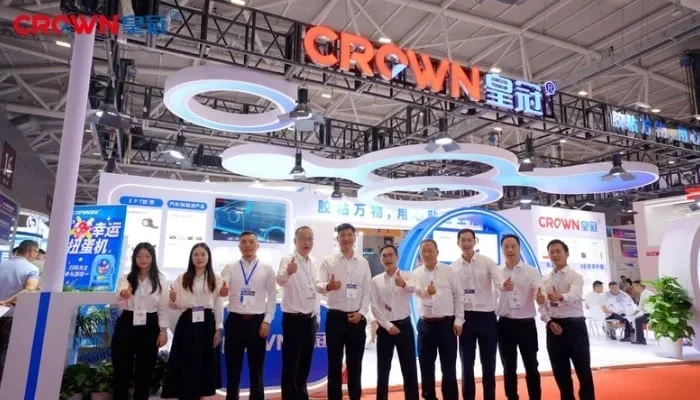
The landscape of China’s ultra-wealthy elite has seen a notable addition this week, as Michael Mai, the chairman and CEO of Crown New Materials Technology, officially attained billionaire status following his company’s stellar initial public offering (IPO) on the Shenzhen Stock Exchange. For many, Mai’s journey—from the classroom of a primary school in Zhongshan to the boardrooms of a publicly traded industrial giant—serves as a striking narrative of the Chinese economic miracle. His company, which specializes in the manufacturing of high-performance adhesive tapes and chemical materials, has become an indispensable cog in the global supply chains of industry titans, including Tesla and Apple.
A Meteoric Market Debut
The transition of Crown New Materials Technology into a publicly listed entity was marked by unprecedented investor enthusiasm. Upon its debut on the Shenzhen Stock Exchange, the company’s share price experienced a dramatic surge. Starting from an initial offering price of 16.98 yuan (approximately USD 2.55), the stock climbed to a peak of 150.58 yuan (USD 22.57) per share within the first day of trading. This represents an astonishing single-day increase of 787%, a figure that reflects both the aggressive growth projections of the company and the broader market appetite for high-tech manufacturing components.
As a major shareholder, Michael Mai saw his personal wealth escalate in tandem with this market performance. Forbes, which monitors the net worth of global entrepreneurs, has pegged Mai’s current wealth at approximately USD 2.5 billion. This valuation cements his position among China’s most affluent individuals. Notably, Mai, who is 62 years old, holds Australian citizenship and maintains permanent residency in Hong Kong, highlighting the increasingly international profile of modern Chinese industrial leaders.
From Pedagogy to Polymers: A Biographical Overview
To understand the trajectory of Michael Mai, one must look back to the turn of the millennium. Before the high-tech adhesives and the international supply chain contracts, Mai was a primary school teacher in Zhongshan, a city located in the Pearl River Delta, which serves as a central hub for China’s manufacturing sector. His transition from educator to entrepreneur occurred in 2000, a period defined by China’s rapid integration into the global economy and the lead-up to its entry into the World Trade Organization (WTO).
Mai founded Crown New Materials Technology in his home city, leveraging the region’s burgeoning industrial infrastructure. The early years of the company were characterized by a focus on niche industrial materials. Unlike many of his contemporaries who pivoted toward consumer electronics or real estate, Mai focused on the "invisible" side of manufacturing: adhesives. His products, which include specialized tapes and chemical solutions, are essential for the assembly of modern hardware, requiring high thermal stability and precision—traits that made his company a preferred vendor for global brands.
Supporting Data and Market Context
The success of Crown New Materials is not an isolated incident but rather a symptom of the specific niche in which the company operates. The global market for specialty adhesives is projected to reach significant valuation heights by 2030, driven by the proliferation of electric vehicles (EVs) and high-end consumer electronics.
The firm’s client list includes some of the world’s most valuable companies. By providing the adhesive materials that hold together the sophisticated internal components of Tesla’s battery packs and the chassis of Apple’s latest smartphone models, Crown New Materials has successfully moved up the value chain.
Key financial indicators for the company at the time of the IPO include:
- Revenue Growth: A steady double-digit increase over the last three fiscal years, fueled by the expansion of the EV market in China.
- Research and Development (R&D): The company allocates approximately 5-7% of its annual revenue to R&D, a high figure for the industrial materials sector, allowing it to maintain competitive patents against international rivals like 3M or Henkel.
- Market Positioning: With its headquarters in Zhongshan, the company benefits from low logistics costs within the Greater Bay Area, providing it with a logistical advantage over manufacturers based in Northern or Western China.
The Chronology of Success
The rise of Michael Mai and his firm can be summarized through several critical phases:
- Foundational Phase (2000–2005): Establishment of the business in Zhongshan. Initial focus on low-cost industrial tapes for the local manufacturing sector.
- Expansion Phase (2006–2015): The company begins to acquire international certifications, allowing it to compete for contracts with foreign firms. R&D centers are established to develop heat-resistant adhesives for the automotive sector.
- Integration Phase (2016–2021): Crown New Materials secures long-term procurement contracts with multinational tech giants. The company streamlines its manufacturing processes to comply with global ESG (Environmental, Social, and Governance) standards.
- Capitalization Phase (2022–2024): Preparation for the Shenzhen IPO, culminating in the historic trading day that saw the company’s valuation skyrocket.
Implications for the Chinese Manufacturing Sector
The rise of a former teacher to the ranks of the billionaire class via an industrial manufacturing firm underscores a significant shift in China’s economic identity. For decades, the Chinese economy was synonymous with low-cost labor and mass-produced consumer goods. However, companies like Crown New Materials demonstrate that the country is successfully pivoting toward "advanced manufacturing."
Analysts suggest that Mai’s success story is a model for the "specialized, refined, differential, and innovation-driven" (SRDI) enterprises that the Chinese government is currently prioritizing. By focusing on critical components—rather than the end-user product—these companies have become essential to the global economy. The "invisible champions" of China, as they are sometimes called, are proving that dominance in specific industrial segments can be as lucrative as dominating the consumer retail space.
Challenges and Future Outlook
Despite the celebratory nature of the IPO, Michael Mai faces a complex road ahead. The global supply chain is currently experiencing significant volatility, and the reliance on major clients like Tesla and Apple brings both prestige and risk. If these global giants decide to diversify their supply chains away from China due to geopolitical tensions or logistical optimization, companies like Crown New Materials may find their revenue streams under pressure.
Furthermore, the surge in share price following the IPO has invited scrutiny from market regulators. The Shenzhen Stock Exchange, like other global bourses, monitors extreme volatility closely. Maintaining a share price at such elevated levels requires consistent performance and continued innovation. Investors will be looking to see if Mai can transition from a founder-manager to a steward of a large-cap public corporation, capable of navigating the demands of shareholders and the complexities of international trade regulations.
Conclusion
The ascent of Michael Mai from a classroom in Zhongshan to the upper echelons of global wealth is a testament to the transformative power of the Chinese manufacturing sector. His story captures the essence of the modern industrialist: someone who identifies a fundamental need in the global supply chain and builds an enterprise to satisfy it with precision and scale. As Crown New Materials Technology moves into this new chapter as a publicly traded company, the world will be watching to see how this former teacher leverages his newfound capital to influence the future of industrial materials. Whether or not he can sustain this level of market valuation, his journey remains a compelling case study in the evolution of the Chinese economy—a shift from the classroom blackboard to the global stage of high-stakes industrial innovation.