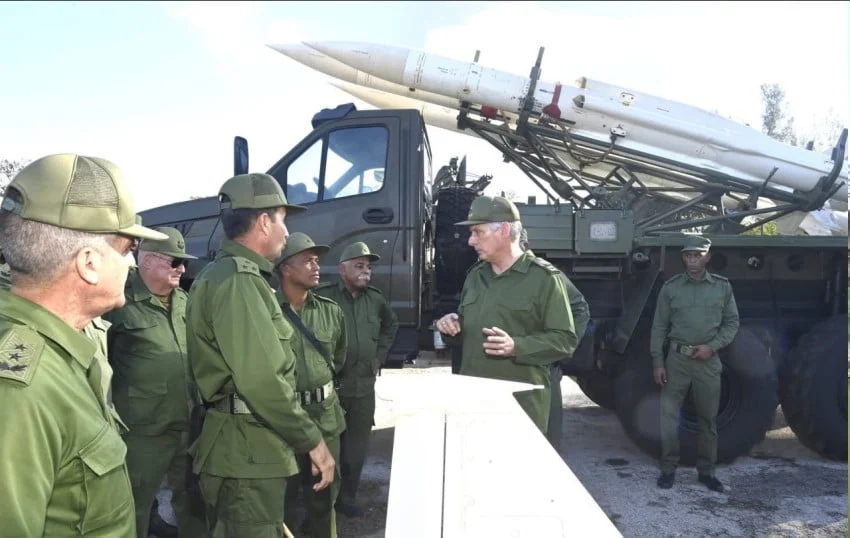
The Permanent Representative of Cuba to the United Nations, Ernesto Soberon, has formally signaled that Havana is escalating its defensive readiness in anticipation of potential military aggression from the United States. In a series of statements provided to the Russian news agency TASS, Soberon underscored that the Cuban government maintains a vigilant posture, conducting weekly defensive drills to ensure the protection of its national sovereignty, territorial integrity, and political independence. While the island nation remains entrenched in a state of high alert, its diplomatic stance reflects a complex duality: preparing for the worst-case scenario while simultaneously extending an invitation for a path toward normalization of relations with Washington.
The Strategic Context of Defensive Readiness
The directive for weekly defensive preparation is not a new phenomenon in the context of Cuban governance; however, the explicit public framing by high-level officials like Ernesto Soberon serves as a significant signal to the international community. Every Friday, civil defense exercises and military drills are carried out across the island. These exercises are designed to simulate various threats, including unconventional warfare, cyberattacks, and direct military incursions.
Soberon’s comments emphasize that these actions are not merely rhetorical but are rooted in a long-standing strategic doctrine of "War of the Whole People." This doctrine posits that in the event of an external invasion, the entire population—not just the professional military—must be prepared to resist. The current heightened alert level is being attributed to what Havana describes as the increasingly aggressive posture of the United States in the international arena, particularly concerning policies that continue to enforce the economic blockade and influence regional stability in Latin America.
Historical Chronology: A Century of Tense Relations
To understand the current tension, one must look at the historical trajectory of U.S.-Cuba relations. The following timeline outlines the pivotal moments that have defined this bilateral impasse:
- 1959: The Cuban Revolution succeeds, leading to the establishment of a socialist state under Fidel Castro.
- 1961: The Bay of Pigs invasion, a failed CIA-backed attempt to overthrow the Cuban government, cements the fear of U.S. intervention.
- 1962: The Cuban Missile Crisis brings the world to the brink of nuclear war, resulting in a fragile agreement that nonetheless solidified the U.S. embargo.
- 1996: The Helms-Burton Act is passed, codifying the U.S. trade embargo into law and making the lifting of sanctions contingent on political changes in Cuba.
- 2014-2016: The "Cuban Thaw" under the Obama administration leads to the restoration of diplomatic ties and the reopening of embassies.
- 2017-2021: The Trump administration reverses much of the progress, re-designating Cuba as a State Sponsor of Terrorism and imposing new sanctions.
- 2021-Present: Tensions remain elevated, exacerbated by post-pandemic economic distress in Cuba and persistent political rhetoric from both sides of the Florida Straits.
Data and Economic Constraints
Cuba’s defensive preparations occur against a backdrop of severe economic volatility. The island is currently facing its most significant economic crisis in decades, characterized by chronic shortages of food, fuel, and medicine. The U.S. embargo, which has remained in place for over six decades, is cited by the Cuban government as the primary driver of this stagnation.
From an analytical perspective, the cost of maintaining a high state of military readiness is substantial. Resources diverted to civil defense drills and military maintenance represent capital that is not being invested in the country’s aging electrical grid or infrastructure. Data from the Stockholm International Peace Research Institute (SIPRI) often highlights the opacity of Cuban military spending, yet it is clear that the nation’s security apparatus remains a priority for the government, even as the civilian economy struggles. The juxtaposition of a nation preparing for war while its population faces a humanitarian-level economic crisis highlights the depth of the perceived threat felt by the Cuban leadership.
The Diplomatic Paradox: Defense vs. Dialogue
Despite the bellicose rhetoric surrounding the potential for conflict, the Cuban diplomatic corps has consistently maintained that war is not the desired outcome. Ernesto Soberon emphasized in his interview that Havana remains open to engagement. "We must be prepared for any scenario, including a military one," Soberon stated, but he was quick to balance this by reiterating Cuba’s interest in a dialogue based on "mutual respect and recognition of our sovereignty."
This reflects a long-standing Cuban diplomatic strategy: maintaining a "tough" exterior to deter potential aggression while using international forums—such as the United Nations—to advocate for the removal of sanctions. From a geopolitical standpoint, this strategy aims to garner sympathy from Latin American and Caribbean partners, many of whom oppose the U.S. embargo, while signaling to the United States that regime change via military force would come at a high cost.
International Reactions and Regional Implications
The international response to these declarations has been muted but observant. Russia, which has historically maintained close ties with Havana, frequently uses such instances to highlight what it characterizes as U.S. "imperialism." Conversely, U.S. officials generally categorize these assertions from Havana as domestic propaganda designed to consolidate support during times of economic hardship.
Regional bodies, such as the Community of Latin American and Caribbean States (CELAC), have historically called for a peaceful resolution to the conflict between Washington and Havana. However, the influence of these organizations is limited by the shifting political tides in South and Central America. The potential for a renewed, albeit limited, regional arms race or increased cooperation between Cuba and global powers opposed to U.S. influence—such as Russia or China—remains a concern for regional security analysts.
Analytical Implications for Future Stability
The reality of a direct U.S. military invasion of Cuba is considered by most geopolitical experts to be highly unlikely under the current administration. However, the perception of such a threat acts as a powerful unifying force for the Cuban leadership. By framing national challenges as an existential struggle against an external enemy, the government can justify the centralization of power and the suppression of internal dissent.
For the United States, the challenge lies in balancing the desire for political reform within Cuba with the risks of destabilizing the region. Military intervention is viewed by most policymakers as a "nuclear option" that would result in massive humanitarian crises, potential migration waves, and severe damage to U.S. soft power globally.
In conclusion, the situation serves as a stark reminder of the frozen conflict that continues to define the Caribbean security landscape. While Ernesto Soberon’s comments to TASS indicate a formalization of defensive posture, they also serve as a reminder that the cycle of distrust between Washington and Havana remains unbroken. The "Friday drills" serve as both a tactical preparation and a political signal—a manifestation of a nation that remains braced for a confrontation that it simultaneously hopes to avoid through the mechanisms of traditional diplomacy. Whether this cycle of tension can be broken through meaningful negotiation remains one of the most persistent and unresolved questions in modern Western Hemisphere relations.