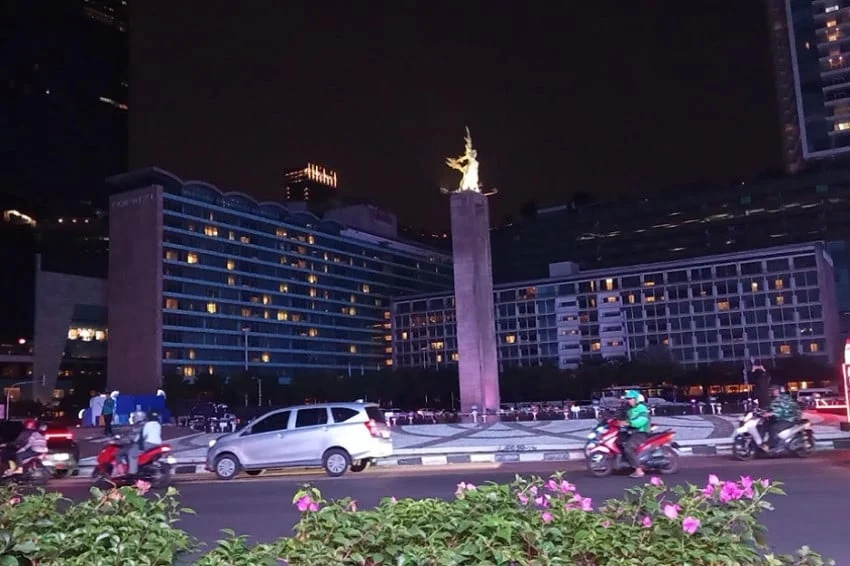
Jakarta experienced a striking visual transformation on Saturday evening as authorities implemented a strategic, one-hour blackout across some of the capital city’s most prominent thoroughfares and landmarks. Stretching from the historic National Monument (Monas) in Central Jakarta all the way to the bustling commercial and cultural hub of the Bundaran Hotel Indonesia (HI), the deliberate suspension of public lighting was executed to mark World Ozone Day. The initiative, designed to raise public awareness regarding climate change, energy conservation, and the ongoing degradation of the stratospheric ozone layer, successfully altered the nocturnal landscape of Indonesia’s economic powerhouse. Despite the sudden loss of illumination, the blackout did not deter crowds of residents and tourists who had gathered to witness the unique spectacle, turning an environmental campaign into an unexpected communal experience.
The coordinated blackout commenced precisely at 8:30 PM local time and lasted for exactly sixty minutes, concluding at 9:30 PM. During this window, major administrative and commercial buildings, street lighting, and decorative illuminations along the designated corridors were switched off. The stark reduction in artificial light cast a rare shadow over the city center, allowing citizens to perceive the urban environment under a remarkably different aesthetic. Rather than driving people away, the dim conditions drew curious onlookers to the plazas and pedestrian walkways surrounding Bundaran HI. Armed with smartphones and digital cameras, visitors eagerly captured the unusual ambiance, snapping selfies and group photographs against the backdrop of a darkened cityscape. While traffic continued to navigate the area under the guidance of local transportation authorities and reduced vehicle headlights, pedestrian zones remained lively. Groups of people sat on stone benches, engaged in conversations, or strolled leisurely, demonstrating how public spaces in Jakarta function as communal living rooms even in the absence of standard municipal lighting.
The decision to plunge key areas of Jakarta into darkness was rooted in global environmental commitments aimed at halting the depletion of the ozone layer. World Ozone Day, officially designated by the United Nations General Assembly as September 16 to commemorate the signing of the Montreal Protocol in 1987, serves as an annual reminder of the international community’s triumph in phasing out ozone-depleting substances such as chlorofluorocarbons (CFCs). Although the official global date fell earlier in the week, municipal authorities and environmental agencies across Indonesia frequently schedule localized awareness campaigns, symbolic blackouts, and educational workshops during the surrounding weekends to maximize public participation and engagement.
The historical context of ozone layer protection is deeply tied to international diplomacy and scientific consensus. In the late 20th century, scientists discovered a massive thinning of the ozone layer over the Antarctic, primarily driven by industrial chemicals utilized in refrigeration, air conditioning, aerosol propellants, and industrial solvents. The resulting increase in ultraviolet (UV) radiation posed severe threats to human health—including heightened rates of skin cancer and cataracts—as well as devastating impacts on marine ecosystems and terrestrial agriculture. The Montreal Protocol stands out as one of the most successful environmental treaties in history, achieving near-universal ratification and resulting in the systematic reduction of over 99 percent of ozone-depleting substances.

However, environmental scientists and policymakers emphasize that the battle for atmospheric health is far from over. Modern climate initiatives frequently link ozone layer recovery with broader greenhouse gas reduction strategies. Many chemical substitutes developed to replace CFCs, such as hydrofluorocarbons (HFCs), proved to be potent greenhouse gases that significantly accelerate global warming. Consequently, subsequent amendments to the Montreal Protocol, such as the Kigali Amendment adopted in 2016, mandate the phase-down of HFCs, bridging the gap between ozone protection and climate change mitigation.
In the wake of Saturday’s event, urban planners, environmental advocates, and municipal officials have weighed in on the broader implications of symbolic energy-saving campaigns. Proponents of such initiatives argue that while a one-hour blackout yields a relatively modest reduction in absolute power consumption, its primary value lies in psychological and educational impact. By physically altering the urban environment, authorities successfully capture the public’s attention, prompting conversations about energy efficiency, carbon footprints, and sustainable urban living. In a metropolis of over ten million residents—and a greater metropolitan area exceeding thirty million—raising individual awareness regarding electricity usage remains a critical component of national carbon-reduction goals.
Energy sector analysts note that Jakarta’s power grid, managed by the state-owned electricity enterprise PT PLN (Persero), operates under immense daily pressure to supply energy to commercial centers, industrial zones, and dense residential neighborhoods. The transition toward renewable energy sources and the reduction of fossil fuel dependency represent major pillars of Indonesia’s long-term environmental strategy, culminating in the national commitment to achieve net-zero emissions by 2060 or sooner. Symbolic events like the Monas-to-Bundaran HI blackout align with these broader policy objectives by encouraging citizens to reflect on their daily energy consumption habits, ranging from residential air conditioning use to reliance on private motor vehicles.
Public policy experts also highlight the socio-cultural dimension of urban blackouts. In recent years, cities around the world have utilized similar initiatives—such as the global Earth Hour movement—to foster a sense of collective responsibility toward the planet. The high turnout at Bundaran HI illustrates a growing appetite among urban Indonesians for public engagement events that address global challenges. Rather than viewing the disruption as an inconvenience, the crowds demonstrated an adaptive and positive response, transforming a municipal environmental policy into a recreational gathering.
As the clock struck 9:30 PM and the lights along the Monas and Bundaran HI corridors flickered back to life, normal urban operations resumed instantly. Floodlights illuminated the fountains, skyscrapers cast their familiar glow across the tarmac, and traffic surged back into its typical rhythm. Yet, the brief hour of darkness left a lasting impression on the thousands of citizens who participated. By temporarily stripping away the relentless glare of modern urban illumination, Jakarta offered its residents a rare glimpse of a quieter, more mindful cityscape—one that underscored the delicate balance between urban development and planetary preservation.