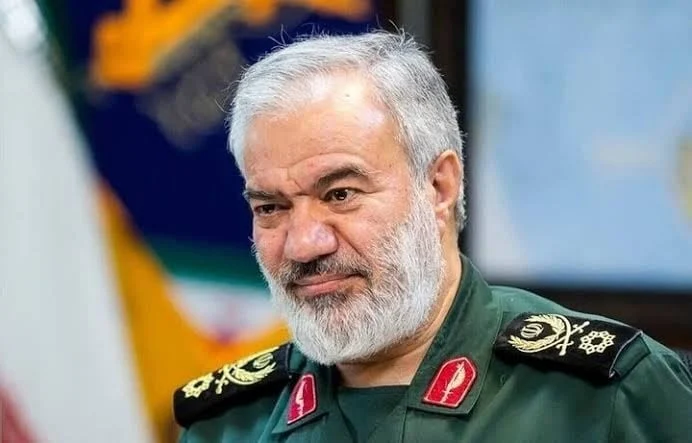
The geopolitical landscape of the Persian Gulf remains one of the most volatile maritime corridors in the world, characterized by a persistent tug-of-war between the Islamic Republic of Iran and the United States. Recent statements from high-ranking Iranian officials have reignited discourse regarding the posture of the United States Navy in the region. Ali Fadavi, the head of the advisory group to the commander of the Islamic Revolutionary Guard Corps (IRGC), asserted that American naval vessels and their associated equipment have been compelled to relocate more than 1,000 kilometers away from Iran’s coastal borders. According to Fadavi, this strategic withdrawal was a direct consequence of Iran’s assertive defensive maneuvers and rapid response capabilities during previous skirmishes.
Fadavi’s claims suggest a shift in the regional power balance, implying that Iran’s persistent naval posturing and the development of asymmetric maritime warfare tactics have forced the U.S. Fifth Fleet to maintain a greater distance from Iranian territorial waters. This narrative serves as a cornerstone of Tehran’s regional deterrence strategy, emphasizing that the Islamic Republic remains steadfast in its refusal to yield to international pressure, despite the prolonged imposition of comprehensive economic sanctions by Washington.
Historical Context and Strategic Deterrence
The Persian Gulf serves as a critical artery for global energy supplies, with a significant percentage of the world’s oil and liquefied natural gas passing through the Strait of Hormuz. For decades, the presence of the U.S. Navy has been framed by Washington as a means of ensuring freedom of navigation. Conversely, the IRGC views the presence of foreign military assets within the Gulf as a provocative violation of regional sovereignty.
The escalation of tensions is not a recent phenomenon but the culmination of years of diplomatic and military friction. Following the 2018 withdrawal of the United States from the Joint Comprehensive Plan of Action (JCPOA), commonly referred to as the Iran Nuclear Deal, the "maximum pressure" campaign initiated by the Trump administration significantly heightened the risk of accidental or intentional military engagement. The deployment of additional U.S. assets to the region during this period was intended to signal resolve, yet it also increased the frequency of close-proximity encounters between Iranian fast-attack craft and American warships.
Chronology of Recent Aerial and Maritime Friction
The assertion of a 1,000-kilometer withdrawal is corroborated by the IRGC through a lens of defensive success, punctuated by specific incidents involving unmanned aerial systems. Among the most cited examples in recent years was the downing of a U.S. drone over the vicinity of Qeshm Island. According to reports from the Fars News Agency, Iranian air defense systems successfully identified and neutralized a U.S. MQ-1 drone. The incident, which took place in the airspace over the Strait of Hormuz, underscored the operational risk posed to sophisticated U.S. surveillance platforms.
This event followed a pattern of escalating drone warfare in the region. In 2019, a more significant incident occurred when a U.S. RQ-4 Global Hawk—a high-altitude, long-endurance surveillance aircraft—was shot down by an Iranian surface-to-air missile. The Pentagon maintained at the time that the drone was in international airspace, while Tehran insisted it had breached Iranian territory. These incidents serve as the technical backdrop for Fadavi’s claims, suggesting that Iran’s integrated air defense network acts as a "no-go zone" for unauthorized foreign platforms.
Analysis of the U.S. Stance
While the rhetoric from Tehran emphasizes military success and forced retreats, the view from Washington is significantly more nuanced. Sergio de la Pena, the former U.S. Deputy Assistant Secretary of Defense, has frequently noted that while the United States maintains the overwhelming military superiority required to engage in a full-scale conflict, such an outcome is not the primary objective of American policy.
From a strategic standpoint, the U.S. maintains that its naval presence is focused on stability and the protection of international trade routes. De la Pena highlighted that the situation is inherently dynamic, characterized by a reliance on diplomatic "off-ramps" rather than purely kinetic solutions. "Everything depends on what options are on the table," he noted. This suggests that the U.S. military posture in the Gulf is carefully calibrated to remain deterrent without inadvertently triggering a regional conflagration that would disrupt the global economy. The "retreat" described by Iranian officials may, from an American military perspective, be interpreted as a strategic repositioning designed to reduce the risk of tactical miscalculation while maintaining regional presence through reach rather than proximity.
Economic Warfare and Internal Resilience
The discourse surrounding naval distance cannot be decoupled from the economic reality of the region. The United States has utilized financial sanctions as a primary tool of statecraft, targeting Iran’s oil exports, banking sector, and military leadership. Tehran’s narrative, as articulated by officials like Ali Fadavi, is that these economic pressures are intended to break the resolve of the Iranian people—a goal that Tehran insists has failed.
By framing the withdrawal of U.S. ships as a victory, the IRGC seeks to bolster internal domestic morale and project an image of regional strength despite economic hardship. This narrative alignment—linking military defiance with economic endurance—is central to the political identity of the IRGC. However, international analysts observe that the economic impact of sanctions has forced Iran to prioritize asymmetric capabilities, such as drone technology and small-boat swarm tactics, which are more cost-effective than building a traditional blue-water navy.
Implications for Future Regional Security
The claims made by the IRGC regarding the 1,000-kilometer withdrawal carry significant implications for the future of maritime security. First, the reliance on unmanned platforms for surveillance and defense creates a persistent cycle of provocation and response. As both sides integrate more Artificial Intelligence (AI) and automated response systems into their defense architectures, the "human in the loop" becomes increasingly marginalized, raising the risk of unintended escalation.
Second, the shifting geography of the Persian Gulf suggests that the traditional definition of "maritime presence" is evolving. If the U.S. is increasingly relying on standoff capabilities—utilizing aircraft carriers, long-range bombers, and satellites from outside the immediate, vulnerable waters of the Gulf—then the concept of a "retreat" is less about geography and more about a change in operational doctrine. The U.S. military is adapting to a reality where the proliferation of Iranian anti-access/area-denial (A2/AD) capabilities makes operating in the narrow confines of the Gulf an increasingly high-risk endeavor.
Finally, the regional stability of the Middle East remains hostage to the lack of a formal de-confliction mechanism between the IRGC and the U.S. Fifth Fleet. While "hotlines" have been proposed in the past, the lack of diplomatic trust means that every close encounter carries the risk of a misinterpretation of intent. The current status quo, as described by both Iranian claims of dominance and American claims of tactical flexibility, is a fragile balance.
Conclusion: A Strategic Stalemate
The report of a 1,000-kilometer withdrawal of U.S. naval assets from Iranian coastal waters serves as a poignant reminder of the enduring friction in the Persian Gulf. Whether viewed as a tactical victory by Tehran or a strategic repositioning by Washington, the result is the same: a region where military posturing remains the primary language of interaction. As both nations continue to navigate this high-stakes environment, the risk of miscalculation remains high.
For the international community, the primary concern remains the safety of global shipping lanes. The continued development of drone technology, coupled with the ongoing deployment of naval assets, ensures that the Strait of Hormuz will remain a critical focal point for global defense policy. As official rhetoric continues to harden on both sides, the necessity for back-channel communications and a clear understanding of the "red lines" for both Washington and Tehran becomes increasingly paramount to ensuring that this ongoing game of cat-and-mouse does not escalate into a broader conflict that neither side can afford. The situation remains, as de la Pena noted, dynamic and dependent on the ever-shifting nature of the diplomatic options presented on the global stage.