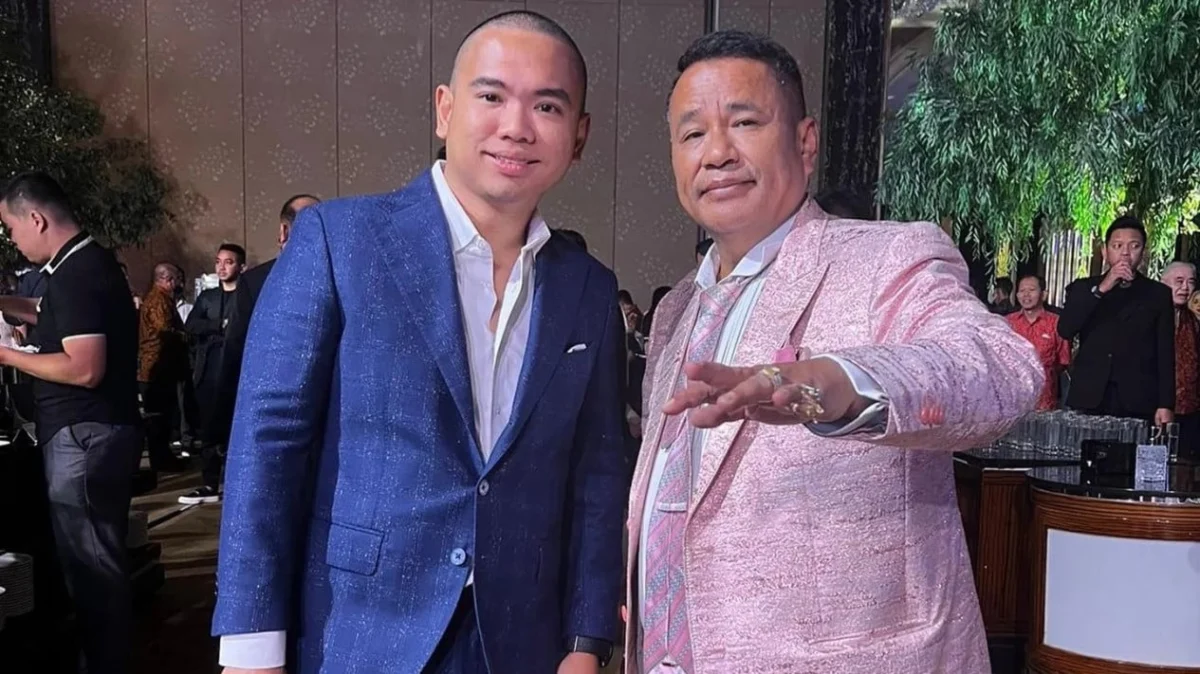
The Indonesian legal landscape and social media spheres have been ignited by a public display of professional and personal dissent within one of the country’s most prominent legal dynasties. Frank Alexander Hutapea, the eldest son of the flamboyant and highly successful attorney Hotman Paris Hutapea, has openly criticized his father’s decision to join the legal defense team for Febrie Adriansyah, the former Junior Attorney General for Special Crimes (Jampidsus). This rare public fracture between father and son has raised significant questions regarding the ethics of high-profile legal representation, the intersection of law and public relations, and the internal dynamics of the Hutapea family’s legal empire.
The controversy began when Hotman Paris Hutapea officially announced his involvement in the legal team representing Febrie Adriansyah. Adriansyah, a figure of immense influence within the Indonesian Attorney General’s Office, has recently been the subject of intense public scrutiny and various legal complexities following his tenure as Jampidsus. While Hotman Paris framed his involvement as a matter of professional duty and claimed he was not seeking financial remuneration for the case, Frank Hutapea took to social media to voice a sharply contrasting perspective, accusing his father of prioritizing "image-building" or pencitraan over genuine legal or social concern.
The Social Media Catalyst and Public Dissent
The friction became public when Frank Hutapea commented directly on social media posts regarding his father’s new high-profile client. Hotman Paris had previously stated to the media and on his digital platforms that his decision to defend the former Jampidsus was not motivated by money, emphasizing a "pro bono" or service-oriented angle to the representation. Frank, however, dismissed these claims with a series of blunt remarks.
In one notable comment, Frank referenced a previous family event to highlight what he perceived as a pattern of contradictory behavior regarding money and public image. "Stop with the image-building (pencitraan). Even for Fritz’s wedding, you still took the angpao (gift money) while acting like you don’t need money," Frank wrote, referring to his younger brother’s wedding. This personal jab served as a precursor to a more systemic critique of his father’s professional brand.
Frank further escalated his criticism by targeting the "Hotman 911" program, a legal aid initiative founded by Hotman Paris that purports to help the underprivileged and victims of injustice. Frank suggested that the program serves more as a branding tool than a sincere philanthropic effort. "Poor people are just used as marketing weapons. He never really cares; he only cares about being the center of attention," Frank posted. These statements have resonated deeply with the public, as they come from an insider who has been intimately involved in the family’s legal practice for over a decade.
Contextual Background: The Role of Febrie Adriansyah
To understand the weight of Frank’s criticism, one must look at the profile of the client in question. Febrie Adriansyah served as the Junior Attorney General for Special Crimes (Jampidsus) at the Attorney General’s Office (AGO) of Indonesia. During his tenure, he was responsible for overseeing some of the nation’s largest corruption investigations, including the massive tin mining corruption case and scandals involving state-owned insurers like Jiwasraya and ASABRI.
The transition of a high-ranking prosecutor to a position requiring a high-profile private defense attorney often triggers public debate regarding the "revolving door" between government service and private legal practice. For Hotman Paris to step in as counsel—especially under the guise of not accepting a fee—created a narrative that Frank Hutapea found disingenuous. The former Jampidsus is a powerful figure, and the optics of Indonesia’s most famous "lawyer for the people" defending a former top-tier state official have created a polarized reaction among the Indonesian populace.
Profile of Frank Alexander Hutapea: A Different Legal Path
Frank Alexander Hutapea is not merely a "celebrity son" but a seasoned legal professional in his own right. Born in 1991, Frank is the eldest of three children born to Hotman Paris and Augustianne Marbun. His siblings, Felicia Putri Parisienne Hutapea and Fritz Junior Hutapea, are also trained in law, making the family a formidable unit in the Indonesian legal sector.
Frank’s educational background reflects a rigorous and international approach to the law. He completed his undergraduate studies at Universitas 17 Agustus 1945 Jakarta, graduating in 2013. Seeking to expand his expertise beyond the domestic framework, he moved to the United Kingdom to attend the University of Kent. There, he specialized in several complex fields, including Banking Law, Corporate Law, Finance Law, and Security Law.
This international education has seemingly shaped a professional outlook that differs significantly from his father’s. While Hotman Paris is known for his "showman" persona, luxury cars, and heavy use of social media to influence public opinion, Frank has often been perceived as more reserved and focused on the technical, corporate aspects of the law. Since returning to Indonesia, Frank has played a pivotal role at Hotman Paris & Partners, often handling the intricate details of corporate litigation and international transactions that lack the tabloid appeal of his father’s "911" cases.
The "Hotman 911" Controversy and Legal Marketing
A central theme in Frank’s critique is the commodification of legal aid. Over the last few years, Hotman Paris has built a massive following through "Hotman 911," where he meets with citizens at coffee shops (most notably Kopi Johny) to hear their grievances. This grassroots approach has solved many individual problems but has also been criticized by some in the legal community as a form of "trial by social media."
Frank’s assertion that "poor people are used as marketing weapons" touches on a sensitive ethical nerve. In the legal profession, pro bono work is a fundamental duty. However, when pro bono work is heavily televised and used to build a "Robin Hood" persona that subsequently attracts high-paying corporate or political clients, the line between altruism and marketing becomes blurred. Frank’s public dissent suggests that within the firm, there is an awareness of this tension. By calling out the "pencitraan," Frank is effectively challenging the moral foundation of his father’s public brand.
Timeline of the Public Rift
The timeline of this specific disagreement highlights the rapid nature of digital discourse in modern Indonesia:
- Early July 2026: Hotman Paris announces his involvement in the legal team for Febrie Adriansyah, citing a desire to ensure "legal balance" and claiming no financial motive.
- Mid-July 2026: Social media discussions begin to swell, with many questioning why a lawyer who claims to represent the "little people" is defending a former high-ranking government prosecutor.
- July 18-19, 2026: Frank Alexander Hutapea begins posting comments on Instagram and other platforms. His remarks about the "angpao" and "marketing weapons" go viral within hours.
- July 19, 2026: National news outlets pick up the story, framing it as a major internal conflict within the Hutapea family.
- Late July 2026: Legal analysts and social observers begin weighing in on the implications of this rift for the Hutapea & Partners law firm.
Implications for the Hutapea Legal Legacy
The public disagreement between Hotman and Frank Hutapea is more than a family spat; it has potential implications for their legal practice. Hotman Paris & Partners is one of the most successful firms in Indonesia, largely due to Hotman’s ability to command attention and navigate the country’s complex judicial system. However, Frank is the presumptive successor to the firm’s leadership.
If the successor publicly views the firm’s marketing strategy as exploitative or disingenuous, it suggests a potential shift in the firm’s future direction. Frank’s preference for a more traditional, perhaps more "British-style" professional conduct—focused on the merits of the law rather than the spectacle of the lawyer—could signal a move away from the "Hotman 911" style of practice in the coming years.
Furthermore, this incident highlights a growing trend in Indonesia where the younger generation of professionals is increasingly willing to challenge the traditional hierarchies and "image-first" cultures of their predecessors. Frank’s willingness to risk family harmony to speak his "truth" regarding the firm’s tactics reflects a broader cultural shift toward transparency.
Official Responses and Public Sentiment
As of the latest reports, Hotman Paris has not issued a formal, aggressive rebuttal to his son’s comments, often choosing to maintain his usual high-energy social media presence. In the past, Hotman has frequently praised his children’s intelligence and independence, sometimes framing their disagreements as a sign of their strong characters. However, the specific accusation of using the poor for marketing is a direct hit to the core of Hotman’s current public identity.
Public sentiment remains divided. On one hand, many netizens applaud Frank for his honesty and for "pulling back the curtain" on the realities of celebrity legal practice. They see him as a voice of reason in a family often defined by excess. On the other hand, some view the public nature of the critique as disrespectful to his father, arguing that such disagreements should be handled behind closed doors.
Conclusion: A Turning Point for Indonesian Legal Branding
The critique leveled by Frank Alexander Hutapea against Hotman Paris serves as a landmark moment in the intersection of law, celebrity, and ethics in Indonesia. By labeling his father’s actions as "marketing" and "attention-seeking," Frank has sparked a necessary conversation about the true nature of pro bono legal work and the responsibilities of high-profile attorneys.
Whether this rift will lead to a permanent professional separation or a change in the firm’s strategy remains to be seen. What is clear, however, is that Frank Hutapea has established himself as a distinct voice in the legal community—one that is willing to challenge even the most powerful figures, including his own father, in the pursuit of what he deems professional integrity. As the legal proceedings for Febrie Adriansyah continue, the eyes of the public will be not only on the courtroom but also on the digital interactions of the Hutapea family, which continue to redefine the boundaries of public and private life in the digital age.