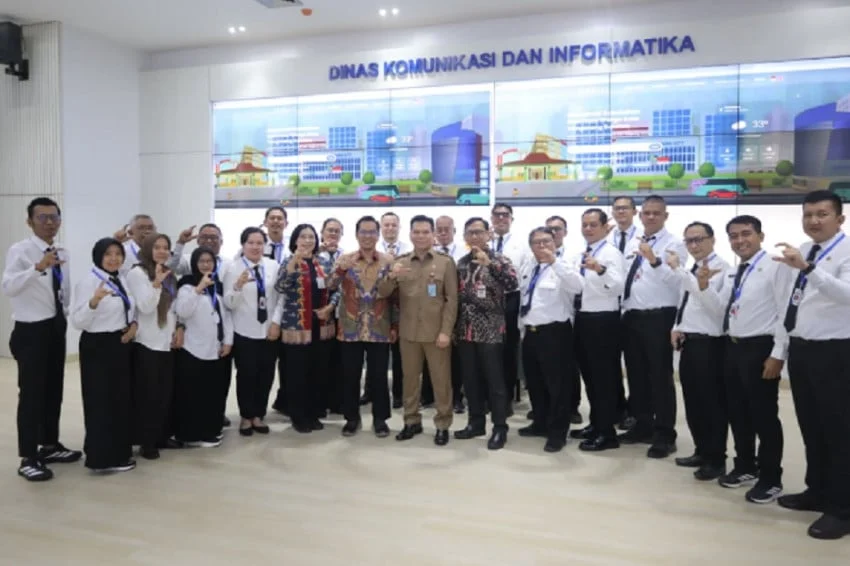
The South Tangerang City Government, commonly referred to as Pemkot Tangsel, has once again been selected as a benchmark for excellence in regional administration, hosting the Field Study for the Leadership Training Administrator (Pelatihan Kepemimpinan Administrator or PKA) Batch V of 2026. Organized by the Regional Human Resources Development Agency (BPSDMD) of Central Java Province, the visit centered on the technological advancements and administrative innovations that have defined South Tangerang’s governance in recent years. The delegation of high-ranking officials and administrative leaders from Central Java gathered at the Command Center of the South Tangerang City Government Center on Tuesday, July 21, 2026, to observe firsthand how digital integration is reshaping public service delivery in one of Indonesia’s most rapidly developing urban centers.
The event featured Tb. Asep Nurdin, the Head of the Communication and Informatics Department (Diskominfo) of South Tangerang, as the primary keynote speaker and resource person. Asep Nurdin shared comprehensive insights into the "best practices" of digital transformation that his department has spearheaded. This session was designed not only as a presentation of achievements but as an interactive exchange of strategies intended to equip Central Java’s administrative leaders with the tools necessary to implement similar efficiencies in their respective jurisdictions. The choice of South Tangerang as a study site underscores the city’s growing reputation as a leader in the Electronic-Based Government System (SPBE) framework, which has become a national priority for the Indonesian Ministry of Administrative and Bureaucratic Reform.
A Philosophical Shift: Beyond Applications to Tangible Public Value
During his presentation, Asep Nurdin emphasized that the success of South Tangerang’s digital journey is rooted in a fundamental shift in mindset. He argued that for many local governments, digital transformation is often misinterpreted as merely the creation of mobile applications or the digitizing of paper forms. However, in South Tangerang, the focus has shifted toward a more holistic integration of technology that prioritizes the user experience of the citizen.
"Digital transformation is not simply about introducing a new application or launching a website," Asep told the delegation. "It is about how that technology can provide real, tangible benefits to the community. Our innovations are always oriented toward making public services more accessible, faster, and more transparent. If an application does not reduce the time a citizen spends in a queue or if it does not clarify the process of obtaining a permit, then it has failed its primary purpose."
This philosophy has guided the development of the city’s integrated service portal, which consolidates various municipal functions into a single, cohesive ecosystem. By centralizing data and services, the city has been able to eliminate the "silo effect" often found in traditional bureaucracy, where different departments operate in isolation. In the 2026 context, this integration has reached a level of maturity where real-time data sharing between health, education, and social services allows for a proactive rather than reactive governance model.
The Role of the Command Center as a Governance Hub
The choice of the Command Center as the venue for the study was highly symbolic. Functioning as the "brain" of the city, the Command Center integrates various data streams from across South Tangerang, including traffic management systems, weather monitoring, public complaint channels, and real-time budget tracking. The PKA participants from Central Java were given a demonstration of how the city’s leadership uses these data visualizations to make informed, evidence-based decisions.
The Command Center’s infrastructure allows the Mayor and department heads to monitor the progress of public works and the efficiency of service delivery in real-time. For example, during the session, it was demonstrated how public complaints submitted via digital platforms are tracked from the moment of submission to the point of resolution. This level of transparency ensures accountability, as every department’s response time is recorded and analyzed as part of their performance metrics.
For the visiting administrators from Central Java, this provided a concrete example of how to manage a modern city. The ability to visualize data allows for a more agile response to urban challenges. Whether it is managing traffic congestion during peak hours or coordinating emergency services during the rainy season, the Command Center serves as the central node for the city’s operational readiness.
Supporting Data and the Evolution of the SPBE Index
South Tangerang’s success is reflected in its consistently high scores in the national Electronic-Based Government System (SPBE) index. As of 2026, the city has maintained its position in the "Excellent" category, a result of sustained investment in both hard infrastructure and human capital. Data presented during the field study indicated that over 90% of municipal services in South Tangerang are now accessible online, ranging from business licensing to civil registry updates.
Furthermore, the city has invested heavily in digital literacy for its civil servants. The transformation described by Asep Nurdin is supported by a workforce that is increasingly proficient in data analytics and digital project management. This internal capacity building is a critical component of the PKA program, as the visiting administrators are tasked with leading their own teams through similar transitions.
The financial data shared during the session also highlighted the cost-effectiveness of digital transformation. By automating routine administrative tasks and reducing the reliance on physical documentation, the South Tangerang government has realized significant savings in operational expenditures. These funds have since been reallocated to high-impact sectors, such as health and education, further demonstrating the "tangible benefits" mentioned by the Diskominfo head.
Case Study: Digital Integration in Health and Social Welfare
A specific example of the city’s digital success that was discussed during the visit is the integration of health services to combat stunting and improve maternal and child health. This initiative, which was highlighted in recent municipal reports, utilizes a centralized database to track the nutritional status of children across the city’s various districts.
By using digital records, health workers can identify "at-risk" families more quickly and provide targeted interventions. This data-driven approach has led to a measurable decline in stunting rates within the city. During the PKA session, Asep Nurdin explained that this was only possible because the Diskominfo department worked closely with the Health Department to ensure that the data collected at local clinics (Puskesmas) was automatically synced with the city’s central database. This cross-departmental collaboration is a hallmark of the Tangsel model.
For the delegates from Central Java, this case study illustrated how digital tools can be used to solve complex social issues. It moved the conversation away from technical specifications and toward social impact, which is a key learning objective for the Leadership Training Administrator program.
Responses from the Central Java Delegation
The delegation from the BPSDMD of Central Java expressed high appreciation for the openness and transparency shown by the South Tangerang government. Representatives from the group noted that the "Tangsel approach" provides a viable roadmap for other regions in Indonesia. They were particularly impressed by the city’s ability to foster a culture of innovation among its staff.
"Seeing how South Tangerang has moved beyond the ‘app-centric’ phase and into a truly ‘service-centric’ phase is inspiring," noted one participant. "The integration of the Command Center with daily administrative tasks provides a level of oversight that we hope to replicate in our own regencies and cities in Central Java."
The PKA participants also engaged in a deep-dive discussion regarding the challenges of data security and privacy. Asep Nurdin reassured the delegation that as the city’s digital footprint grows, so does its investment in cybersecurity. The city has established a dedicated Cyber Security Incident Response Team (CSIRT) to monitor threats and ensure that the personal data of citizens remains protected, a critical factor in maintaining public trust in digital governance.
Broader Impact and Future Implications
The continued selection of South Tangerang as a site for national-level field studies has broader implications for regional development in Indonesia. It positions the city as a "center of excellence," fostering a spirit of healthy competition and collaboration between local governments. As more regions adopt the digital practices pioneered in Tangsel, the overall quality of governance in Indonesia is expected to rise, contributing to the national goal of "Indonesia Emas 2045" (Golden Indonesia 2045).
The digital transformation in South Tangerang also has a significant impact on the local economy. By streamlining the process for obtaining business permits and reducing the potential for illegal levies through automated systems, the city has become an increasingly attractive destination for investment. This economic vitality, in turn, provides the tax base necessary to fund further technological and social innovations.
As the session concluded, Tb. Asep Nurdin reiterated that the journey of digital transformation is never truly finished. "Technology evolves, and so do the expectations of our citizens," he said. "Our task as administrators is to remain agile and to always ask how we can use the tools at our disposal to make life better for the people we serve."
The visit of the Central Java PKA Batch V participants to South Tangerang serves as a testament to the power of knowledge sharing in the public sector. By documenting and disseminating these successful strategies, the South Tangerang government is playing a pivotal role in shaping the future of Indonesian administration, ensuring that the benefits of the digital age are felt by all citizens, regardless of their location. The event ended with a commitment from both parties to maintain a channel of communication, allowing for ongoing mentorship and the exchange of ideas as Central Java begins to implement the lessons learned during their time in the "Smart City" of South Tangerang.