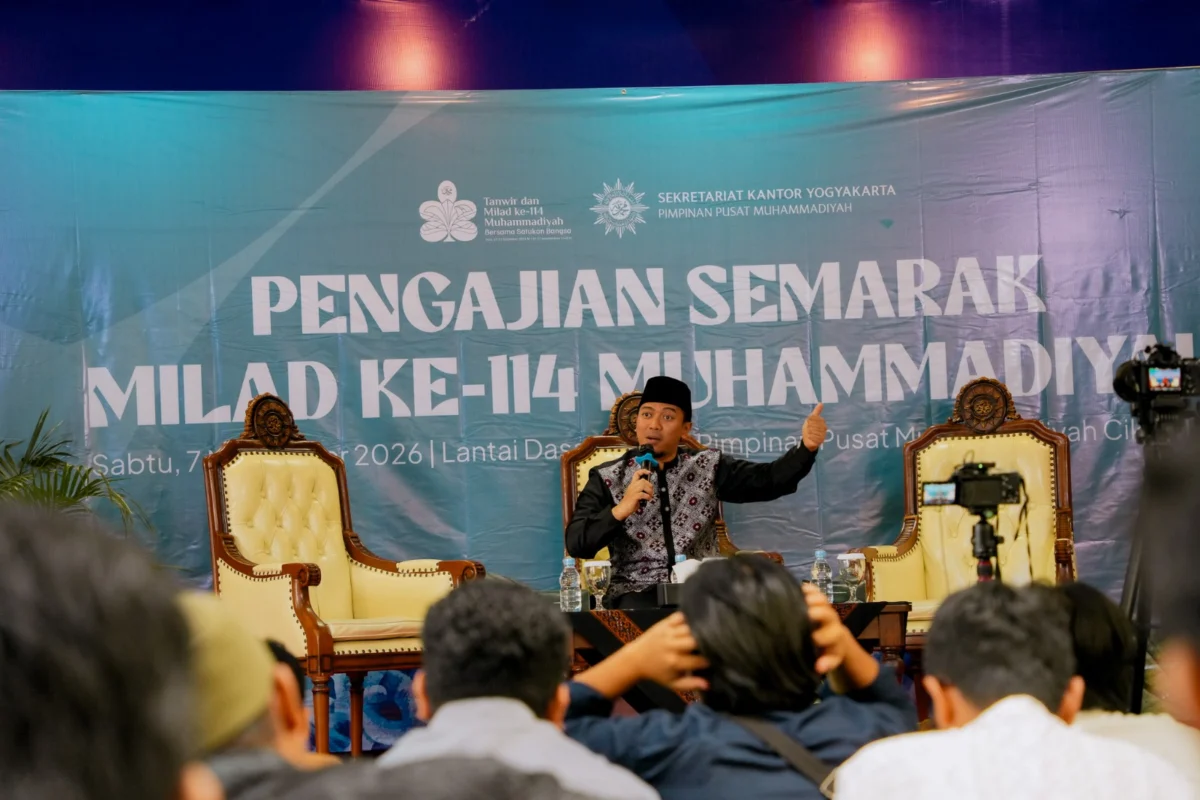
YOGYAKARTA — Amidst the relentless onslaught of global information flows, the dizzying velocity of the digital era, and the pervasive pressures of modern life, maintaining spiritual clarity, recognizing personal limitations, and exercising strict self-control have emerged as critical necessities for contemporary believers. This core message resonated profoundly during the commemorative Pengajian Semarak Milad to celebrate the 114th anniversary of Muhammadiyah, held at the Central Executive (PP) Muhammadiyah office in Yogyakarta.
The gathering, which brought together the entire administrative staff, officers, and internal stakeholders of the PP Muhammadiyah office, served not only as a moment of institutional reflection but also as a vital spiritual recharge. As one of Indonesia’s oldest and most influential Islamic reformist organizations, Muhammadiyah continues to use its anniversary milestones as platforms to address both the spiritual and socio-cultural challenges facing contemporary Indonesian society.
High-Ranking Officials Lead the Commemoration
The auspicious event was graced by several prominent figures within the central leadership of the organization. Among those in attendance were Dr. Agus Taufiqurrahman, Chairperson of PP Muhammadiyah, and Muhammad Sayuti, Secretary of PP Muhammadiyah. Their presence underscored the institutional importance of nurturing the internal community—the administrative backbone that keeps the vast network of Muhammadiyah’s educational, health, and social institutions running smoothly.
The focal point of the gathering was the primary tausiah (Islamic lecture) delivered by Ustaz Irfan Rizki Haas. Known for his engaging and culturally relevant approach to Islamic preaching, Ustaz Irfan addressed the psychological and spiritual toll that the twenty-first-century information ecosystem inflicts on individuals. His discourse bridged classical Islamic jurisprudence and theology with the hyper-connected realities of modern digital communications, offering a robust framework for ethical and mental survival in an age of anxiety.
The Context of Digital Fatigue and Modern Despair
In his opening remarks, Ustaz Irfan confronted a pressing psychological reality of the modern era: the pervasive sense of doom, anxiety, and eventual despair triggered by the constant cycle of negative news, global crises, and social media polarization. In an interconnected world where tragic events, economic uncertainties, and toxic public discourse are beamed directly into personal smartphones 24 hours a day, burnout and existential fatigue have become widespread.
However, the lecturer firmly reminded the congregation that surrender to despair is fundamentally incompatible with Islamic theology. Citing Surah Az-Zumar, verse 53, he reminded the audience of the divine injunction prohibiting believers from despairing of the mercy of Allah SWT.
"In the midst of crashing waves of negative reporting and the loud dynamics of the modern world, human beings often feel anxious to the point of almost giving up. Yet, as believers, despair is strictly forbidden," Ustaz Irfan stated during his lecture. He emphasized that divine mercy remains infinitely expansive, serving as an anchor for individuals navigating turbulent socio-political and economic landscapes.
Three Pillars for Navigating an Instant Era
To successfully navigate an era characterized by instant gratification, rapid-fire communications, and fleeting attention spans, Ustaz Irfan outlined three fundamental spiritual and psychological pillars that every believer must cultivate. These principles—focused on internal purity, self-awareness, and behavioral restraint—provide a comprehensive blueprint for personal integrity and societal harmony.
The First Pillar: Cultivating a Sound Heart (Qalbin Salim)
The first foundational principle articulated by the lecturer is the preservation of a sound heart, or qalbin salim. Drawing upon classical prophetic traditions, Ustaz Irfan reminded the audience that the physical body’s condition is inextricably linked to the state of this spiritual epicenter. When the heart is corrupted by greed, malice, anxiety, or arrogance, the entire human apparatus falters. Conversely, a heart anchored in sincerity, gratitude, and divine consciousness produces upright actions and moral resilience.
He contextualized this concept within the eschatological framework of Islam, noting that material achievements, professional accolades, and familial lineage will hold no weight in the ultimate accounting before the Creator.
"Because when standing before Allah in the hereafter, the measure of success will no longer be how much wealth or how many descendants one brought, but rather whether one brings a sound heart, a qalbin salim," he explained. In the context of the digital age, maintaining a sound heart implies protecting one’s mental and spiritual faculties from the corrosive effects of online envy, cyberbullying, performative piety, and the relentless pursuit of digital validation.
The Second Pillar: Self-Awareness and Personal Capacity (Syakilah)
The second pillar focuses on profound self-awareness, encapsulated by the Islamic concept of syakilah. Referencing Surah Al-Isra, verse 84—which notes that every individual works according to their own disposition, inclinations, and capacity (kullu ya’malu ala syaakilatih)—Ustaz Irfan highlighted the divine wisdom behind human diversity.
Every person is created with unique potentials, intrinsic talents, and specific roles to play within the grand design of civilization. Consequently, understanding one’s distinct identity and limitations allows an individual to adapt effectively to any environment without succumbing to the disease of constant comparison or misplaced ambition.
"Realizing who we are, what our capacity is, and where our arena of devotion lies is far more important than simply harboring an ambition to become something or someone else," Ustaz Irfan asserted. This principle serves as a powerful antidote to modern career anxiety and the "comparison trap" fueled by professional networking platforms and social media highlight reels, urging individuals instead to focus on excellence and authenticity within their designated spheres of influence.
The Third Pillar: Mastering Self-Control in the Digital Public Sphere
The third and final pillar addresses the paramount need for self-control, particularly regarding speech, digital expression, and emotional impulses. In the contemporary digital ecosystem, where information, opinions, and instant reactions can be broadcast globally in a fraction of a second, the velocity of communication frequently outpaces moral deliberation.
Ustaz Irfan warned that the temptation to weigh in on every online controversy, to retaliate against perceived slights, or to consume and share unverified information poses a severe threat to personal peace and social cohesion. True strength, he noted, is manifested not in verbal dominance or reactive outbursts, but in the deliberate practice of restraint, patience, and emotional regulation.
"Sometimes, not everything needs to be uttered. Patience, sincerity, and turning to Allah will make those moments part of a meaningful journey," he emphasized. This counsel aligns closely with prophetic traditions that advise believers to speak good or remain silent, transforming digital restraint from a mere social media strategy into a profound spiritual discipline.
Broader Implications and Institutional Relevance
The themes addressed during the 114th Milad Pengajian carry profound implications not only for the individual staff members of PP Muhammadiyah but for Indonesian society at large. As an organization that oversees thousands of schools, universities, hospitals, and social welfare institutions across the archipelago, Muhammadiyah’s administrative apparatus handles vast flows of information, public engagement, and community service.
In an era marked by the rapid spread of misinformation, ideological polarization, and digital burnout, the internal capacity of organizational actors to maintain emotional equilibrium and spiritual grounding is vital. By emphasizing internal psychological hygiene—such as emotional self-control, self-awareness, and spiritual purity—Muhammadiyah reinforces the ethical foundations of its workforce. This approach ensures that institutional stewardship remains rooted in service, empathy, and moral clarity rather than reactionary politics or digital noise.
Furthermore, the emphasis on syakilah (self-awareness) and structural contribution offers a constructive model for organizational efficiency. When individuals operate from a place of self-awareness regarding their capabilities and defined roles, institutional synergy improves, reducing internal friction and enhancing collective productivity.
Conclusion: A Timeless Message for a Modern World
The 114th anniversary commemoration of Muhammadiyah at its Yogyakarta central office transcended a routine institutional gathering. By blending classical Islamic theology with pressing contemporary realities, the event provided its attendees with practical, spiritually grounded tools to navigate the complexities of the twenty-first century.
Through the synthesis of maintaining a sound heart (qalbin salim), embracing individual capacity and self-awareness (syakilah), and exercising rigorous emotional and digital self-control, the participants were reminded that the ultimate battleground of the modern era is internal. As society continues to accelerate into an unpredictable digital future, the timeless wisdom articulated during the Pengajian Semarak Milad stands as a steadfast reminder that resilience begins from within.