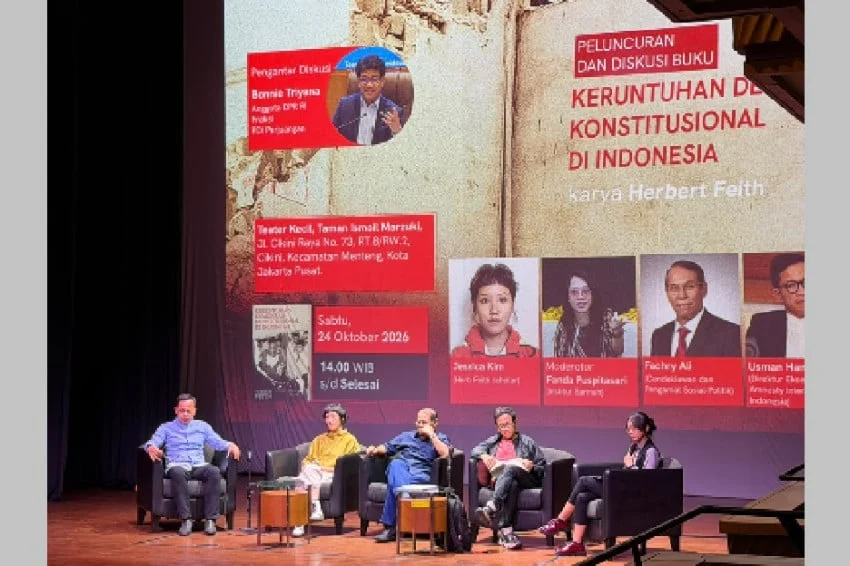
The intellectual discourse surrounding the fragility of democratic systems in Southeast Asia’s largest economy experienced a prominent revival as historians, politicians, and academics gathered at the Teater Kecil in Taman Ismail Marzuki, Central Jakarta. The occasion was the official launch and public discussion of the seminal historical work, The Decline of Constitutional Democracy in Indonesia, originally authored by the renowned Australian political scientist Herbert Feith. Among the key speakers was prominent historian and member of the House of Representatives (DPR) from the Indonesian Democratic Party of Struggle (PDI-P), Bonnie Triyana, who used the platform to draw striking parallels between the political dynamics of the 1950s and the contemporary challenges facing the nation’s governance today.
The event, which drew a diverse audience of students, researchers, and political observers, focused heavily on re-examining the parliamentary democracy era of 1950–1957. Bonnie opened the discussion by asserting that the academic friction between Feith and his contemporaries offers vital lessons for understanding current political polarization, elite fragmentation, and the ongoing struggle to institutionalize substantive democratic norms in the contemporary era.
The Historical Context of Feith’s Masterpiece and the Benda Critique
Herbert Feith’s The Decline of Constitutional Democracy in Indonesia stands as one of the most exhaustive empirical and theoretical studies of Indonesia’s early post-independence political experiment. Published originally in the 1960s, Feith meticulously documented how the parliamentary system—characterized by a shifting mosaic of political parties, frequent cabinet collapses, and intense ideological rivalry—gradually unraveled, paving the way for President Sukarno’s "Guided Democracy" and the subsequent rise of authoritarian rule.
During the Jakarta discussion, Bonnie Triyana elaborated on the intellectual sparring that once defined Indonesian studies, specifically highlighting the sharp critique leveled against Feith by fellow historian Harry J. Benda. According to Bonnie, Benda accused Feith of falling into the trap of Eurocentrism. Benda’s core argument posited that Feith had mistakenly elevated the Western liberal parliamentary model as the universal baseline for political normalcy, measuring Indonesia’s unique socio-political trajectory against an external standard.
"Benda argued that the parliamentary democracy of 1950-1957 was merely a temporary phenomenon, or an interlude, imported from the outside and accepted only on the very surface of Indonesian society," Bonnie explained to the audience, capturing the nuance of historical critiques that continue to shape how political scientists view institutional transplantation in post-colonial states.
Elites, Administrators, and Solidarity Makers
A central pillar of Feith’s analytical framework is his famous dichotomy of Indonesian political elites: the "administrators" and the "solidarity makers." In Feith’s taxonomy, administrators were pragmatic, problem-solving technocrats focused on economic management, institutional building, and bureaucratic efficiency. Conversely, solidarity makers were charismatic figures, often nationalist or ideological leaders, who excelled in mass mobilization, symbol manipulation, and maintaining revolutionary fervor.
While Harry J. Benda and other revisionist scholars argued that this binary framework oversimplified a deeply complex and fractured societal reality, Bonnie Triyana maintained that the categorization retains significant analytical utility. He noted that the tension between technocratic problem-solving and populist symbol-wielding remains visibly embedded in modern Indonesian political campaigns, policy-making, and executive-legislative relations.
"For me, the debate between Feith and Benda, which took place over six decades ago, continues to disturb our thoughts and provoke numerous questions," Bonnie emphasized, underscoring that historical methodologies must be continuously re-evaluated to prevent cyclical democratic backsliding.
Geopolitical Roots of Indonesia’s Democratic Experiment
Expanding upon the broader historical framework, Bonnie contextualized the birth of Indonesia’s democratic architecture within the turbulent geopolitical landscape immediately following the Second World War. He detailed the critical juncture surrounding the issuance of the Government Decree of November 3, 1945 (Maklumat X), which officially opened the floodgates for a multi-party system.
This policy shift was not merely an internal administrative adjustment, Bonnie argued, but a calculated geopolitical maneuver. The nation’s founding elites were urgently attempting to demonstrate to the global community—particularly Western powers whose recognition was vital for international diplomacy—that the newly proclaimed Republic of Indonesia was a progressive, pluralistic nation committed to democratic values rather than a remnant or puppet of Japanese fascism.
However, this rapid transition toward a multi-party parliamentary system introduced structural vulnerabilities. Without deeply rooted civic institutions, a cohesive national identity that transcended regional loyalties, or a stable economic foundation, the system buckled under the weight of regional rebellions, ideological polarization between Islamic, nationalist, and communist factions, and persistent friction between civilian leaders and the military.
Broad Implications for Contemporary Indonesian Democracy
The resuscitation of these historical debates carries profound implications for contemporary Indonesia. Observers note that as the nation navigates complex political transitions, questions concerning the resilience of constitutional checks and balances, the role of political parties, and the dangers of elite capture remain as pertinent as ever.
Modern political analysts observing the event pointed out that Feith’s documentation of how democratic norms erode from within—not necessarily through sudden, violent coups, but via slow institutional decay, cabinet instability, and the marginalization of technocratic governance—serves as a cautionary tale. In an era marked by debates over democratic consolidation, executive overreach, and the health of civil liberties, returning to the foundational texts of Indonesian historiography offers essential perspective.
Furthermore, the discussion at Taman Ismail Marzuki highlights a growing public appetite for critical historical reflection. By bridging the gap between academic historiography and contemporary political discourse, events of this nature encourage a more informed citizenry capable of contextualizing current national challenges within a broader historical continuum.
Conclusion and Future Outlook
As Indonesia continues to test the durability of its constitutional framework through successive national leadership transitions, the lessons of the 1950s—analyzed through the competing lenses of Herbert Feith and Harry J. Benda—provide invaluable intellectual guardrails. The enduring relevance of Feith’s work, as articulated by scholars and political figures alike, underscores that the journey toward a stable, resilient, and substantive democracy is neither linear nor guaranteed, requiring constant vigilance, institutional adaptation, and a profound understanding of the historical forces that shaped the republic.