
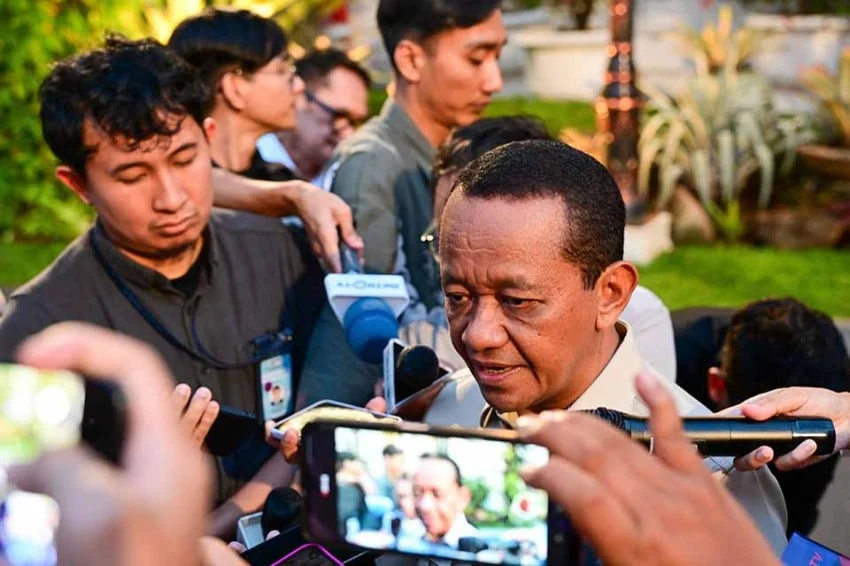
JAKARTA — The Indonesian government has moved to clarify its recent strategic decision to curtail natural gas exports to Singapore, emphasizing that the policy is a temporary measure designed to prioritize national energy security and the escalating demands of domestic industrialization. Bahlil Lahadalia, serving in his dual capacity as the Minister of Energy and Mineral Resources (ESDM) and the Coordinating Minister for Downstreaming and Energy Transition, confirmed that the government remains committed to its international contractual obligations while simultaneously asserting its right to reallocate resources to bolster the local economy.
The policy shift involves a reduction of approximately 31 million standard cubic feet per day (MMSCFD) of gas. This volume represents a small fraction of the total 409 MMSCFD currently mandated under long-standing export contracts with Singapore. Minister Bahlil, speaking at the State Palace in Jakarta on Thursday, October 29, 2026, underscored that this adjustment remains well within the technical and legal parameters stipulated in the existing agreements.
Strategic Prioritization: The Domestic Imperative
The core rationale behind the reduction lies in the government’s ambitious "Downstreaming" (hilirisasi) agenda. As Indonesia transitions from a commodity-exporting nation to a value-added industrial economy, the demand for reliable and affordable energy—particularly natural gas—has surged. This is especially evident in the development of special economic zones, chemical processing plants, and the burgeoning electric vehicle (EV) battery supply chain, all of which require consistent gas inputs to maintain operational efficiency.
"We are constantly monitoring the situation," Bahlil stated. "Our primary responsibility is to ensure that the domestic industrial sector has the energy it requires to thrive. Once these national needs are fully satisfied and surplus capacity is confirmed, the government is absolutely open to resuming higher levels of exports to our neighbors, including Singapore."
The minister’s remarks address a delicate balance in international relations. Indonesia and Singapore have historically maintained a robust energy partnership, with Indonesia serving as a primary gas supplier for Singapore’s power generation plants. However, the shifting global economic landscape and Indonesia’s internal development goals have necessitated a recalibration of how natural gas is allocated.
Legal and Contractual Framework
A key point of contention in such international trade adjustments is the potential for contract violations. Minister Bahlil was categorical in his assessment that the reduction of 31 MMSCFD does not constitute a breach of contract. By framing the decision within the context of the total 409 MMSCFD contract, the government signaled that it is operating within the "minimum take-or-pay" clauses or similar regulatory buffers inherent in high-level energy procurement agreements.
The reduction is calculated to ensure that Singapore’s energy security remains stable while allowing Indonesia to redirect the specific volume to high-priority domestic infrastructure projects. This calibrated approach is intended to avoid a diplomatic or economic rift while asserting national sovereignty over resource management.
The Broader Context: Energy Geopolitics
The decision to limit gas exports occurs against a backdrop of global energy market volatility. In his recent public commentary, Bahlil has frequently noted that geopolitical instability—particularly in the Middle East and Eastern Europe—has fundamentally altered the global energy trade. In an era where oil and gas are increasingly viewed through the lens of national security rather than just commodities, Indonesia is positioning itself to be more protective of its own reserves.
Analysts suggest that the global shift toward "energy nationalism" is a direct response to the supply chain disruptions witnessed over the past few years. For Indonesia, which is seeking to industrialize rapidly, relying on external supply chains for its own energy needs while simultaneously exporting raw materials is a model the current administration is actively trying to dismantle.

Economic Implications for the Domestic Sector
The reallocation of gas resources is expected to have a tangible impact on Indonesia’s industrial output. By prioritizing domestic consumption, the government aims to lower operational costs for manufacturers. Natural gas is a critical feedstock for the petrochemical industry and a primary energy source for ceramic, glass, and fertilizer production.
The government’s decision is part of a broader, multi-year plan to overhaul the national energy mix. As Indonesia transitions toward renewables, natural gas is viewed as the essential "bridge fuel." Ensuring that the domestic market has sufficient supply is not merely an industrial goal but a fundamental component of the country’s long-term energy transition strategy.
Chronology of Events and Policy Evolution
The path to this current policy adjustment can be traced through several critical developments:
- Mid-2024: The Indonesian government initiates an audit of all long-term gas export contracts to assess how much volume could be diverted to support the downstreaming of nickel, bauxite, and other minerals.
- Early 2025: Rising domestic energy prices and supply bottlenecks in major industrial hubs lead to calls for a review of existing export quotas.
- Late 2025: Bahlil Lahadalia assumes the mantle of the newly formed Coordinating Ministry for Downstreaming and Energy Transition, signaling a more integrated approach to energy policy.
- October 2026: Official announcement of the 31 MMSCFD reduction to Singapore, framed as a flexible, non-permanent measure contingent on domestic supply metrics.
Stakeholder Perspectives and Market Reaction
While the government maintains that the move is purely economic and contractual, the market reaction is closely monitored. Singapore, a nation with limited natural energy resources, has historically relied on a diversified portfolio of gas imports, including pipeline gas from Indonesia and Malaysia, as well as Liquefied Natural Gas (LNG) from global markets.
Industry experts suggest that Singapore is likely to manage the shortfall by increasing its LNG procurement or utilizing its strategic gas reserves. The fact that the reduction is relatively small (roughly 7.5% of the total contract) suggests that the impact on Singapore’s power grid will be minimal, provided the reduction does not escalate further.
For Indonesian investors and manufacturers, the news is generally received as a positive indicator of the government’s commitment to providing a stable business environment. However, the success of this policy will ultimately depend on the government’s ability to distribute the recovered gas efficiently to the intended domestic projects without creating logistical or infrastructural bottlenecks.
Future Outlook: What Happens Next?
The "non-permanent" nature of the reduction is the most significant aspect of Bahlil’s statement. It suggests that the Indonesian government is adopting a dynamic approach to trade policy, one that reacts to real-time supply and demand data rather than rigid, long-term projections.
The criteria for returning to previous export levels are expected to be based on:
- Domestic Demand Satisfaction: A clear assessment that all key industrial zones are meeting their production targets with sufficient energy.
- Production Efficiency: Improvements in upstream gas extraction and domestic distribution pipelines.
- Global Market Pricing: An evaluation of whether the global price environment justifies re-exporting, or if domestic value-added production remains the more lucrative path for the Indonesian economy.
Conclusion
The government’s decision to reduce gas exports to Singapore is a calculated maneuver in a complex energy landscape. By asserting control over its natural resources, Indonesia is prioritizing its industrial future while maintaining a measured and legally sound approach to its international commitments. As Bahlil Lahadalia highlighted, the priority remains the domestic economy, but the door remains open for future cooperation.
The coming months will be critical in determining whether this reduction remains a localized adjustment or if it signals a permanent shift in how Indonesia interacts with the global energy market. For now, the administration appears confident that by balancing the needs of its domestic industries with the realities of its international contracts, it can secure the energy independence required to propel the nation into its next phase of economic development.