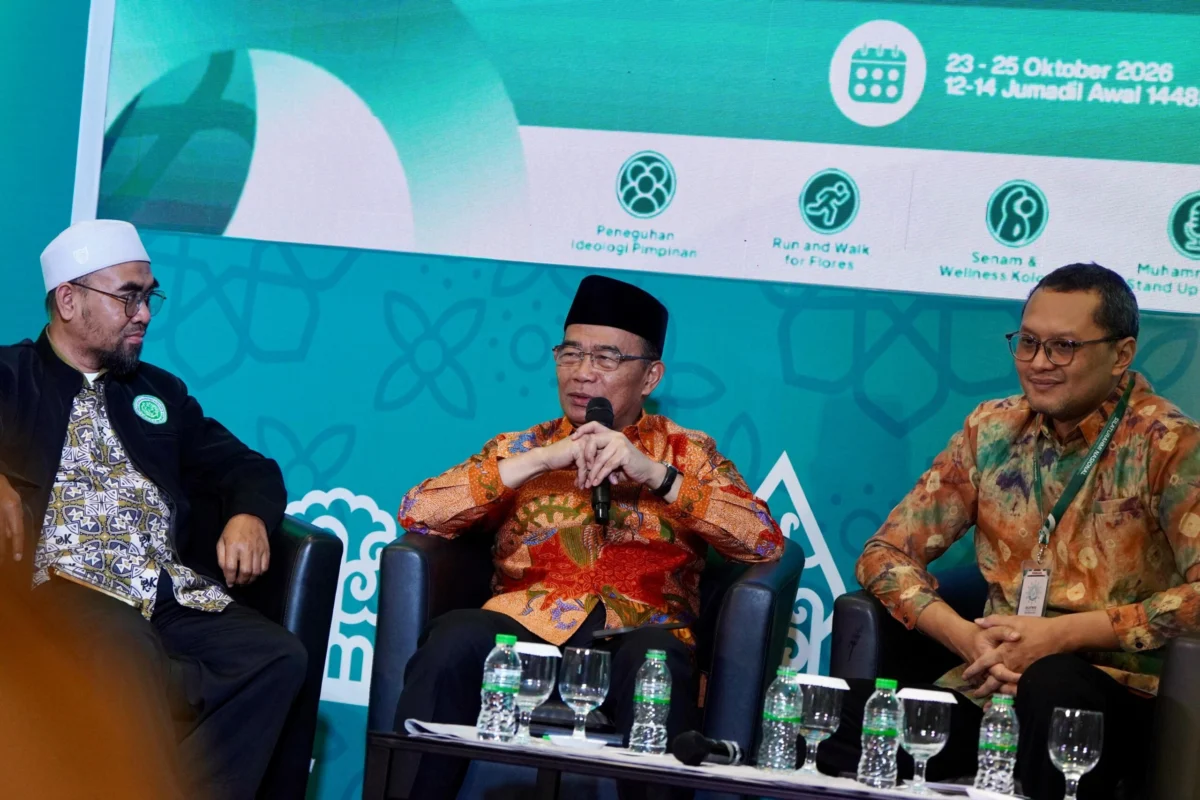
YOGYAKARTA — In a decisive push toward total organizational financial autonomy, Central Board (PP) Muhammadiyah Chairman Muhadjir Effendy has called upon the massive Islamic socio-religious movement’s business networks, entrepreneurs, and institutional leaders to aggressively scale up their operations within the creative economy, tourism, and international hospitality sectors. The strategic directive was formally delivered during the National Gathering of Muhammadiyah Tourism and Creative Economy Practitioners, drawing stakeholders from across the archipelago to strategize on sustainable economic empowerment.
The gathering, held on Sunday, October 25, served as a crucial platform for reassessing the operational scope of Muhammadiyah’s vast commercial and social infrastructure. Muhadjir, who also serves as the Indonesian Presidential Special Envoy for Hajj Affairs, emphasized that the organization must transition from theoretical economic discourse to high-impact, results-driven enterprise. By harnessing the untapped commercial potential within religious tourism and cultural heritage preservation, Muhammadiyah aims to solidify its footprint not only as a pillar of education and health, but as a formidable economic powerhouse on both national and international stages.
Moving Beyond Discourse to Tangible Revenue
At the core of Muhadjir’s address was a call for pragmatic, profit-yielding execution. He explicitly invoked the guiding philosophy articulated by PP Muhammadiyah General Chairperson Haedar Nashir, who famously remarked that Muhammadiyah economic actors should focus less on endless deliberation and debate, and concentrate intensely on revenue generation and concrete economic output.
This philosophy challenges the traditional bureaucratic inertia that frequently plagues large institutional organizations. For decades, Muhammadiyah has excelled in establishing thousands of schools, universities, hospitals, and social welfare orphanages. However, economic independence at the grassroots level has occasionally lagged behind its philanthropic expansion. By urging business leaders to prioritize profitable, scalable ventures, the leadership aims to create a continuous financial bloodstream that can sustainably fund the organization’s vast charitable endeavors without relying solely on external donations or fluctuating membership dues.
Strategic Expansion into Hajj and Umrah Infrastructure
Among the most ambitious proposals tabled by Muhadjir is a structural pivot toward the lucrative international Hajj and Umrah pilgrimage market. Given his governmental role as Presidential Special Envoy for Hajj, Muhadjir possesses unique insight into the logistical bottlenecks, financial scales, and economic leakage associated with Indonesian pilgrimages to Saudi Arabia. Every year, millions of Indonesian Muslims spend billions of dollars on pilgrimage packages, a vast percentage of which flows entirely to foreign entities.
To capture this value for the organization and, by extension, the broader Indonesian economy, Muhadjir proposed a bold institutional partnership. He suggested that the Leadership Council for Economy and Entrepreneurship (LPEK) collaborate directly with the Muhammadiyah Hajj and Umrah Bureau (LHU) to execute long-term capital investments in Mecca and Medina.
Specifically, Muhadjir recommended entering into long-term lease agreements spanning approximately 20 years, or outright purchasing large-scale hotel towers located strategically within a 300 to 500-meter radius of the Masjidil Haram. Owning and operating dedicated accommodations for Indonesian pilgrims would ensure high standards of service, directly control operational costs, and generate substantial, recurring foreign currency revenue for the organization. Such an enterprise would transform Muhammadiyah from a mere consumer of religious tourism services into an empowered international provider capable of competing at the highest global standards.
Preserving and Monetizing Muhammadiyah Historical Heritage in Yogyakarta
Shifting focus to the domestic front, Muhadjir underscored the immense, underexplored potential of historical tourism anchored in Yogyakarta, the birthplace of the movement. Founded by K.H. Ahmad Dahlan in 1912 in Kauman, Yogyakarta, Muhammadiyah boasts a rich institutional history deeply intertwined with the Indonesian national independence movement and educational reform.
However, many original sites, archives, and architectural landmarks associated with the movement’s inception require urgent preservation, restoration, and professional curation. Muhadjir advocated for a coordinated campaign to rescue, document, and modernize these historical assets, transforming them into vibrant educational tourism destinations for domestic and international visitors alike.
The initiative is designed to intersect directly with educational curricula. Muhadjir proposed institutionalizing historical study tours for students across Muhammadiyah’s extensive school network, integrating experiential learning into subjects like Al-Islam and Kemuhammadiyahan (Islamic and Muhammadiyah studies).
By walking the same alleys where the organization’s founders established their first schools and clinics, young students can absorb the historical context of the movement’s struggle through direct sensory engagement rather than static classroom lectures. Furthermore, packaged professionally, these historical trails hold significant appeal for cultural tourists and researchers worldwide, turning organizational heritage into a self-sustaining economic asset.
Reclaiming National Historiography and Strengthening Collective Identity
Beyond physical tourism and real estate investments, Muhadjir’s address ventured into the philosophy of historiography—the writing and interpretation of history. He forcefully argued that the documentation of history is not merely an academic exercise, but a foundational pillar that dictates a nation’s collective self-esteem, confidence, and identity.
Drawing a sharp critique of colonial-era historiography, Muhadjir pointed out how Dutch colonial powers systematically engineered historical narratives to diminish the dignity of the indigenous population, painting them as perpetually defeated, subservient, and culturally inferior. This engineered narrative, he argued, inflicted generational psychological damage, fostering a lingering sense of national self-doubt.
Applying this critique to the internal documentation of the movement, Muhadjir insisted that Muhammadiyah cadres must take absolute ownership of their organizational narrative. He warned against passively accepting external interpretations or writing sloppy, uncritical histories that fail to capture the visionary courage of the movement’s pioneers. Writing accurate, comprehensive, and inspiring histories is presented as a vital duty to ensure that future generations inherit a narrative of excellence, resilience, and intellectual rigor.
Institutional Framework and Economic Implications
The convergence of creative economy development, international hospitality ventures in Saudi Arabia, heritage tourism in Yogyakarta, and historical reclamation represents a multidimensional strategy. Financial analysts and organizational observers note that this holistic approach could fundamentally alter Muhammadiyah’s balance sheet over the coming decade.
By diversifying away from traditional funding models and investing in high-yield assets like international real estate and specialized tourism, the organization is future-proofing its charitable infrastructure. The integration of LPEK and LHU exemplifies a cross-sectoral synergy that breaks down bureaucratic silos, allowing capital to flow where it can generate the highest societal and economic return.
As global economic uncertainties persist and the demand for specialized religious tourism continues its exponential post-pandemic recovery, Muhammadiyah’s proactive stance positions it as a vanguard of modern Islamic institutional economics. The challenge moving forward will lie in execution—translating Muhadjir’s visionary blueprints into rigorous feasibility studies, disciplined capital allocation, and transparent operational management.
Conclusion
The Silaturahmi Nasional Pelaku Pariwisata dan Ekonomi Kreatif Muhammadiyah has thus set a definitive tone for the organization’s economic future. By urging its business practitioners to abandon endless debate in favor of bottom-line productivity, demanding strategic investments in Mecca hotels, preserving Yogyakarta’s priceless heritage sites, and reclaiming historical dignity from colonial biases, Muhadjir Effendy has outlined a comprehensive manifesto for modern self-reliance. For Muhammadiyah, economic empowerment is not merely a mechanism for financial survival, but an essential instrument for sustainable societal transformation.