The motorcycle aftermarket landscape in Indonesia received a significant technological upgrade with the official introduction of the Showa Evo PD suspension system. Unveiled on Friday, September 25, 2026, during the prestigious Automechanika exhibition held at the Nusantara International Convention Exhibition (NICE) located in PIK 2, Tangerang, Banten, this advanced damping system targets riders seeking enhanced comfort, stability, and performance customization. Developed by Hitachi Astemo—a global automotive supplier formed through the integration of Hitachi Automotive Systems, Showa, Keihin, and Nissin—the Showa Evo PD introduces sophisticated Position Dependence (PD) technology to everyday riders.
This product launch highlights the strategic importance of the Indonesian archipelago within the broader Southeast Asian automotive sector. With a staggering population of over 120 million registered motorcycles traversing urban streets and rural highways daily, Indonesia represents one of the most dynamic and rapidly expanding two-wheeler markets globally. By bridging the gap between original equipment manufacturer (OEM) reliability and high-performance aftermarket capabilities, Astemo aims to cater to a demographic of increasingly discerning consumers who demand superior handling characteristics under diverse riding conditions.
Technological Innovation: The Mechanics of Position Dependence
At the core of the Showa Evo PD suspension system is its proprietary Position Dependence (PD) technology, a mechanical design philosophy that redefines how shock absorbers react to varying road profiles and payload weights. Traditional motorcycle suspensions often utilize a uniform damping rate across the entire stroke of the shock absorber, which frequently forces engineers to compromise between a plush ride over minor imperfections and firm control during heavy loads or aggressive cornering.
The Showa Evo PD overcomes this inherent limitation by dynamically altering its damping characteristics based on the exact working position of the shock absorber. When a rider commutes solo on relatively smooth asphalt, the suspension operates within a relatively short stroke range. Under these conditions, the system engages a lower damping force, ensuring that minor road vibrations, cracks, and minor irregularities are effectively absorbed without transmitting harsh feedback to the rider.
Conversely, when the dynamic profile changes—such as when carrying a passenger, transporting heavy cargo, or navigating severely damaged roads featuring deep potholes and speed bumps—the suspension stroke compresses deeper. As the shock absorber moves further into its operational range, the internal valving and fluid dynamics of the Position Dependence system automatically increase the damping force. This progressive hardening prevents the suspension from bottoming out, curtails excessive chassis pitching, and maintains optimal tire contact patch with the road surface, thereby preserving high-speed stability and cornering composure.
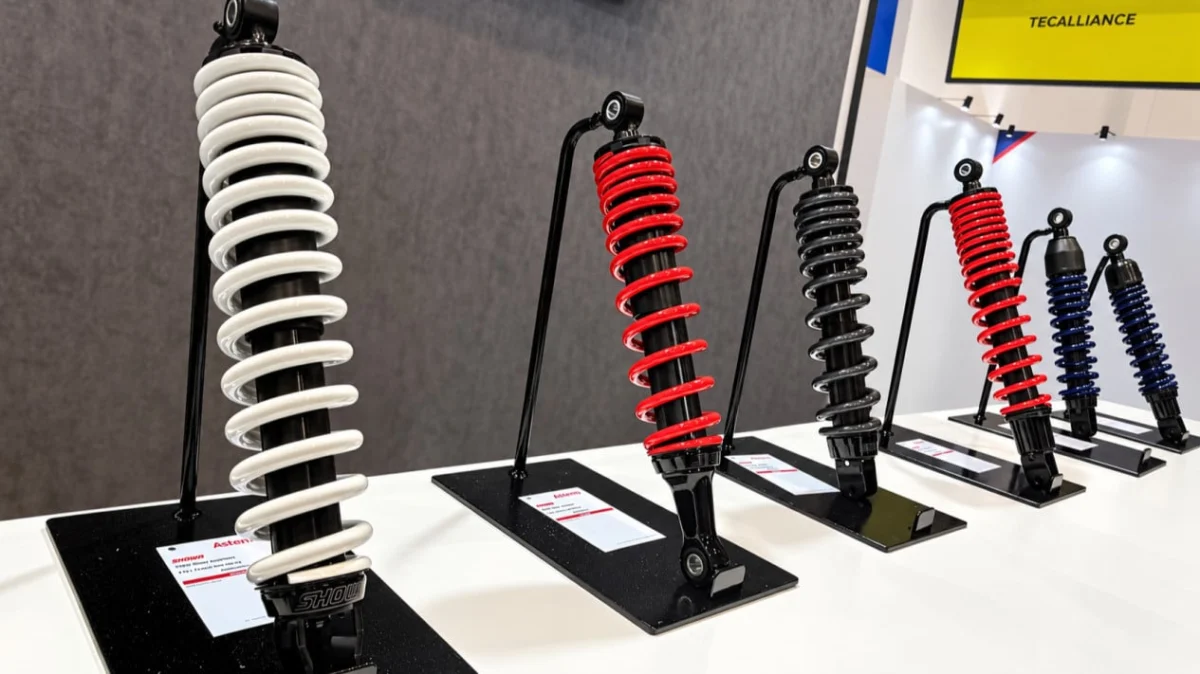
Beyond the fundamental PD technology, the Showa Evo PD integrates several advanced engineering features designed to maximize durability and minimize mechanical resistance. These include a specially engineered progressive spring design that complements the variable damping rate, a progressive bump stopper to safely manage extreme compression events, and low-friction piston rings that reduce internal drag, resulting in a more responsive and supple suspension action throughout its operational lifespan.
Strategic Market Context and the Indonesian Automotive Landscape
The decision by Hitachi Astemo to premiere and market the Showa Evo PD series in Indonesia is underpinned by robust macroeconomic and industry data. According to regional briefings provided during the Automechanika exhibition, the broader Asian market accounts for an estimated 600 million active motorcycles. Within this massive continental footprint, Indonesia stands out as a critical growth engine, characterized by continuous year-on-year fleet expansion and a vibrant motorcycle culture.
Rakesh Gandhi, the Asia Region Aftermarket Business Unit Head for Astemo, emphasized the strategic rationale behind focusing corporate resources on the Indonesian market. During his address at the exhibition, Gandhi noted that the sheer scale of the vehicle population—surpassing 120 million units—creates an exceptionally resilient aftermarket ecosystem. Furthermore, Astemo’s market research indicates a profound demographic shift among Indonesian motorcyclists. Younger consumers, in particular, are increasingly tech-savvy, performance-conscious, and willing to invest in premium aftermarket modifications that enhance both the aesthetic appeal and the functional capabilities of their daily rides.
While the Showa Evo PD represents a fresh offering for the local aftermarket sector, the underlying brands—Showa, Keihin, Nissin, and Tokico—are far from unfamiliar to Indonesian motorists. For decades, these Japanese engineering marques have supplied OEM components for millions of motorcycles manufactured and sold across the archipelago by major global brands. Consequently, the introduction of the Showa Evo PD leverages substantial brand equity and consumer trust built over generations of reliable motoring.
Chronology of the Launch Event at Automechanika 2026
The rollout of the Showa Evo PD was executed within the framework of the Automechanika trade show, a premier B2B and B2C automotive exhibition series that regularly attracts industry leaders, parts distributors, and automotive enthusiasts from across Southeast Asia.
Morning Session: Industry Stakeholder Briefings
The event commenced on the morning of Friday, September 25, 2026, with closed-door meetings between Astemo regional executives and key Indonesian distribution partners. Discussions centered on supply chain logistics, warranty frameworks, and technician training programs designed to ensure proper installation and tuning of the Showa Evo PD units.
Afternoon Session: Official Product Reveal
At 23:10 WIB, the official public unveiling took place at the Astemo exhibition booth within the NICE complex in PIK 2, Tangerang. Rakesh Gandhi delivered the keynote presentation, detailing the engineering philosophy of Position Dependence and outlining the company’s long-term vision for the Indonesian aftermarket sector. Media representatives and automotive influencers were given exclusive access to static displays, cutaway models of the shock absorber, and technical specification sheets.
Late Afternoon to Evening: Interactive Demonstrations and Expert Panels
Following the unveiling, technical specialists conducted live demonstrations explaining how the progressive spring design and low-friction piston rings function in real-world scenarios. Panel discussions featuring suspension tuners and aftermarket experts explored the safety implications of upgrading from stock suspension to high-end performance dampers, emphasizing that improved stability directly contributes to accident mitigation on challenging roadways.
Implications for Riders, Mechanics, and the Aftermarket Industry
The arrival of sophisticated aftermarket suspension technologies like the Showa Evo PD signals a maturation of the Indonesian motorcycle enthusiast community. As urban infrastructure faces congestion and varying standards of road maintenance, vehicle owners are increasingly prioritizing ergonomic comfort and active safety over basic cosmetic modifications.
Enhanced Safety and Ergonomics
From an ergonomic standpoint, upgrading to a suspension system that intelligently adapts to load variations dramatically reduces rider fatigue on long-distance commutes or touring trips. Back pain and joint strain, frequently induced by stiff or worn-out stock suspension units absorbing repetitive shock impacts, can be substantially mitigated. From a safety perspective, maintaining optimal tire contact during emergency braking maneuvers or evasive steering actions prevents loss of traction, thereby lowering crash risks.
Economic Ripple Effects for Local Businesses
The proliferation of premium aftermarket parts also invigorates local independent workshops and specialized tuning garages. Mechanics and technicians must undergo specialized training to understand the nuances of adjustable damping, spring preload calibration, and oil viscosity tuning associated with advanced units like the Showa Evo PD. This knowledge transfer elevates the technical competency of the domestic automotive service sector, creating higher-value employment opportunities and fostering a more professionalized secondary market.
Environmental and Durability Considerations
Durability is another critical vector. By utilizing high-grade materials, precision-machined low-friction rings, and robust sealing mechanisms, premium aftermarket suspensions reduce the frequency of replacement cycles. While the initial investment cost for a specialized shock absorber exceeds that of standard factory replacements, the extended service life and rebuildability of high-end units offer long-term economic advantages to daily commuters.
Future Outlook for Hitachi Astemo in Southeast Asia
The successful introduction of the Showa Evo PD at Automechanika 2026 serves as a bellwether for Hitachi Astemo’s regional strategy. As urbanization accelerates across Southeast Asia, the demand for personal mobility solutions that balance efficiency, safety, and driving pleasure will only intensify.
Astemo has signaled its intent to leverage its deep technological heritage—spanning powertrain management, braking systems, and advanced chassis dynamics—to capture a larger share of the expanding aftermarket pie. By localizing distribution networks and tailoring product lineups to the specific geographical and behavioral demands of Indonesian riders, the company is positioning itself as a dominant force in the evolution of two-wheeled performance engineering.
Ultimately, the Showa Evo PD transcends being merely a new hardware catalog entry; it represents a paradigm shift in how everyday motorcyclists interact with their machines and the road infrastructure beneath them. As these advanced suspension units begin appearing on local motorcycles across Jakarta, Surabaya, Bandung, and beyond, Indonesian riders are poised to experience a new standard of ride quality, stability, and control.