The maritime industry is reeling following a catastrophic fire aboard a foreign-flagged bulk carrier docked at the Beihai Shipbuilding facility in Qingdao, China. The incident, which occurred on Thursday, September 10, 2026, resulted in the tragic loss of 25 lives, marking one of the most significant industrial maritime accidents in the region in recent years. While emergency response teams managed to bring the blaze under control within a few hours, the scale of the human toll has prompted an immediate investigation into the safety protocols and maintenance operations currently underway at one of China’s most prominent shipbuilding hubs.
The Chronology of the Incident
According to reports verified by state-run media outlets, including CCTV and Xinhua, the vessel—a large bulk carrier currently undergoing maintenance—was moored at the Beihai Shipbuilding yard in the coastal province of Shandong. The sequence of events began on the morning of September 10.
At approximately 11:15 a.m. local time, smoke was observed emanating from the vessel’s lower decks, where maintenance work was reportedly being conducted. The fire spread with alarming speed, likely exacerbated by the presence of industrial materials, fuel, or cargo remnants typically found in bulk carriers undergoing refitting or repairs.
The shipyard’s emergency response teams, supported by local Qingdao firefighting units, were deployed immediately to the scene. The intensity of the inferno required significant resources to contain, as the fire threatened to spread to other vessels docked in the immediate vicinity. After a grueling three-hour battle against the flames, authorities confirmed that the fire was successfully extinguished by 2:30 p.m. local time.
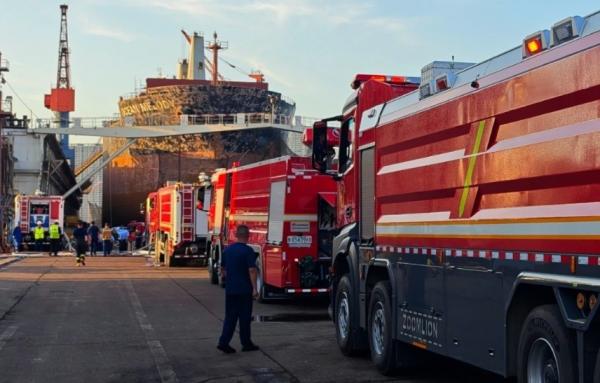
Of the 42 crew members present on the vessel at the time of the incident, 17 were accounted for by late afternoon. Among the survivors, five individuals sustained injuries ranging from smoke inhalation to moderate thermal burns and were transported to local hospitals in Qingdao for urgent medical treatment. Tragically, the remaining 25 crew members were confirmed deceased, with recovery teams locating their remains in the aftermath of the blaze.
Understanding the Context of Beihai Shipbuilding
The Beihai Shipbuilding facility in Qingdao is a critical node in China’s massive maritime infrastructure. As a subsidiary of the China Shipbuilding Industry Corporation (CSIC), the yard specializes in the construction, repair, and conversion of large-scale commercial vessels, including bulk carriers, tankers, and container ships.
The incident has brought intense scrutiny to the shipyard’s safety standards. Industrial accidents in the maritime sector, particularly those involving fire during welding or repair operations, are not unheard of, but a casualty rate of this magnitude is rare in modern, highly regulated Chinese shipyards. The facility typically adheres to international maritime safety standards, including those set by the International Maritime Organization (IMO). However, the complexity of modern bulk carrier construction—which involves hazardous materials, complex electrical systems, and confined spaces—makes fire prevention a constant challenge.
Emergency Response and Official Inquiries
In the immediate wake of the disaster, the local government in Qingdao established an emergency task force to oversee the recovery operation and, subsequently, the investigation. Senior officials from the Shandong provincial government and the Ministry of Transport have reportedly arrived at the site to coordinate with the shipyard management.
While official statements have remained guarded as the investigation progresses, preliminary assessments suggest that the fire may have been triggered by a technical malfunction or a violation of safety protocols during hot work (such as welding or cutting) in the ship’s holds. The identity of the deceased, including their nationalities, has not been fully disclosed by authorities as they work to notify the respective embassies and next of kin.

International maritime law dictates that the flag state of a vessel is primarily responsible for the conduct of safety investigations; however, because the vessel was in a Chinese shipyard, the Chinese Maritime Safety Administration (MSA) will lead the inquiry, likely in cooperation with the flag state’s maritime authorities.
Maritime Safety Implications
The loss of 25 lives raises urgent questions regarding fire safety on ships undergoing maintenance. In the shipping industry, the period during which a vessel is "in drydock" or undergoing major repairs is often considered the most dangerous. During these periods, fixed fire-suppression systems (such as CO2 flooding) are often deactivated to allow for welding and grinding, leaving the ship reliant on temporary firefighting measures.
Safety experts argue that this incident may lead to a tightening of international regulations regarding the "hot work" permits issued during ship repairs. Furthermore, the incident serves as a grim reminder of the risks faced by shipyard workers and the crew members who remain on board during these essential maintenance phases.
The International Chamber of Shipping (ICS) and other global maritime bodies are expected to monitor the outcome of the Qingdao investigation closely. If the report identifies systemic failures in the shipyard’s safety management system, it could lead to stricter inspections of major shipyards globally, impacting the timelines and costs of maritime maintenance operations worldwide.
Broader Economic and Industrial Impact
The port of Qingdao is one of the busiest in the world, and the Beihai Shipbuilding yard is a major contributor to the regional economy. The immediate impact of the fire has been the temporary suspension of operations in the affected area of the shipyard. While the disruption is expected to be localized, the reputational damage to the yard and the potential for a prolonged investigation could delay the delivery of other vessels currently under contract.

Beyond the logistical challenges, the psychological impact on the maritime community is significant. The incident comes during a volatile period for global shipping, which has been grappling with geopolitical tensions in various maritime chokepoints and increasing pressure to decarbonize the global fleet.
Moving Forward: Recovery and Accountability
As the investigation enters its next phase, the primary focus will remain on the identification of the victims and the forensic analysis of the ship’s wreckage. Investigators are currently recovering the ship’s "black box" (Voyage Data Recorder) and maintenance logs to reconstruct the events of the morning of September 10.
For the families of the 25 victims, the wait for answers will be agonizing. International labor organizations are already calling for transparency in the investigation, urging authorities to ensure that the findings are made public to prevent future occurrences.
The tragedy in Qingdao is a stark illustration of the inherent risks in the global supply chain. Behind the statistics of international trade and the massive scale of industrial output, the human cost of maintaining the world’s fleet remains a sobering reality. As the maritime industry continues to evolve, the lessons learned from the fire on this bulk carrier will undoubtedly play a pivotal role in shaping future safety policies and the standard of care provided to those who work at sea.
Authorities have stated that they will provide further updates as the investigation progresses, with a comprehensive report expected to be released in the coming weeks. For now, the global maritime community remains in mourning, honoring the lives lost in what will likely be recorded as one of the most tragic industrial accidents of the decade.