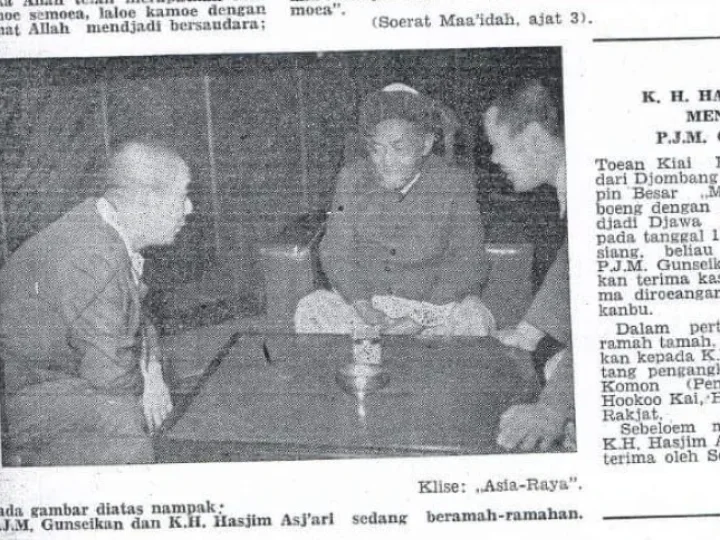
Among the millions of documents meticulously preserved within the hallowed halls of the National Archives of the Republic of Indonesia (ANRI), a single newspaper page stands as a silent yet potent testament to the tumultuous journey of the Indonesian nation during the Japanese occupation. The Asia Raya newspaper, in its edition dated 20 March 2604 (corresponding to 20 March 1944 in the Gregorian calendar), featured a prominent photograph of Hadratussyekh KH. Hasyim Asy’ari on its front page. At first glance, the image simply portrays an elderly, revered Islamic scholar (ulama) seated serenely, his hands gently folded in his lap. His countenance appears tranquil, betraying no overt signs of distress or suffering. Yet, beneath this veneer of calm lies a deeply complex narrative of unwavering spiritual fortitude, a staunch defense of religious principles against overwhelming military might, and the very real physical torment he endured for his convictions at the hands of the Japanese military administration.
For historians and researchers, this photograph transcends mere visual documentation; it functions as an invaluable primary source, meticulously recording a pivotal shift in the intricate relationship between the Japanese occupying government and the influential ulama class in Indonesia. The archival discovery illuminates a profound paradox: an ulama who had been incarcerated and subjected to torture just two years prior for his refusal to acquiesce to Japanese policies was now prominently featured in the official media outlet of the very same occupying power. This stark contrast imbues the photograph with immense historical significance, ensuring its continued relevance as a focal point for scholarly inquiry and public fascination. The image not only captures a moment in time but also encapsulates the complex interplay of power, resistance, adaptation, and propaganda that defined this critical period in Indonesian history.
The Shadow of Occupation: Japan’s Rule in Indonesia (1942-1945)
To fully grasp the magnitude of the Asia Raya photograph, it is essential to contextualize it within the broader framework of the Japanese occupation of the Dutch East Indies, which commenced in early 1942. Following their rapid military successes against Allied forces, Japan swiftly seized control of the archipelago, ending over three centuries of Dutch colonial rule. Initially, many Indonesians, particularly nationalist figures, viewed the Japanese as liberators, offering a glimmer of hope for independence under the banner of "Asia for Asians." However, this initial optimism quickly soured as the true nature of Japanese rule became apparent. The Japanese military administration, or Gunseibu, implemented a harsh and exploitative regime characterized by forced labor (romusha), resource extraction for their war effort, and stringent political and social control. All aspects of life, from education to media, were subjected to strict censorship and directed towards supporting Japan’s Greater East Asia Co-Prosperity Sphere.
Central to Japanese policy was the imposition of their cultural and spiritual values. This included the mandatory practice of seikeirei, a ritual bowing towards Tokyo in the direction of the Japanese Emperor, considered a divine figure in Shintoism. This practice clashed directly with the monotheistic tenets of Islam, which prohibits bowing to anyone other than God. For devout Muslims and their leaders, the ulama, seikeirei was an act of apostasy, a direct assault on their religious identity and faith. This imposition led to widespread quiet resistance and, in many cases, open defiance from religious communities, particularly among the influential network of pesantren (Islamic boarding schools) and their charismatic leaders.
Hadratussyekh KH. Hasyim Asy’ari: A Pillar of Resistance and Faith
Hadratussyekh KH. Hasyim Asy’ari (1871-1947) stood as one of the most revered and influential ulama in Indonesia, widely recognized for his profound scholarship, spiritual authority, and nationalist sentiments. He was the founder of Nahdlatul Ulama (NU), one of the largest Islamic organizations in Indonesia, established in 1926. NU’s extensive network of pesantren and its mass following provided KH. Hasyim Asy’ari with an unparalleled moral and social authority that extended across Java and beyond. His unwavering commitment to Islamic principles, combined with a pragmatic approach to social engagement, made him a pivotal figure in both religious and nationalist movements.
Upon the Japanese demand for seikeirei, KH. Hasyim Asy’ari, like many other ulama, firmly rejected the practice. He viewed it as a violation of Islamic monotheism (tauhid) and an affront to the dignity of the Indonesian people. His defiance was not merely a personal stance but a powerful statement that resonated deeply within the Muslim community. The Japanese, seeking to consolidate their power and crush any form of dissent, reacted with brutal force. In 1942, shortly after the occupation began, KH. Hasyim Asy’ari was arrested along with several other religious leaders. He was subjected to severe interrogation and physical torture during his detention. This act of oppression, rather than breaking the spirit of the ulama, further solidified their resolve and deepened the resentment among the populace towards the occupiers. His arrest and subsequent suffering became a symbol of resistance against the Japanese regime, demonstrating the profound courage required to uphold religious convictions in the face of brutal authoritarianism.
The Ordeal and the Shift: From Persecution to Propaganda
The Japanese military, initially convinced that brute force and intimidation would suffice to control the Indonesian population, soon realized the limits of such tactics, especially concerning the highly influential religious leaders. The imprisonment and torture of figures like KH. Hasyim Asy’ari, far from quelling dissent, inadvertently fueled it and alienated a significant segment of the population whose cooperation was vital for Japan’s war effort. As the tide of World War II began to turn against Japan, particularly after their strategic defeats in the Pacific, the Gunseibu recognized the urgent need to secure indigenous support and manpower. This realization prompted a strategic re-evaluation of their approach towards the ulama.
By late 1942 and early 1943, a discernible shift in Japanese policy began to emerge. Instead of outright suppression, the occupiers moved towards a strategy of co-optation and controlled engagement. They sought to harness the moral authority and organizational networks of the ulama for their own propaganda purposes, particularly to mobilize support for the "Greater East Asia War" and to recruit romusha. As part of this new strategy, KH. Hasyim Asy’ari was eventually released from prison, although the exact date remains debated among historians, most agreeing it was in late 1942 or early 1943. His release signaled a tactical retreat by the Japanese, an acknowledgment that outright confrontation with such a revered figure was counterproductive.
Following his release, the Japanese sought to integrate KH. Hasyim Asy’ari and other prominent ulama into their administrative structures, albeit under strict supervision. This culminated in the establishment of the Majelis Syuro Muslimin Indonesia (Masyumi) in November 1943. Masyumi was ostensibly a representative body for Indonesian Muslims, but it was, in reality, a Japanese-controlled organization designed to consolidate Islamic support for the war. KH. Hasyim Asy’ari was appointed as its first general chairman, a position that placed him in a precarious but strategically vital role, allowing him to subtly protect Islamic interests while navigating the treacherous political landscape imposed by the occupiers.
Asia Raya: The Voice of the Occupiers
The Asia Raya newspaper serves as a quintessential example of the Japanese propaganda machinery during their occupation. Launched in Batavia (present-day Jakarta) in 1942, shortly after the Japanese invasion, it was the primary Indonesian-language daily newspaper published under strict military supervision. Its entire operation, from editorial content to distribution, was controlled by the Sendenbu, the Japanese military’s Department of Propaganda. The newspaper’s explicit purpose was to disseminate Japanese propaganda, project a positive image of the Imperial Japanese Army, promote the ideals of the Greater East Asia Co-Prosperity Sphere, and foster anti-Western sentiment among the Indonesian populace. It tirelessly glorified Japan’s military prowess and sought to convince Indonesians of their shared destiny under Japanese leadership.
Despite its overt propagandistic function, Asia Raya inadvertently became an invaluable primary source for historians studying the period. It contains a wealth of information about the social, political, and cultural dynamics of Indonesian society under Japanese rule, offering insights into daily life, official policies, and even subtle forms of resistance or adaptation. Its pages chronicle the efforts to mobilize the population, the implementation of economic policies, and the cultural initiatives undertaken by the Japanese. Consequently, scholars frequently consult Asia Raya to reconstruct the complexities of the occupation era, analyzing not just what was explicitly stated but also what was implied, omitted, or strategically highlighted. Among its numerous editions, the 20 March 1944 issue stands out for its depiction of KH. Hasyim Asy’ari, a figure of immense moral authority whose presence in the official propaganda organ represented a significant political maneuver.
The Iconic Photograph: March 20, 1944
The front-page photograph of KH. Hasyim Asy’ari in the 20 March 1944 edition of Asia Raya was far from a casual inclusion. Its appearance was a deliberate and calculated move by the Japanese propaganda apparatus. The image portrays him in a posture of quiet dignity, seated with his hands folded, his face reflecting composure and wisdom. There is no visible sign of the physical hardship he had endured, projecting an image of calm and acceptance. This visual narrative was crafted to serve specific Japanese objectives: to demonstrate a supposed harmony between the occupiers and the revered Indonesian religious leaders, to legitimize Japanese rule by showcasing the support of prominent figures, and to subtly encourage the wider Muslim population to cooperate with the regime.
The choice of March 1944 for this publication is also significant. By this point, Japan’s military situation was deteriorating on multiple fronts, and securing internal stability and resources from occupied territories was paramount. The propaganda value of an image featuring such a respected figure, especially one who had initially resisted and suffered, was immense. It aimed to reassure the populace that their leaders were collaborating, thus implicitly endorsing Japanese rule and urging continued participation in the war effort. The image served as a powerful visual message, intended to convey unity and acceptance, masking the underlying coercion and strategic manipulation.
Unpacking the Image: A Deeper Analysis

The photograph of KH. Hasyim Asy’ari in Asia Raya is a multi-layered historical artifact, revealing much about the power dynamics of the Japanese occupation. On one hand, it represents a propaganda victory for the Japanese. By featuring a figure of his stature, they sought to project an image of benevolent rule and successful integration of local leaders. They aimed to convey that even the most devout and influential figures had come to terms with, and indeed supported, the Japanese administration. This was a crucial psychological tactic to undermine resistance and foster compliance among the broader population.
On the other hand, the photograph also subtly underscores the resilience and enduring influence of the ulama. Despite the immense pressure and suffering, KH. Hasyim Asy’ari remained a figure of profound respect. His very presence in the newspaper, even if manipulated, confirmed his indispensable role in Indonesian society. It demonstrated that the Japanese, despite their military might, could not entirely break the spirit or diminish the authority of figures like him. For the Indonesian populace, seeing their revered leader, though perhaps disconcerting given his past persecution, might also have been interpreted through various lenses – perhaps as a sign of his continued leadership, or a subtle message to navigate the difficult times with wisdom. Historians often debate the extent to which such "co-optation" actually succeeded in securing genuine support versus merely enforcing outward compliance.
The Strategic Turn: Japan’s Co-optation of Religious Leaders
The appearance of KH. Hasyim Asy’ari in Asia Raya was not an isolated incident but a key component of a broader strategic shift in Japanese policy towards religious leaders. Recognizing the failure of their initial repressive tactics, the Japanese implemented a more sophisticated approach focused on winning over, or at least neutralizing, the powerful ulama. This strategy included:
- Establishment of Religious Councils: The creation of organizations like Masyumi (Majelis Syuro Muslimin Indonesia) in 1943 was a prime example. While ostensibly a platform for Muslim representation, Masyumi was heavily controlled by the Japanese, serving as a conduit for their policies and propaganda. However, its formation also inadvertently provided a limited, albeit controlled, space for ulama to organize and communicate, which would prove beneficial in the post-independence struggle.
- Controlled Religious Education: The Japanese attempted to integrate Islamic education into their broader ideological framework, emphasizing loyalty to Japan. Yet, the deep-rooted tradition of pesantren education often allowed for subtle forms of resistance and the preservation of authentic Islamic teachings.
- Engagement with Ulama: Regular meetings and consultations with prominent ulama were initiated, aiming to foster a sense of partnership and gain their endorsement for various Japanese initiatives, from recruitment for romusha to food production drives.
- Media Manipulation: As seen with Asia Raya, the controlled press was utilized to highlight the supposed cooperation between Japanese authorities and local religious figures, projecting an image of unity and shared purpose.
This shift from brutal suppression to strategic co-optation was a pragmatic response to the realities of occupation. The Japanese understood that controlling the hearts and minds of the Indonesian people, especially the majority Muslim population, required the tacit consent or at least the non-resistance of their spiritual guides. The photograph of KH. Hasyim Asy’ari epitomizes this complex and often contradictory policy.
Broader Implications and Legacy
The historical episode surrounding KH. Hasyim Asy’ari’s photograph in Asia Raya carries significant broader implications for understanding Indonesian history and the enduring role of religious leaders:
- Resilience of Religious Authority: The fact that the Japanese eventually felt compelled to feature a previously persecuted ulama underscores the profound and unyielding authority that figures like KH. Hasyim Asy’ari commanded among the Indonesian populace. Their spiritual and moral influence could not be easily crushed by military might.
- Navigating Political Treachery: The situation forced religious leaders into an incredibly difficult position, requiring them to navigate a treacherous political landscape. Their "cooperation" with the Japanese was often a delicate balance of protecting their communities, preserving religious institutions, and subtly resisting while appearing to comply. This experience honed their political acumen, which would prove crucial during the Indonesian War of Independence.
- Foundation for Future Political Mobilization: Organizations like Masyumi, though Japanese-initiated, provided a framework for broader Muslim political engagement. The experience of working within (or subtly subverting) these structures laid some groundwork for the subsequent role of Islamic organizations in the independent Republic of Indonesia.
- Propaganda as a Historical Source: The Asia Raya newspaper itself, despite its original intent, demonstrates how propaganda materials can become invaluable historical sources, offering insights into the strategies of occupiers and the societal responses to them.
Conclusion
The photograph of Hadratussyekh KH. Hasyim Asy’ari on the front page of Asia Raya on 20 March 1944 is far more than a mere archival curiosity. It is a powerful historical artifact, rich with layers of meaning and implication. It stands as a stark visual representation of the complex and often brutal realities of the Japanese occupation of Indonesia, illustrating the dramatic shift in Japanese policy from overt persecution to strategic co-optation of influential religious leaders. More profoundly, it speaks volumes about the indomitable spirit and unwavering faith of figures like KH. Hasyim Asy’ari, whose moral authority proved resilient even in the face of immense suffering and oppression. The image serves as a constant reminder of the intricate dance between power and resistance, propaganda and principle, that shaped the destiny of a nation on the cusp of independence. Its continued study by historians ensures that the lessons of this critical period, and the sacrifices made, remain vividly preserved for future generations.