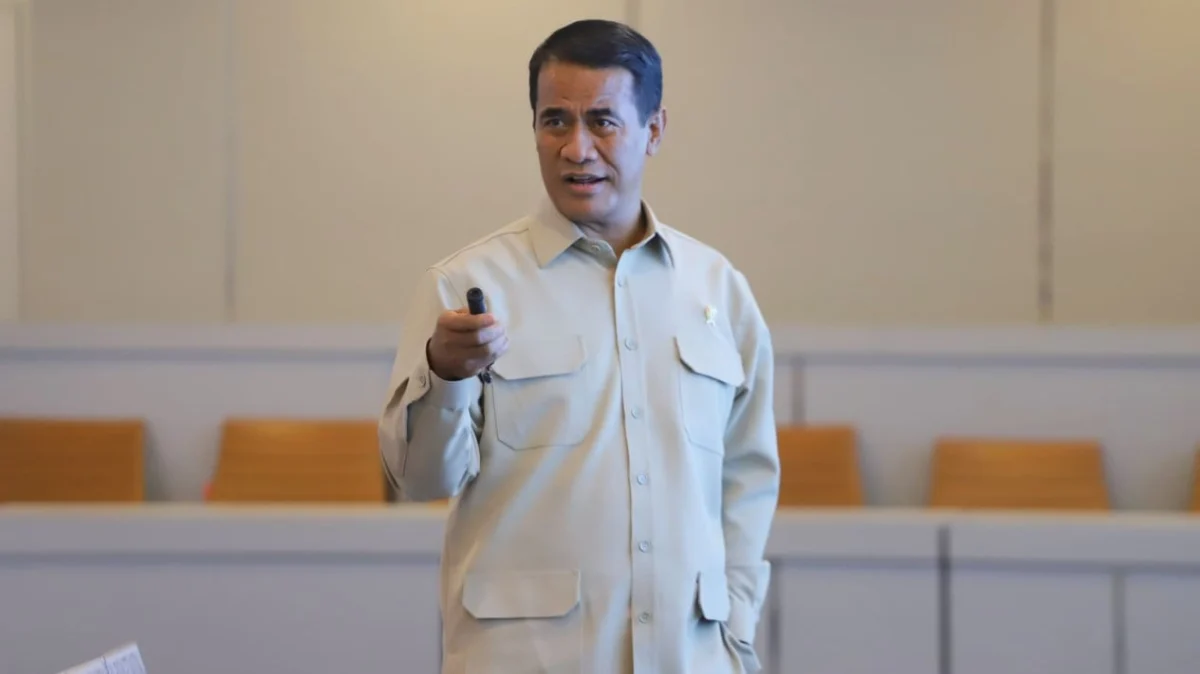
Jakarta, VIVA – In a resolute statement delivered on Monday, July 20, 2026, Minister of Agriculture (Mentan) Andi Amran Sulaiman vehemently refuted widespread allegations claiming that agricultural land in Papua was being acquired from local communities at an unfairly low price of Rp 100,000 per hectare. Speaking at a significant youth forum, Minister Amran underscored that such narratives constituted "cruel slander" against the government and its developmental initiatives, asserting unequivocally that all agricultural land developed under government programs in Papua remains the rightful property of the local communities.
The Minister’s clarification came during the 65th Milad (anniversary) Reception of the Ikatan Pelajar Muhammadiyah (IPM) and the IPM National Work Meeting, an event themed "Resonansi Algoritma Pelajar Berdampak" (Resonance of Impactful Student Algorithms), held at the Universitas Muhammadiyah Jakarta. The gathering brought together an impressive contingent of approximately 2,000 IPM cadres from across Indonesia, representing a vital segment of the nation’s youth and future leaders. It was in this dynamic setting that Amran chose to address the contentious issue, highlighting the government’s commitment to transparency and empowering the next generation with accurate information.
Addressing Misinformation at a Youth Forum
The formal proceedings of the IPM event, a crucial platform for student engagement and policy discourse, were momentarily paused for a direct dialogue session. It was during this segment that Muhammad Tamim Setiaji, an IPM delegate from Tangerang Selatan, Banten, posed a pointed question to the Minister. Tamim referenced the circulating information regarding the alleged undervaluation of land in Papua, specifically mentioning the Rp 100,000 per hectare figure. He sought clarification from the Minister, emphasizing the need for young people to assess such issues rationally amidst a deluge of information, often unverified, permeating public discourse.
Minister Amran seized the opportunity to directly confront these "fitnah" or slanders, stating that the information was entirely inconsistent with the realities on the ground. He expressed concern over the deliberate spread of misinformation, which he characterized as a concerted effort to undermine public trust and discredit genuine government efforts aimed at improving the welfare of Papuan communities. The Minister’s presence at the IPM event itself was a strategic move, leveraging a respected youth organization to disseminate accurate information and foster a more informed understanding of complex development issues. Muhammadiyah, a large Islamic organization in Indonesia, has a vast network of educational institutions and youth movements like IPM, making it an influential voice among students and the broader community.
Papua’s Agricultural Transformation: A Community-Centric Approach
In his detailed response, Minister Amran meticulously outlined the government’s approach to agricultural development in Papua, directly countering the narrative of forced or undervalued land acquisition. He emphasized that the programs are not designed to take over community land but rather to collaborate with and empower local populations. "That is cruel slander. One of them is the land price of Rp 100,000 per hectare. That is a very cruel slander against the government, including us who are running the program. In fact, the reality is not like that at all," Amran stated emphatically.
Instead of acquiring land, the government initiates and supports the construction of new agricultural areas, particularly rice fields, which are then designated as the exclusive property of the local communities. This model, according to the Minister, ensures that the benefits of increased agricultural productivity directly accrue to the Papuan people. The government’s role extends beyond mere land preparation; it encompasses comprehensive support, including the provision of essential infrastructure such as irrigation networks, and the distribution of agricultural machinery (alsintan) – all provided free of charge to the farmers.
Amran highlighted the significant scale of these interventions, reporting that the government has, to date, developed approximately 137,000 hectares of agricultural land across various regions in Papua. This extensive development is part of a broader national strategy to enhance food security and promote economic growth in eastern Indonesia, a region historically underserved in terms of infrastructure and development. The Minister proudly declared that all these developed lands remain under the ownership of the local communities, serving as a testament to the government’s commitment to respecting indigenous land rights and fostering sustainable livelihoods.
Substantial Investment and Holistic Support
The Minister further elaborated on the massive financial commitment backing these initiatives. He stated that the value of assistance provided to Papuan farmers through these programs runs into "trillions of rupiah." While specific budgetary breakdowns were not detailed in his address, this figure underscores the significant investment by the central government aimed at uplifting the agricultural sector in Papua. This investment covers a wide array of support mechanisms designed to boost productivity and improve the overall welfare of farmers.
Beyond land development and infrastructure, the government’s holistic approach includes:
- Provision of Agricultural Machinery: Hundreds of units of agricultural machinery, ranging from tractors and rice planters to harvesters, have been dispatched to Papua. This mechanization is crucial for increasing efficiency, reducing manual labor, and enabling multiple cropping cycles, thereby enhancing overall agricultural output.
- Establishment of Food Brigades: The formation of "Brigade Pangan" (Food Brigades) suggests an organized effort to support farmers, possibly through technical assistance, pest control, or post-harvest management, ensuring a more resilient food production system.
- Irrigation Network Development: Robust irrigation systems are fundamental to modern agriculture, especially for rice cultivation. The construction and rehabilitation of irrigation networks guarantee a consistent water supply, mitigating the risks associated with erratic rainfall and expanding the cultivable area.
- Support for Local Commodities: Recognizing the unique ecological and cultural context of Papua, the government also provides targeted support for the development of indigenous commodities like sago and coconut. This approach not only promotes biodiversity but also respects local traditions and food systems, ensuring that development is culturally sensitive and economically viable for local populations. Sago, in particular, is a staple food for many Papuan communities, and its enhanced cultivation can significantly contribute to local food security and income generation.
"The rice fields belong to the people. None of them belong to the state. We provide agricultural machinery for free. We build irrigation. Even the assistance provided is worth trillions of rupiah. All of that is for the community," Amran reiterated, leaving no room for doubt about the ownership and beneficiary of these programs.
Broader Context of Land Rights and Development in Papua
The issue of land rights in Papua is a deeply sensitive and complex matter, often intertwined with historical grievances, economic disparities, and the push for development. Large-scale development projects in the region, while promising economic growth, have sometimes faced scrutiny over their impact on indigenous communities and their ancestral lands. It is against this backdrop that allegations of undervalued land acquisition can quickly gain traction, tapping into existing concerns about exploitation and marginalization.
Minister Amran’s strong rebuttal and detailed explanation are therefore critical for fostering trust and clarity. The government’s emphasis on community ownership and free provision of resources aims to demonstrate a departure from past practices where development might have been perceived as top-down or extractive. The stated approach aligns with broader national policies that increasingly recognize the importance of indigenous land rights and participatory development models, particularly in regions with diverse cultural landscapes like Papua.
President Joko Widodo’s administration has consistently highlighted the acceleration of development in Papua as a national priority, encompassing infrastructure, education, health, and economic empowerment. Agricultural development, as spearheaded by Minister Amran, forms a crucial pillar of this strategy, aiming to transform Papua into a significant food-producing region while ensuring the prosperity of its inhabitants. The 137,000 hectares of developed land symbolize not just agricultural expansion but also an investment in the long-term food security and economic self-sufficiency of Papuan communities.
Implications for Public Trust and Policy
The Minister’s direct engagement with youth at the IPM event signifies the government’s recognition of the power of information and the need to counter misinformation proactively. In an era of rapid digital communication, false narratives can quickly spread and erode public trust, hindering the implementation of vital development programs. By providing factual counter-arguments and inviting rational inquiry, the government aims to empower citizens, especially the youth, to critically evaluate information and support evidence-based policy discussions.
The implications of Minister Amran’s statement extend beyond merely refuting a specific rumor. It reinforces the government’s commitment to:
- Transparency and Accountability: By openly addressing allegations, the government demonstrates a willingness to be held accountable and to clarify its actions.
- Community Empowerment: The focus on community ownership and free provision of resources underscores a strategy aimed at empowering local populations rather than displacing them.
- Sustainable Development: Supporting local commodities and building robust agricultural infrastructure contributes to sustainable economic growth that respects the unique ecological and cultural context of Papua.
- Combating Disinformation: Direct engagement with influential youth groups is a strategic approach to inoculate the public against misinformation and promote informed civic participation.
In conclusion, Minister Andi Amran Sulaiman’s emphatic denial of land acquisition at Rp 100,000 per hectare in Papua serves as a crucial clarification amidst circulating misinformation. His detailed explanation of the government’s community-centric agricultural development programs, characterized by significant investment, free provision of resources, and unwavering respect for local land ownership, aims to reaffirm trust and underscore a commitment to the genuine welfare and empowerment of Papuan communities. The incident highlights the ongoing challenge of combating disinformation and the importance of transparent communication in fostering public understanding and support for national development initiatives, particularly in sensitive regions like Papua.