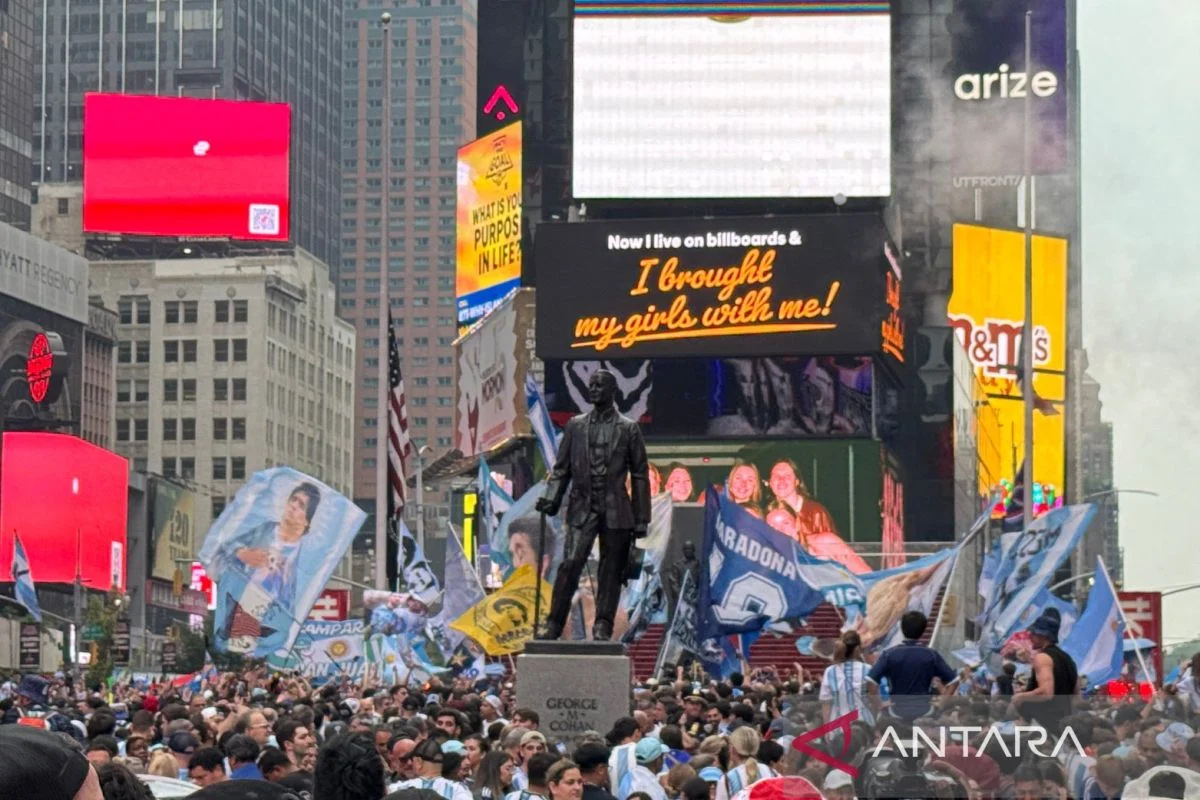
On a vibrant Saturday afternoon, the iconic crossroads of the world, Times Square in Manhattan, New York City, underwent a dramatic transformation, becoming a pulsating epicenter of Argentinian national pride. Thousands of fervent supporters of the Albiceleste converged on the bustling plaza, turning the commercial hub into a sea of blue and white, their collective enthusiasm a powerful prelude to the FIFA World Cup 2026 Final scheduled for the following day. The air buzzed with an electrifying mix of anticipation and joy, as fans from across the globe, united by their passion for football and their national team, celebrated their journey to the pinnacle of the sport.
The Blue and White Tide in Times Square
The overwhelming majority of the supporters proudly donned the home jersey of the Argentinian national team, many bearing the revered name "Messi" and the iconic number 10 on their backs, a tribute to their captain, Lionel Messi, widely regarded as one of the greatest footballers of all time. Beyond the sea of jerseys, a kaleidoscopic display of national identity unfolded. Large Argentinian flags billowed in the afternoon breeze, alongside banners emblazoned with the likeness of the legendary Diego Maradona, whose spirit continues to inspire generations of Argentinian footballers and fans. The number 10, synonymous with both Maradona and Messi, was a recurring motif, appearing on countless flags and homemade signs, symbolizing a lineage of footballing greatness.
The heart of the gathering centered around the statue of George M. Cohan on the northern side of Times Square. Here, the crowd erupted into a symphony of traditional Argentinian football chants and songs of support, their voices echoing through the canyon of skyscrapers. The atmosphere was one of pure, unadulterated euphoria, a testament to the deep cultural significance of football in Argentina. The demographic of the crowd was remarkably diverse, spanning generations from eager children to seasoned elderly fans, with even toddlers seen amidst the vibrant throng, embodying the intergenerational passion for the sport.
While the vast majority were Argentinian, a scattering of Spanish national team supporters could be observed interspersed within the crowd. However, their presence did not ignite any friction; instead, the overall sentiment was one of shared passion for the beautiful game, even amidst the rivalry. As the afternoon progressed, the influx of supporters grew steadily, transforming Times Square into an even more densely packed spectacle. Waves of fans continually approached the central gathering points, their arrival marked by fresh bursts of cheering and enthusiastic renditions of team anthems, underscoring the escalating excitement for Sunday’s monumental clash.
A Final of Historic Proportions
The FIFA World Cup 2026 Final, pitting Argentina against Spain, is scheduled for Sunday, July 19, at 3:00 PM local time at the state-of-the-art New York New Jersey Stadium (MetLife Stadium). This highly anticipated showdown represents the culmination of a grueling tournament and a defining moment for both footballing nations. Neither team is willing to leave the tournament empty-handed, with the stakes incredibly high for both continental powerhouses.
Argentina enters the final with the ambition of securing their fourth World Cup title, building upon their previous triumphs in 1978, 1986, and most recently, 2022. For Lionel Messi, this final offers another opportunity to cement his already legendary status, potentially adding a historic fourth star to the Albiceleste jersey. The weight of expectation from a nation that breathes football is immense, and the team will undoubtedly draw inspiration from their rich World Cup history and the passionate support of their global fanbase.
Conversely, Spain is determined to claim their second World Cup crown, having previously lifted the coveted trophy in 2010. After a period of rebuilding and tactical evolution, La Roja has demonstrated remarkable resilience and skill throughout the tournament, showcasing a blend of technical prowess and strategic acumen. A victory would signify a triumphant return to the summit of international football, reaffirming their place among the elite and ushering in a new era of Spanish footballing dominance.
The Road to Glory: Argentina’s and Spain’s World Cup Legacies
Argentina’s World Cup history is etched with moments of unparalleled brilliance and profound national emotion. Their first triumph in 1978, on home soil, was a defining moment for a nation grappling with political complexities, providing a source of immense national pride. Eight years later, in Mexico 1986, Diego Maradona’s transcendent performances, including the infamous "Hand of God" goal and his mesmerizing solo effort against England, led Argentina to their second title, cementing his status as a footballing deity. The 2022 victory, spearheaded by Lionel Messi in Qatar, was particularly poignant, as it delivered the long-awaited global crown for a generation of fans and for Messi himself, fulfilling a lifelong dream and solidifying his claim as the undisputed greatest of his era. Each victory has been celebrated with an fervor that transcends mere sporting achievement, becoming deeply intertwined with the nation’s identity.
Spain’s journey to footballing glory has a different narrative, characterized by a patient evolution and the eventual ascendancy of a unique, possession-based style known as "tiki-taka." For decades, Spain was considered a perennial underachiever on the international stage, despite boasting immensely talented players. However, their fortunes dramatically shifted in the late 2000s, culminating in their historic Euro 2008 victory, followed by their maiden World Cup triumph in 2010 in South Africa. That team, featuring iconic players like Xavi, Iniesta, and Casillas, captivated the world with their intricate passing, tactical discipline, and fluid attacking play, establishing a golden era for Spanish football. Their subsequent Euro 2012 win cemented their status as one of the most dominant international teams in history. The pursuit of a second World Cup title represents not just another trophy, but a reaffirmation of their enduring footballing philosophy and a testament to their continuous development.
Interestingly, throughout the entire history of the FIFA World Cup prior to the 2026 edition, Argentina and Spain had only met once in the tournament’s four-year cycle. This solitary encounter took place during the group stage of the 1966 World Cup in England. In that match, held in Birmingham, Argentina emerged victorious with a 2-1 scoreline. Luis Artime was the hero for Argentina, netting both goals, while José Pirri managed to pull one back for Spain. This historical footnote adds a layer of novelty to the 2026 final, as it marks a rare and significant clash between two nations with rich, yet distinct, footballing traditions.
New York/New Jersey: The Epicenter of Global Football
The selection of New York/New Jersey as the host for the FIFA World Cup 2026 Final underscores the region’s global prominence and its capacity to stage events of monumental scale. The New York New Jersey Stadium, more commonly known as MetLife Stadium, boasts a seating capacity exceeding 82,000, making it one of the largest stadiums in the United States. Its modern facilities and strategic location make it an ideal venue for such a high-stakes encounter, capable of accommodating the massive influx of international visitors, media, and dignitaries.
Hosting the World Cup Final brings with it a multitude of benefits, particularly economic. The influx of hundreds of thousands of fans, tourists, and media personnel is expected to generate billions of dollars in economic activity for the New York metropolitan area. This includes revenue from hospitality services, transportation, retail, dining, and local attractions. Beyond the immediate economic boost, the global spotlight on New York City and the wider New Jersey region provides invaluable international exposure, enhancing its reputation as a premier destination for major international events and tourism.
The FIFA World Cup 2026 itself is a landmark tournament, being the first to feature an expanded format of 48 teams and the first to be co-hosted by three nations: the United States, Canada, and Mexico. This expansion not only increases the number of participating countries but also broadens the geographical reach and cultural impact of the tournament across North America. The decision to award the final to the US, specifically the New York/New Jersey area, highlights the region’s infrastructure, diverse population, and proven track record in managing large-scale events, from Super Bowls to papal visits.
Security and Logistics: Ensuring a Seamless Spectacle
Organizing an event of this magnitude, particularly in a densely populated urban area, presents significant logistical and security challenges. Local authorities, including the New York Police Department (NYPD) and New Jersey State Police, in conjunction with federal agencies such as the Department of Homeland Security and the FBI, have meticulously planned extensive security measures. These include heightened surveillance, increased police presence, crowd control strategies, and coordinated emergency response protocols. The primary objective is to ensure the safety and security of all attendees, from the players and officials to the fans and residents.
Traffic management and public transportation will also be crucial. Special measures are expected to be in place to facilitate the movement of thousands of spectators to and from MetLife Stadium, including enhanced public transit services and designated shuttle routes. Communications from city officials have emphasized the collaborative efforts across various agencies to ensure a seamless and safe experience for everyone involved, reflecting the commitment to showcasing the region’s capability on the global stage. The peaceful coexistence observed in Times Square, even with rival fans, bodes well for the overall atmosphere surrounding the final.
Distinguished Guests and Diplomatic Spectacle
Adding another layer of significance to the already momentous occasion, the final match of the FIFA World Cup 2026 will be graced by the presence of three heads of state from the host nations. United States President Donald Trump, Canadian Prime Minister Mark Carney, and Mexican President Claudia Sheinbaum are all confirmed to attend the highly anticipated clash.
The presence of these high-profile leaders underscores not only the sporting importance of the event but also its diplomatic and political significance. It symbolizes the unity and collaborative spirit among the co-hosting nations, highlighting their successful joint endeavor in organizing the expanded tournament. Their attendance serves as a powerful endorsement of international cooperation through sport and reinforces the global appeal of the FIFA World Cup as a platform for cultural exchange and goodwill. This gathering of leaders at such a pivotal sporting event is a testament to football’s unique ability to transcend national borders and bring together people from diverse backgrounds.
The Enduring Legacy of the 2026 FIFA World Cup
The FIFA World Cup 2026 Final between Argentina and Spain is more than just a football match; it is a global spectacle that encapsulates the dreams, aspirations, and collective passion of billions. For Argentina, it is an opportunity to extend a dynasty and further elevate Lionel Messi’s unparalleled legacy. For Spain, it is a chance to reclaim their position at the pinnacle of international football and inspire a new generation.
Beyond the immediate outcome on the pitch, the tournament, and particularly this final in New York/New Jersey, will leave a lasting legacy. It will undoubtedly boost the profile of football (soccer) in North America, inspiring greater participation and interest in the sport across the United States, Canada, and Mexico. The infrastructure improvements, economic benefits, and enhanced global standing for the host cities will endure long after the final whistle blows. The images of Times Square awash in blue and white, the roar of the crowd at MetLife Stadium, and the convergence of world leaders will forever be etched in the annals of sporting history, celebrating the enduring power of the beautiful game to unite, thrill, and inspire.