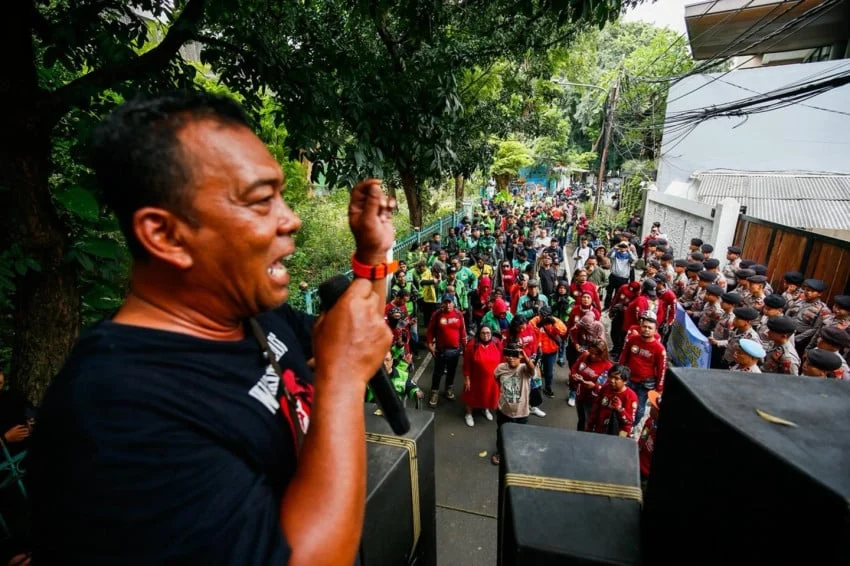
JAKARTA – The office of Saiful Mujani Research and Consulting (SMRC) in Gondangdia, Central Jakarta, became the focal point of a significant public demonstration on Tuesday, April 14, 2026, when a large contingent of online motorcycle taxi (ojol) drivers gathered to voice their strong disapproval. The protest was a direct consequence of a statement made by SMRC founder Saiful Mujani, which was widely interpreted as alluding to efforts to destabilize or even overthrow the government of President Prabowo Subianto. The incident has since ignited a broader debate on freedom of expression, political stability, and the role of public opinion research institutions in Indonesia’s democratic landscape.
The initial protest on April 14 saw hundreds of ojol drivers converge on the SMRC premises, chanting slogans and displaying banners that demanded accountability from Saiful Mujani. Eyewitnesses and media reports from the scene depicted a charged atmosphere, with protestors explicitly calling for Mujani’s arrest and legal prosecution, accusing him of sedition or incitement against the legitimate government. The gravity of their demands underscored the depth of public anger and the perceived seriousness of Mujani’s comments.
The day following the protest, on Wednesday, April 15, 2026, Saiful Mujani himself took to social media platform X (formerly Twitter) to address the unfolding situation. In a series of posts, he confirmed the April 14 demonstration by the ojol community and revealed that further protests were anticipated. "People calling themselves the association of ojol and today a group of students are said to be storming my office," Mujani wrote on his official account, @saiful_mujani. He also granted SindoNews permission to quote his statements, further highlighting the public nature of the escalating conflict. Mujani’s posts concluded with a poignant reflection on the evolving political climate: "The arena of conflict is expanding from ‘rakyat vs istana’ (people vs. palace) to ‘rakyat vs rakyat’ (people vs. people) as well. The cost of a stance." This observation by Mujani suggested a deepening polarization within Indonesian society, where political disagreements were no longer confined to traditional power structures but were manifesting as direct confrontations among different segments of the populace.
Chronology of Escalation
The events leading to the protest and its aftermath unfolded rapidly, showcasing the swift mobilization capabilities of various groups in Indonesia, particularly through digital platforms.
- Pre-April 14, 2026: Saiful Mujani reportedly makes a statement, the exact wording of which was not provided in the initial reports but was widely interpreted as critical of the newly inaugurated administration or as suggesting methods of opposition that some deemed subversive. While the specific context remains partially obscured, such statements, especially from influential public figures, often gain traction quickly through social media and word-of-mouth.
- Tuesday, April 14, 2026: Hundreds of online motorcycle taxi drivers, identifying themselves as members of various ojol associations or simply as concerned citizens, gather outside the SMRC office in Gondangdia, Central Jakarta. The protest is vociferous, with participants demanding the arrest and trial of Saiful Mujani for his alleged comments. The presence of such a large and visible group draws significant media attention, elevating the issue to national discourse.
- Wednesday, April 15, 2026 (Morning): Saiful Mujani posts on his X account, acknowledging the previous day’s protest and indicating that his office is bracing for further demonstrations, this time involving both ojol groups and student collectives. His tweet underscores the expanding scope of the protests and his perception of the shifting dynamics of political conflict in Indonesia.
Background: Saiful Mujani and SMRC’s Role in Indonesian Politics
Saiful Mujani is a highly prominent figure in Indonesian academia and public opinion research. As a political scientist and the founder of SMRC, he has played a significant role in shaping political discourse and providing data-driven insights into voter behavior and public sentiment. SMRC itself is recognized as one of Indonesia’s leading independent survey institutions, renowned for its pre-election polls, public policy research, and socio-political analysis.
Established with a commitment to scientific rigor and objectivity, SMRC has historically provided crucial data that has informed election campaigns, policy decisions, and public understanding of political trends. Its surveys are often cited by media, politicians, and academics, making its pronouncements influential. The institution’s independence has generally been a hallmark of its operations, striving to provide unbiased data even when findings might be uncomfortable for various political factions. This established credibility makes any controversy involving its founder particularly noteworthy, as it can raise questions about academic freedom, the neutrality of research, and the potential for political pressure on independent institutions.
In a political landscape where public trust in institutions can be fragile, the role of survey organizations like SMRC is dual-edged. While they provide essential metrics for democratic processes, their interpretations and public statements can also become lightning rods for political contention, especially during sensitive periods such as the early stages of a new presidential administration.
The Substance of the Alleged Statement and Its Sensitivity
While the exact statement made by Saiful Mujani that triggered the protests was not detailed in the original report, its characterization as "alluding to efforts to overthrow President Prabowo Subianto" points to its highly sensitive nature. In Indonesia, any rhetoric perceived as undermining the constitutional order or inciting rebellion against a legitimately elected government carries significant legal and political weight. The concept of makar (treason or subversion) is a serious charge under Indonesian law, often invoked in cases where individuals or groups are seen as threatening national stability or the integrity of the state.
During the initial phase of a new presidential term, such as that of President Prabowo Subianto, the political atmosphere is often particularly charged. Administrations typically seek to consolidate power, build public confidence, and demonstrate stability. Any public commentary, especially from influential figures, that suggests or supports destabilizing actions can be met with strong reactions from government supporters and security apparatuses. The perception of such statements can be amplified through social media, leading to rapid mobilization of counter-movements, as evidenced by the ojol protest.

The incident highlights a recurring tension in Indonesian democracy: the balance between guaranteed freedom of speech and the state’s prerogative to maintain order and prevent incitement. Public intellectuals and researchers often navigate this delicate line, providing critical analysis that can be interpreted differently by various political actors.
The Online Motorcycle Taxi (Ojol) Community as a Political Force
The mobilization of online motorcycle taxi drivers in the protest against SMRC is a significant aspect of this event. The ojol community in Indonesia represents a massive demographic, numbering in the millions across major cities. These drivers are not merely a workforce; they are a highly connected, often organized, and politically aware segment of society. Their collective power has been demonstrated in various contexts, from advocating for better working conditions and fairer regulations to participating in broader social and political movements.
Factors contributing to their political significance include:
- Large Numbers: Their sheer multitude provides substantial physical presence in protests.
- Ease of Mobilization: Digital platforms and established networks among drivers facilitate rapid communication and assembly.
- Socio-economic Vulnerability: Many drivers operate on thin margins, making them susceptible to economic and political pressures, and sometimes to organized influence.
- Direct Public Interface: As they interact with a vast cross-section of society daily, their opinions and actions can resonate widely.
The involvement of ojol drivers in this specific protest raises questions about the authenticity of grassroots anger versus potential orchestration. While genuine anger over perceived insults to the presidency could certainly motivate some drivers, the organized nature of such large-scale protests often suggests a degree of coordination or encouragement from specific political factions or interest groups. This dynamic reflects the broader pattern in Indonesian politics where various social groups, including labor unions, student organizations, and religious groups, can be mobilized for political ends.
Broader Implications for Indonesian Democracy and Free Speech
Saiful Mujani’s remark about the conflict expanding from "rakyat vs istana" to "rakyat vs rakyat" encapsulates a crucial concern for Indonesia’s democratic health. Such intra-societal conflicts, particularly when fueled by political rhetoric and facilitated by social media, can lead to deeper societal divisions, erosion of trust, and potential instability.
The incident carries several broader implications:
- Freedom of Academic and Political Expression: The protest against SMRC raises alarms among proponents of academic freedom and freedom of speech. If researchers and public intellectuals face physical intimidation and calls for arrest over their interpretations or analyses, it could create a chilling effect, discouraging critical discourse and independent thought. This could ultimately undermine the quality of public debate and policy formation.
- Role of Independent Institutions: The integrity and independence of survey institutions like SMRC are vital for a functioning democracy. They provide objective data that can hold power accountable and inform citizens. Protests aimed at silencing such institutions can be seen as an attempt to control the narrative and suppress dissenting views, thereby weakening democratic checks and balances.
- Political Mobilization and Social Cohesion: The use of large social groups like ojol drivers for political protests, especially those targeting individuals or institutions for their opinions, highlights the potential for instrumentalizing segments of the population. This can strain social cohesion, particularly if different groups are pitted against each other based on political loyalties.
- Consolidation of Power: In the context of a new administration, such protests can be interpreted in multiple ways. On one hand, they could represent genuine popular support for the president and a rejection of perceived threats. On the other, they could be seen as a tactic to consolidate power by signaling that critical voices will not be tolerated, thereby limiting the space for opposition and dissent.
- Impact on Public Discourse: The controversy is likely to intensify debates within Indonesia about what constitutes acceptable political commentary, where the line between legitimate criticism and incitement lies, and how social media platforms contribute to the rapid spread and polarization of these discussions.
Inferred Reactions and Responses
While specific official statements beyond Saiful Mujani’s tweet were not provided, a situation of this magnitude would invariably elicit reactions from various stakeholders:
- From SMRC and Saiful Mujani (Beyond the Tweet): It is highly probable that SMRC, as an institution, would issue a formal statement defending its integrity, the scientific basis of its research, and the right to academic freedom. Saiful Mujani himself might clarify his original statement, perhaps arguing that it was taken out of context or misinterpreted, and reasserting his commitment to democratic principles and national unity, while denying any intent to incite rebellion.
- From the Government/Presidential Palace: The administration would likely issue a call for calm, emphasizing the importance of national unity and adherence to legal processes. While implicitly supporting the public’s right to express their views, they would also likely caution against actions that could lead to public disorder or be interpreted as undermining state authority. There might be subtle messaging to deter further escalation while avoiding direct confrontation with protestors.
- From Civil Society Organizations and Academia: Human rights groups, academic associations, and other civil society organizations would likely voice concerns about the potential for intimidation against researchers and the erosion of freedom of expression. They would advocate for a robust democratic space where critical analysis is tolerated and protected.
- From Pro-Government Groups: Supporters of President Prabowo Subianto would likely justify the ojol protest as a legitimate expression of public support for the president and a defense against perceived attempts to destabilize the government. They might reiterate calls for respect for the newly elected leadership.
- From Opposition Figures/Critics: Political figures and commentators critical of the government might express concern over the use of street protests to silence dissent, viewing it as a worrying trend that could stifle democratic debate.
Conclusion: The Enduring "Cost of a Stance"
The protest at the SMRC office on April 14, 2026, and its subsequent developments, encapsulate a complex moment in Indonesian political life. It underscores the continued sensitivity surrounding political discourse, particularly when it touches upon the stability of the government or the legitimacy of its leadership. Saiful Mujani’s observation that the "arena of conflict is expanding from ‘rakyat vs istana’ to ‘rakyat vs rakyat’" serves as a stark reminder of the potential for deep societal divisions when political tensions are high.
This incident will likely be remembered as a critical test for Indonesia’s democratic maturity, challenging its commitment to freedom of expression while navigating the imperatives of national stability. The "cost of a stance," as Mujani articulated, extends far beyond the individual, impacting the health of public discourse, the independence of research institutions, and the very fabric of social cohesion in one of the world’s largest democracies. The resolution of this situation, and the public and official responses to it, will offer significant insights into the future trajectory of political freedoms and civic engagement in Indonesia.