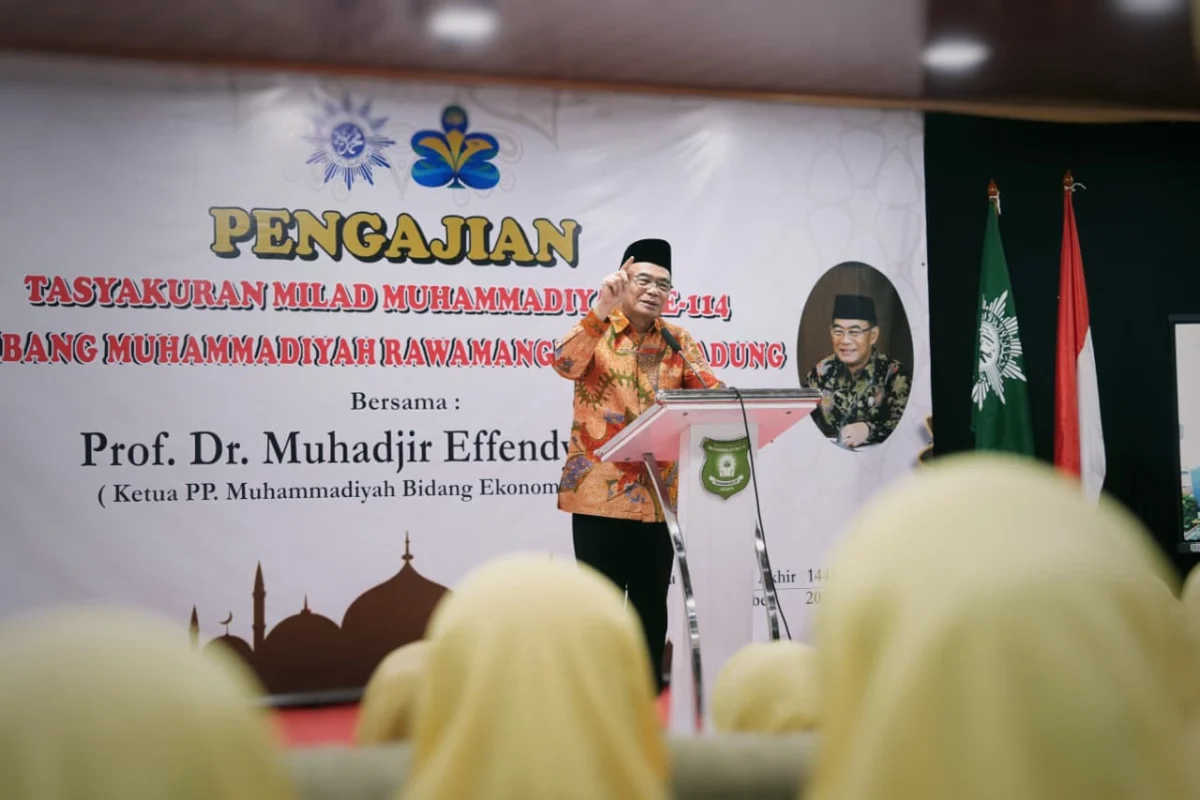
JAKARTA — In a decisive push toward long-term financial autonomy, Chairman of the Central Leadership (PP) of Muhammadiyah, Muhadjir Effendy, has called upon all organizational ranks within the Persyarikatan to fundamentally transform their approach to asset and financial management. Speaking at a high-profile commemorative gathering in East Jakarta, Muhadjir emphasized that stationary funds and underutilized real estate must be converted into dynamic, productive economic engines capable of generating sustainable, recurring revenue streams for one of Indonesia’s largest Islamic socio-educational organizations.
The directive was delivered on Saturday, November 21, during the commemorative lecture celebrating the 114th anniversary of the Muhammadiyah Rawamangun Branch Leadership (PCM). The event took place at the Moch Sjarief Hall within the SMP Muhammadiyah 31 complex in Rawamangun, drawing numerous local chapter leaders, educators, and community stakeholders eager to chart the organization’s financial future in an increasingly complex economic landscape.
Shifting Paradigms: From Capital Preservation to Wealth Generation
At the heart of Muhadjir’s address was a critique of traditional, passive financial administration within community organizations. For decades, religious and social non-profits have frequently adhered to conservative treasury models that prioritize absolute capital preservation—holding funds in low-yield or non-interest-bearing accounts to eliminate risk. However, Muhadjir argued that this defensive posture is no longer sufficient for an organization of Muhammadiyah’s vast operational scale.
He asserted that financial resources must actively work to multiply. Using a vivid financial metaphor that quickly resonated with the audience, Muhadjir remarked that funds left idle represent a missed opportunity for community empowerment.
"Money that is not put to work is money that fails to reproduce; we must ensure that even a single rupiah works to generate returns," Muhadjir stated emphatically during his address.
Rather than allowing capital to sit dormant, Muhammadiyah entities at every level—from regional chapters down to sub-branch units—must adopt professional investment frameworks. This involves identifying secure, high-yield financial instruments, such as compliant time deposits, mutual funds, and strategic business ventures that offer calculated risks alongside predictable financial returns.
According to the PP Muhammadiyah leadership, this shift does not imply reckless speculation. Instead, it demands rigorous financial planning, transparent auditing, and strict adherence to governance standards. By leveraging modern portfolio management techniques, the organization can protect its principal assets while simultaneously unlocking new streams of operational income.
Redefining the Role of the Organizational Treasurer
A cornerstone of Muhadjir’s message was the modernization of the treasurer’s role within Muhammadiyah’s hierarchical structure. Historically, organizational treasurers have viewed their primary mandate through an administrative lens: balancing ledgers, disbursing operational funds, and safeguarding cash reserves against loss or theft.
Muhadjir challenged this conventional job description, arguing that modern treasury management requires proactive financial stewardship. Treasurers can no longer afford to act merely as custodians of capital.
"A treasurer’s primary duty is not simply to hoard money, but to figure out how to circulate capital so that it transforms into a reliable source of revenue," he explained.
This philosophical pivot elevates the position of treasurer from a clerical bookkeeping function to a strategic economic leadership role. Treasurers within PCM and regional leadership (Pimpinan Daerah Muhammadiyah) units are now encouraged to undergo financial literacy training, collaborate with economic development boards, and actively identify viable local commercial opportunities. By viewing balance sheets as dynamic blueprints for growth rather than static historical records, local chapters can build localized economic buffers that insulate them from external macroeconomic shocks.
Context and Chronology: Celebrating 114 Years of Service
The setting for this financial call to action—the 114th anniversary of the Rawamangun branch—provided a poignant backdrop for reflections on longevity and institutional sustainability. Founded over a century ago, Muhammadiyah has grown from a localized Islamic reform movement in Yogyakarta into a nationwide network encompassing thousands of schools, universities, hospitals, clinics, and orphanages.
The chronology of Muhammadiyah’s institutional expansion highlights a persistent challenge: while the social footprint of the organization has expanded exponentially, funding mechanisms have occasionally relied heavily on sporadic philanthropic donations, government subsidies, and tuition or service fees generated by its Amal Usaha Muhammadiyah (AUM)—its network of charitable business ventures.
Over the past decade, leadership at the central level has recognized that relying solely on traditional fundraising models leaves the organization vulnerable to economic downturns, inflation, and shifting demographic realities. The COVID-19 pandemic further underscored the urgency of establishing robust, diversified financial reserves. Events like the Rawamangun milestone celebration have consequently transformed from purely ceremonial gatherings into strategic forums where central executives outline policy priorities for grassroots implementers.
The Strategic Imperative of Endowment Funds and Asset Optimization
To operationalize Muhadjir’s directives, Muhammadiyah has increasingly focused on institutionalizing endowment funds (dana abadi) and comprehensive asset mapping. Endowment funds allow large organizations to invest principal capital in perpetuity, utilizing only the investment yields to fund ongoing programs, institutional expansion, and crisis response initiatives.
During his lecture, Muhadjir highlighted the development of robust endowment structures as a critical pathway toward self-reliance. A well-managed endowment fund provides a perpetual financial cushion that protects core educational and health services from short-term fiscal volatility. Furthermore, these financial mechanisms directly address one of the most pressing internal challenges facing the organization: the welfare of educators, medical personnel, and administrative staff working within AUM institutions.
Across Indonesia, tens of thousands of teachers and healthcare workers dedicate their careers to Muhammadiyah institutions, often earning compensation structures that lag behind their counterparts in the public sector or corporate multinational enterprises. Muhadjir noted that increasing asset productivity and cultivating structured investment yields will directly enable local chapters to improve compensation packages, enhance health insurance benefits, and provide retirement security for loyal staff members.
"When we optimize our assets and generate sustainable revenue, the ultimate beneficiaries are not just the organizational ledgers, but the people who power our mission—our teachers, our medical workers, and the broader community we serve," Muhadjir noted.
Broader Implications and Implementation Challenges
Economic analysts observing the institutional evolution of Indonesia’s major Islamic organizations note that Muhadjir’s call reflects a broader national trend toward professionalized religious philanthropy and asset monetization. Both Muhammadiyah and its counterpart, Nahdlatul Ulama (NU), manage vast portfolios of real estate, educational institutions, and commercial enterprises. Transitioning these legacy assets from low-yield social holdings into high-yield commercial properties represents a massive operational undertaking.
Implementing this vision at the grassroots level, however, is not without challenges. Local chapters, such as the PCM Rawamangun, often operate with volunteer-driven administrative boards that may lack specialized expertise in corporate finance, portfolio management, or commercial real estate development. Bridging this capacity gap will require the Central Leadership to roll out standardized training programs, establish centralized investment consulting units, and enforce rigorous governance frameworks to prevent mismanagement or exposure to high-risk ventures.
Moreover, local chapters must navigate the delicate balance between commercial profitability and Muhammadiyah’s foundational commitment to public service and social welfare. Assets historically dedicated entirely to community outreach cannot be abruptly commercialized without considering the social impact on vulnerable populations who rely on affordable schooling and healthcare.
Conclusion and Future Outlook
As Muhammadiyah looks toward its future following more than a century of continuous public service, the directive articulated by Muhadjir Effendy marks a clear strategic evolution. By reframing asset management as an ethical and organizational imperative, the central leadership is signaling that financial stewardship is inextricably linked to institutional survival and independence.
The success of this initiative will ultimately depend on how effectively regional and branch-level leaders translate these macroeconomic principles into local operational strategies. If local chapters can successfully bridge the gap between traditional community service and modern financial productivity, Muhammadiyah will solidify its position not only as a spiritual and social pillar of Indonesian society, but also as a model of resilient, self-sustaining institutional governance for the decades to come.