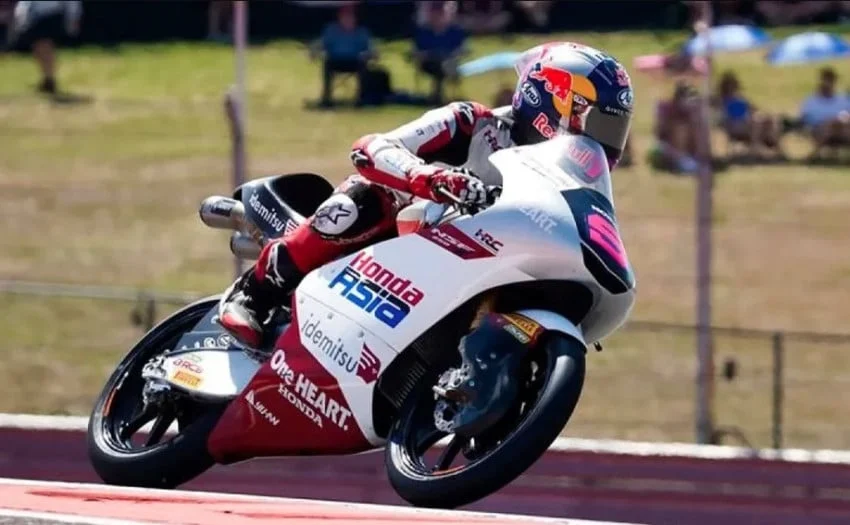
Indonesian rising motorsport star Veda Ega Pratama delivered a masterclass in resilience and racecraft at the Lusail International Circuit, charging through the field to secure a brilliant fourth-place finish in the Moto3 Qatar 2026 Grand Prix. Competing for Honda Team Asia, Pratama’s performance was all the more remarkable given that he was forced to overcome a significant grid handicap, starting from fourteenth position following a penalty incurred during the weekend’s practice sessions.
The season-opening race under the floodlights of Doha provided a dramatic spectacle for motorsport enthusiasts worldwide. While Davis Almansa claimed the top step of the podium after a dominant wire-to-wire performance, it was Pratama’s relentless charge through the pack that captured the attention of pundits and fans alike. The young Indonesian rider demonstrated maturity, strategic acumen, and exceptional pace, cementing his status as one of the most promising talents in the junior classes of Grand Prix motorcycle racing.
Main Facts of the Grand Prix
The Moto3 Qatar 2026 race at the 5.38-kilometer Lusail International Circuit lived up to its reputation for producing slipstream battles and thrilling multi-rider tussles. Davis Almansa, piloting his machine with precision, managed to break away from the chaotic pack early on, dictating the pace from the front and ultimately crossing the finish line first to claim victory. Behind him, Adrian Fernandes secured a hard-fought second place, displaying brilliant defensive and offensive maneuvers in the closing laps. The podium was rounded out by Maximo Quiles, who took third after navigating a fierce battle for the minor podium places.
However, much of the post-race discussion centered on Veda Ega Pratama. Starting down in fourteenth place on the grid, the Honda Team Asia rider executed a textbook recovery drive. By the end of the very first lap, Pratama had already sliced his way through traffic to claim eighth place, signaling his intent to fight for the upper echelons of the points-paying positions. As the race entered its decisive second half, Pratama found himself embroiled in a breathless, high-stakes battle for the leading group alongside established and rising talents such as Joel Kelso, Alvaro Carpe, and Malaysian competitor Hakim Danish.
Though he narrowly missed out on a podium finish, crossing the line just behind the top three, Pratama’s fourth-place finish represents a monumental achievement for both his championship aspirations and the representation of Southeast Asian riders on the global stage.
Chronology of the Race Weekend
The path to Pratama’s fourth-place finish was fraught with adversity, beginning days before the race lights went out in Doha. The chronology of the weekend highlights the mental fortitude required by the young Indonesian to turn a setback into a triumph.
On Friday during the official practice sessions at the Lusail International Circuit, Pratama encountered trouble with race officials. FIM MotoGP Stewards investigated an incident where the Honda Team Asia rider allegedly ignored yellow flags—a strict safety protocol designed to protect marshals and fallen riders on the circuit. Following a review of the incident, the stewards handed down a severe sanction: a six-position grid penalty for Sunday’s main race, compounded by the complete cancellation of his fastest lap times recorded during the infringement.
This punishment dealt a heavy blow to Pratama’s weekend preparations, relegating him to fourteenth on the starting grid on a track where qualifying position and early clean air are traditionally vital for success. Despite the setback, Pratama and his technical crew maintained a professional demeanor, using the remainder of the practice sessions to focus on race pace and tire degradation management rather than single-lap glory.
When the race commenced on Sunday evening, the strategy paid immediate dividends. As the pack surged toward Turn 1, Pratama avoided the typical first-lap turbulence that often plagues mid-grid starters. Displaying exceptional spatial awareness, he picked off opponents systematically. By the conclusion of the opening lap, he had vaulted six positions to eighth.
As the race settled into its rhythm, Almansa established a psychological and physical gap at the front. Meanwhile, Pratama anchored himself within the second group, which quickly morphed into a fierce four-way dogfight involving Kelso, Carpe, and Danish. Lead changes were frequent down the circuit’s long main straight, with riders trading paint and slipstreaming one another through the sweeping medium-and-high-speed corners of the Qatari layout.
Entering the final three laps, Pratama pushed to break into the podium positions, engaging in tactical positional warfare with Quiles and Fernandes. While the podium trio managed to hold off his late-race surge, Pratama successfully defended his fourth place from the chasing group, bringing his Honda machine home safely to secure a stellar haul of championship points.
Supporting Data and Context of the Event
The Lusail International Circuit has historically been a demanding venue for lightweight class machines, where aerodynamics and engine power dictate much of the lap time, often resulting in massive slipstream trains. Pratama’s ability to bridge the gap independently without the benefit of a dedicated towing partner for much of the race underscores the raw speed of his Honda machinery and his own adeptness at maximizing corner exit speeds.
Honda Team Asia has long served as a crucial stepping stone for Asian talent aiming for the pinnacle of MotoGP. Pratama’s integration into the squad marks a continuation of this strategic development pathway. Statistically, overcoming a double-digit grid penalty to finish inside the top five in Moto3 is a rare feat achieved only by riders possessing exceptional race pace. In the 2026 season opener, Pratama’s average race lap time was remarkably close to race winner Almansa, indicating that without Friday’s penalty, a maiden Grand Prix victory or podium would have been well within the realm of possibility.
Official Responses and Team Perspectives
While formal post-race press conferences highlighted the tactical brilliance of race-winner Davis Almansa and the resilience of podium finishers Adrian Fernandes and Maximo Quiles, behind-the-scenes reactions within the Honda Team Asia garage were nothing short of celebratory.
Team management expressed immense satisfaction with Pratama’s composure under pressure. Speaking off the record following the race, senior engineers praised the Indonesian rider for not letting the Friday penalty affect his psychological readiness. Instead of venting frustration over the stewards’ decision, Pratama reportedly channeled his energy into data analysis, working late into the night with his crew to find a bike setup that would allow him to carve through the field efficiently.
Prior to the main race, when asked about the penalty, Pratama had exhibited a mature competitive spirit, issuing a brief statement through team channels affirming that he would channel the disappointment into fuel for a maximum-effort performance on Sunday. True to his word, his aggressive yet calculated driving style on race day validated the team’s unwavering faith in his potential.
Furthermore, reactions from the Southeast Asian motorsport community have been overwhelmingly positive. The fierce, respectful duel between Pratama and Malaysia’s Hakim Danish was widely praised as a shining example of the growing depth of talent emerging from the region, drawing heavy media attention across Asian sports outlets.
Broader Impact and Implications
Veda Ega Pratama’s performance at the Moto3 Qatar 2026 Grand Prix carries significant implications for both his personal career trajectory and the broader landscape of international motorcycle racing.
From a championship perspective, collecting a hefty tally of points from a compromised starting position provides a sturdy foundation for a prolonged campaign. In the high-attrition, hyper-competitive world of Moto3, consistency is frequently the currency of champions. By salvaging fourth place instead of crashing out while trying to force risky overtakes in the early laps, Pratama demonstrated the tactical intelligence that team managers in Moto2 and MotoGP actively seek.
Geopolitically and commercially, Pratama’s success acts as a powerful catalyst for the growth of motorcycle racing in Indonesia. As one of the world’s most passionate markets for two-wheeled motorsport, Indonesia has long craved a homegrown Grand Prix star capable of consistently challenging at the front of a world championship class. Performances like the one witnessed in Doha ignite domestic interest, attract regional sponsorships, and inspire a new generation of riders training in regional academies across Southeast Asia.
As the Moto3 World Championship prepares to pack its equipment and move on to the next round of the grueling global calendar, all eyes will inevitably remain fixed on the #- machine of Veda Ega Pratama. If his performance at the Lusail International Circuit is any indication of what is to come, the 2026 season promises to be a breakout year for the young Indonesian prodigy, setting the stage for what could very well be a historic campaign in the lightweight class.