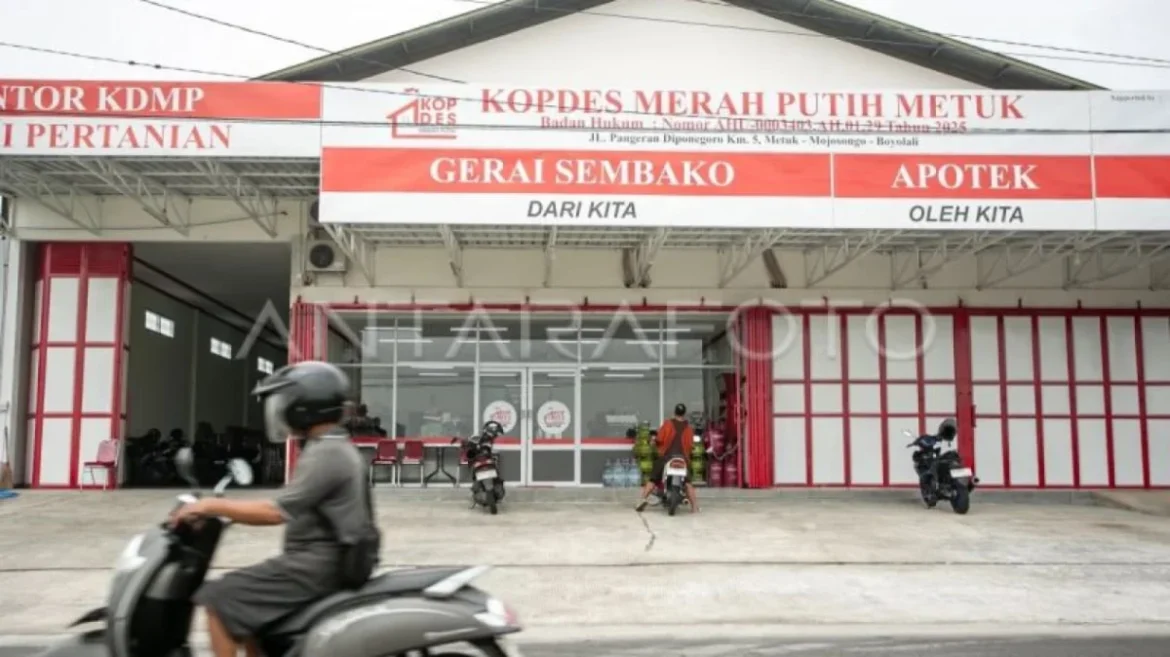
Jakarta — The Ministry of Cooperatives (Kemenkop) has officially announced that tens of thousands of managers for the newly established Village and Subdistrict Red and White Cooperatives, or Koperasi Desa/Kelurahan Merah Putih (KDKMP), will officially begin their operational duties across various assigned regions starting October 1, 2026. This monumental nationwide rollout marks a critical milestone in the Indonesian government’s ongoing strategy to restructure rural economies, streamline the distribution of government subsidies, and strengthen grassroots infrastructure.
The deployment strategy, however, has encountered logistical hurdles regarding geographic placement. Addressing these concerns during a recent High-Level Coordination Meeting in Jakarta, Minister of Cooperatives Ferry Juliantono provided comprehensive clarifications regarding cross-regional assignments, worker status protections, and remuneration structures designed to accommodate the 28,620 managers who received their official appointment decrees (Surat Keputusan/SK) on September 25, 2026.
Background and Strategic Rationale of the Cross-Regional Placement
The implementation of the KDKMP program requires meticulous synchronization between infrastructure development and human resource allocation. According to Minister Ferry Juliantono, the decision to deploy managers across provincial and regional lines—often far from their original places of domicile—was driven by an urgent necessity to ensure the equitable distribution of qualified human resources nationwide.
Furthermore, the cross-regional assignments serve a practical, immediate purpose: filling urgent vacancies in regions where physical construction of the KDKMP facilities has already been completed. By placing ready-to-work managers in these finished hubs, the government aims to prevent operational bottlenecks and allow these vital rural economic engines to commence activities without delay.
"The cross-regional placement is fundamentally necessary to bridge the gap in human resource availability. We have regions where the cooperative buildings are entirely finished and desperately require managerial oversight to run operations smoothly," Minister Ferry explained following the coordination meeting.
Flexibility and Protections for Assigned Managers

Recognizing that sudden relocations can pose personal and financial challenges for appointees, the Ministry of Cooperatives, in coordination with the Coordinating Ministry for Food, has introduced flexible policy adjustments to safeguard the welfare and employment status of the managers.
Ferry emphasized that managers who initially express reservations or feel burdened by assignments located far from their home regions will not face immediate disqualification. Crucially, their professional status will remain intact while administrative channels work to find viable solutions. Managers who have received SKs for out-of-town placements are strongly encouraged to accept these initial assignments as a transitional phase. The Ministry has assured personnel that once the construction of KDKMP facilities in their respective home regions is finalized, their placements will be reviewed and adjusted to align with their original domiciles.
Echoing this sentiment, Coordinating Minister for Food Zulkifli Hasan underscored that accepting the initial placement is essential for maintaining contractual validity. Under the current framework, these professionals operate under a two-year Fixed-Term Employment Agreement (Perjanjian Kerja Waktu Tertentu/PKWT) administered through PT Agrinas Pangan Nusantara.
"Later, once the cooperative facilities near their home domiciles are fully constructed, the locations will be adjusted accordingly. Therefore, their employment status will not be nullified," Zulkifli stated.
Addressing concerns regarding potential attrition, Minister Ferry confirmed that managers who ultimately choose to resign rather than accept out-of-region deployments will not face punitive administrative sanctions. He noted that the volume of resignations recorded thus far remains statistically insignificant, indicating strong overall compliance and commitment among the workforce.
Chronology of the Deployment Process
The rollout of the KDKMP managerial workforce follows a tight administrative timeline structured by the government and its partnering state-owned enterprises to ensure the infrastructure goes live seamlessly:
- September 25, 2026: PT Agrinas Pangan Nusantara officially distributed appointment decrees (SK) to a total of 28,620 KDKMP managers across the archipelago.
- September 28, 2026: The mandatory deadline set for appointed managers to provide their formal attendance and assignment confirmations.
- October 1, 2026: The official activation date where managers are mandated to report to their respective regional work locations and commence duties.
Comprehensive Remuneration and Financial Security

To attract competent professionals and guarantee financial stability, the government has established a competitive compensation package for the KDKMP managers. Each manager is slated to receive a monthly income ranging between Rp6.3 million and Rp8.3 million. This total figure is meticulously calculated to comprise a base salary alongside specific allowances tailored to match the prevailing Provincial or Regency/City Minimum Wage (Upah Minimum Kabupaten/Kota/UMK) of their respective operational deployment areas.
This financial framework is designed not only to reward administrative and commercial competence but also to shield workers from regional cost-of-living disparities, ensuring that managers can focus entirely on driving rural economic development without financial distress.
Broader Economic Implications and Government Objectives
The Koperasi Desa/Kelurahan Merah Putih initiative represents a cornerstone of the national strategy to modernize village-level commerce and optimize public service delivery. Positioned as a direct extension of government infrastructure, these cooperatives are envisioned to act as primary conduits for channeling subsidized goods, agricultural supplies, and targeted social assistance directly to rural populations.
By eliminating long supply chains and integrating local agricultural producers directly into structured cooperative networks, the KDKMP program seeks to insulate rural communities from price volatility and empower local economic productivity. The presence of professionally trained managers is vital to ensuring transparency, modernizing bookkeeping, and fostering commercial viability within village markets.
As the October 1 operational deadline approaches, the Ministry of Cooperatives remains optimistic that the minor logistical frictions surrounding regional allocations will be smoothly resolved. With over 28,000 managers stepping into their roles, the Red and White Cooperatives stand poised to reshape the landscape of Indonesia’s rural economy, fulfilling the state’s vision of equitable, localized growth and enhanced public welfare.