The geopolitical landscape of the Persian Gulf remains volatile following a series of conflicting reports involving the Islamic Revolutionary Guard Corps (IRGC) and the United States military. Tehran recently alleged that its naval forces successfully reclaimed two Iranian oil tankers purportedly seized by U.S. personnel, claiming the operation was executed while American sailors were asleep. Furthermore, the IRGC asserted that it launched an offensive against the aircraft carrier USS Abraham Lincoln during the opening stages of an operation they labeled "Epic Fury." These assertions, which suggest a significant escalation in maritime hostilities, have been categorically denied by the United States Central Command (CENTCOM), which dismissed the claims as fabrications and part of a broader disinformation campaign.
Chronology of the Disputed Events
The claims emerged in late November 2026, marking a significant uptick in rhetoric between Washington and Tehran. According to statements attributed to Iranian military leadership, the IRGC Navy executed a precise tactical operation to recover two vessels that were allegedly held under American custody. Tehran characterized this as a successful reclamation of national assets, asserting that the U.S. forces aboard the tankers were caught off guard.
Simultaneously, the Iranian narrative included claims regarding the commencement of "Operation Epic Fury." In this account, the IRGC purported to have engaged the USS Abraham Lincoln, suggesting that the strike was significant enough to force U.S. forces to request emergency evacuation support from neighboring Gulf states.
The U.S. military response was swift and definitive. Through its official channels on the social media platform X, CENTCOM addressed the allegations by labeling them as "another fabricated lie." CENTCOM emphasized that the USS Abraham Lincoln had completed its designated combat deployment and had, in fact, returned to the United States safely the previous month. This timeline discrepancy serves as a primary pillar of the U.S. rebuttal, casting doubt on the logistical possibility of the reported attack.
Strategic Context and the Strait of Hormuz
The Strait of Hormuz remains one of the world’s most critical maritime chokepoints, through which approximately 20% of the world’s total petroleum consumption passes. Historically, the area has been a flashpoint for maritime confrontations, including the boarding of commercial vessels, the deployment of sea mines, and drone surveillance activities.
The IRGC has frequently accused the United States of illicitly seizing Iranian oil tankers as part of its sanctions enforcement regime. Conversely, Washington maintains that it upholds freedom of navigation and enforces international maritime law to prevent the proliferation of illicit materials. The allegation that the U.S. was charging a "transit fee" of $2.5 million for vessels passing through the Strait is a relatively new and sensational addition to the rhetoric. CENTCOM has officially denied these claims, asserting that no such tolls or tariffs are levied by U.S. naval forces, which operate under the mandate of protecting global maritime commerce.
The Role of the USS Abraham Lincoln
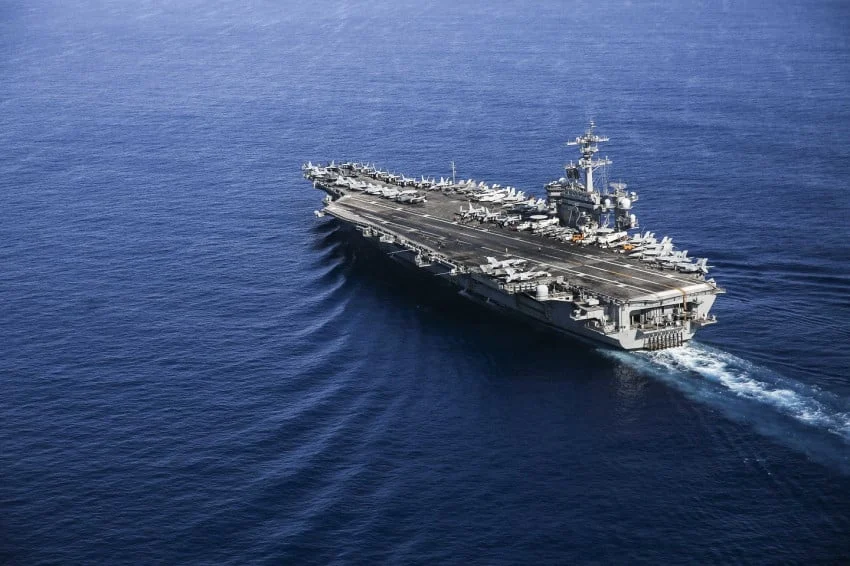
The USS Abraham Lincoln (CVN-72), a Nimitz-class nuclear-powered aircraft carrier, represents the pinnacle of U.S. power projection capabilities. Throughout its deployment in the Middle East, the carrier strike group has been tasked with deterring regional aggression and maintaining a robust defensive posture.
The assertion by the IRGC that the vessel was under attack is significant because of the potential for such an event to trigger a massive military escalation. By stating that the vessel had already completed its tour and returned to home port, CENTCOM aims to deflate the narrative of a successful Iranian strike. Military analysts observe that the presence of an aircraft carrier in the region is meant to serve as a deterrent; therefore, claims of "attacking" such a high-value asset are often used by regional actors for domestic propaganda purposes to project strength and defiance against Western military presence.
Fact-Based Analysis of Regional Implications
The conflicting accounts reflect the ongoing "grey zone" warfare that characterizes the current relationship between Iran and the United States. In this environment, information operations are as critical as kinetic military movements.
- Information Warfare: The use of social media and state-controlled news outlets to broadcast unverified military successes is a tactic designed to influence domestic public opinion in Iran and regional allies. By claiming to have "outsmarted" U.S. forces, the IRGC seeks to bolster its image as a capable naval power.
- Maritime Security: The repeated claims regarding the seizure of tankers highlight the ongoing tension surrounding oil exports. With Iran under heavy international sanctions, the movement of its tankers is a sensitive geopolitical issue that frequently draws the attention of U.S. maritime patrols.
- Escalation Risks: While both parties have avoided a full-scale open conflict, the frequency of these "he-said, she-said" incidents increases the risk of miscalculation. If a military commander on the ground believes a false report of an attack, it could lead to an accidental kinetic engagement that might spiral out of control.
Official Responses and Diplomatic Stance
The United States has consistently maintained that its naval presence in the Persian Gulf is essential for regional stability. In its statement, CENTCOM went as far as to state that "Iran no longer has a Navy" in the traditional sense, a remark that serves to diminish the perceived threat level of Iranian naval assets. This rhetoric is intended to assure regional partners—such as Saudi Arabia, the United Arab Emirates, and Qatar—that the U.S. maintains operational dominance in the theater.
Iran, conversely, maintains that the presence of foreign navies in the Gulf is the primary cause of instability. The IRGC’s insistence on these claims, despite the lack of corroborating evidence or neutral observer confirmation, underscores a strategy of "persistent resistance." By framing their actions as a victory over a superpower, Tehran continues to solidify its narrative of sovereignty and defiance.
Historical Precedents and Future Outlook
This is not the first time that the U.S. and Iran have engaged in a battle of narratives regarding naval incidents. In previous years, videos released by the U.S. Navy showing "unsafe and unprofessional" intercepts of American ships by Iranian speedboats have been met with denials from Tehran. Similarly, Iran has released footage of its own interceptions, often edited to emphasize their perceived control of the waters.
Looking ahead, the international community remains concerned about the potential for these incidents to disrupt global energy markets. The volatility of the Strait of Hormuz means that any credible threat of violence leads to immediate fluctuations in oil prices. Insurance premiums for commercial shipping through the Gulf have historically spiked during periods of heightened tension, reflecting the tangible economic cost of these geopolitical confrontations.
As of late 2026, the situation appears to be in a state of diplomatic stalemate. While the U.S. military has successfully countered the specific claims regarding the USS Abraham Lincoln and the tanker seizures, the underlying tensions remain unresolved. The effectiveness of U.S. deterrence relies heavily on its ability to project strength while simultaneously avoiding entrapment in unnecessary escalations. For Iran, the reliance on such claims demonstrates a desire to maintain high-intensity rhetoric to deter further Western encroachment, even if the facts on the ground do not align with the broadcasted claims.
Conclusion
The events surrounding the alleged seizure of oil tankers and the attack on the USS Abraham Lincoln illustrate the complexities of modern maritime security. While the IRGC’s claims appear to be largely unsubstantiated and contradict the established movements of U.S. naval assets, they remain a potent tool in the regional information landscape. CENTCOM’s firm denial and public debunking of these claims underscore a commitment to transparency and a refusal to allow state-sponsored disinformation to dictate the regional security narrative. As the Persian Gulf remains a vital corridor for global commerce, the international community will continue to monitor the region for any signs of actual, rather than rhetorical, escalations. The case of the USS Abraham Lincoln serves as a reminder that in the high-stakes arena of global power politics, the narrative is often as heavily contested as the waters themselves.