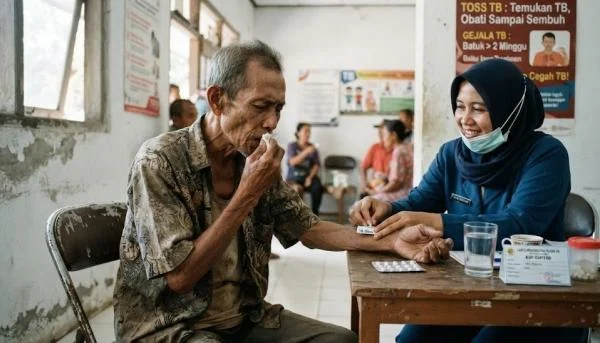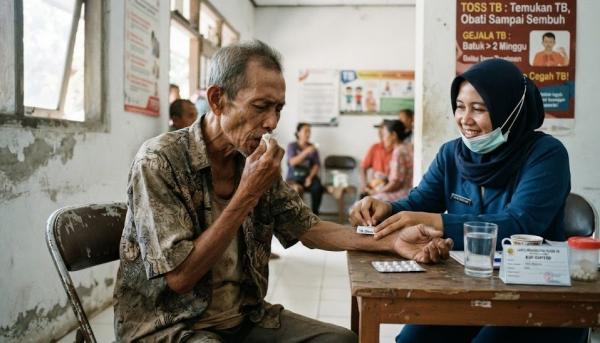
JAKARTA — In a notable public health development for Indonesia’s capital, the Ministry of Health has announced that the administration of Tuberculosis Preventive Therapy (TPT) in DKI Jakarta has experienced a substantial surge, climbing to over 26 percent. This figure represents a dramatic improvement compared to the stagnant coverage rates of just 5 percent recorded two to three years prior.
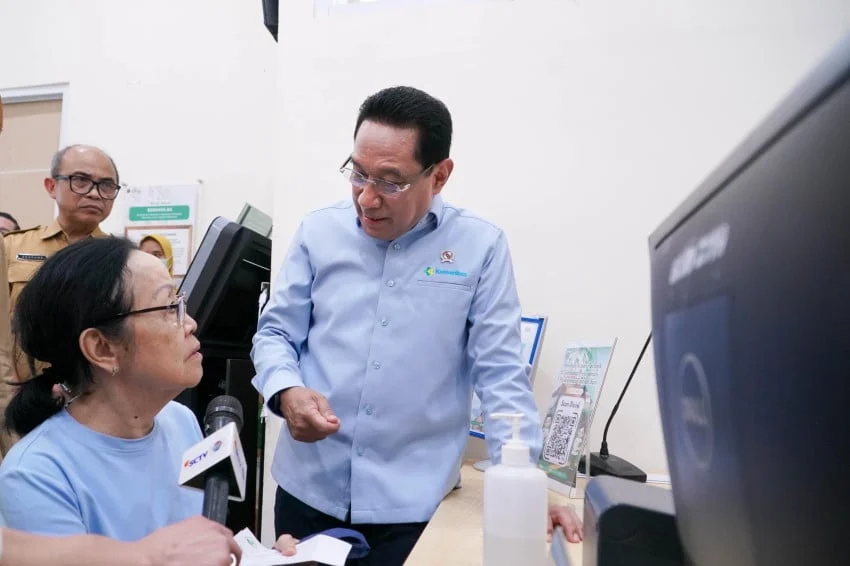
The positive trajectory was brought to light following a comprehensive monitoring and evaluation field visit conducted by Deputy Minister of Health Dr. Benjamin Paulus Octavianus. The high-level assessment took place in the densely populated Taman Sari sub-district of West Jakarta, involving close coordination with the Jakarta Provincial Health Office, eight regional community health centers (Puskesmas), and several prominent medical institutions, including RS Pelni, RS Sumber Waras, and RS Cengkareng.
Public health experts view this milestone as a crucial turning point in Indonesia’s ongoing, nationwide campaign to eradicate tuberculosis by 2030, aligning with global Sustainable Development Goals. While clinical treatment protocols have historically demonstrated high success rates across the archipelago, the preventative pillar of the national strategy has traditionally lagged behind. The recent data from Jakarta suggests a concerted shift in operational focus from reactive treatment to proactive prevention.
Evaluating the Ground Reality in Taman Sari
During his visit to Taman Sari, Deputy Minister Benjamin Paulus Octavianus engaged directly with local health workers, administrative officials, and medical practitioners to evaluate the on-the-ground execution of the tuberculosis eradication program. Taman Sari serves as an important micro-location for public health assessments due to its high demographic density, high mobility, and urban housing conditions, which historically present unique hurdles for infectious disease containment.
The collaborative evaluation session brought together key stakeholders from various tiers of the healthcare system. Representatives from the eight local Puskesmas shared operational insights regarding grassroots tracking, while major referral facilities such as RS Pelni, RS Sumber Waras, and RS Cengkareng discussed inter-facility coordination for patient referrals and contact tracing.
Deputy Minister Benjamin formally expressed his appreciation for the concerted efforts displayed by regional health authorities and medical personnel. He noted that achieving a fourfold increase in TPT coverage within a relatively short timeframe is no small feat, reflecting improved institutional alignment and enhanced political will at the local government level.
However, health officials emphasize that while a 26 percent coverage rate represents a commendable leap forward, the ultimate objective remains universal coverage among eligible close contacts, indicating that further scaling and resource mobilization will be required in the coming fiscal cycles.
Shifting Paradigms: From Treatment to Comprehensive Prevention
For decades, Indonesia’s national tuberculosis strategy heavily emphasized the cure rate of active cases—commonly measured through Treatment Success Rates (TSR) under the Directly Observed Treatment, Short-course (DOTS) strategy. While these therapeutic measures successfully cured millions of patients, the epidemiological cycle frequently perpetuated new infections due to untreated latent tuberculosis infections within households and close social circles.
Addressing this historical bottleneck, the Ministry of Health has increasingly underscored the vital importance of the preventative paradigm. Latent tuberculosis infection (LTBI) occurs when an individual is infected with Mycobacterium tuberculosis but does not yet manifest active, contagious disease. Without preventative intervention, a significant percentage of individuals with LTBI will eventually develop active tuberculosis, sustaining community transmission chains.
In his official statement, Deputy Minister Benjamin highlighted this strategic dichotomy, pointing out that while the clinical treatment apparatus for active cases operates at a high standard, the preventive machinery requires continuous reinforcement.
"Thus far, our performance in treating active tuberculosis patients has been quite commendable," stated Dr. Benjamin in an official release. "Our primary ongoing challenge, however, lies in prevention. Whenever a close contact is identified as being at risk of contracting the disease, they must be tracked down immediately and administered preventive medication, while those already afflicted must be treated without delay. Through this dual approach, new cases can be intercepted before they develop into full-scale clinical disease."
This philosophy underpins the expansion of TPT protocols, which involve administering short-course antibiotic regimens to individuals exposed to active pulmonary tuberculosis patients, thereby drastically reducing the probability of disease progression.
Strategic Prioritization: DKI Jakarta and Bangka Belitung in Focus
The positive evaluation in Taman Sari aligns with broader national policy directives that designate specific regions as high-priority zones for intensified tuberculosis interventions. DKI Jakarta, alongside the province of Bangka Belitung, has been identified by the central government as a critical priority area due to high transmission densities, population influx, and urban vulnerability factors.
Metropolitan centers like Jakarta present complex epidemiological landscapes. High population mobility, shared residential quarters, and dense commercial hubs create ideal conditions for airborne transmission of Mycobacterium tuberculosis. Consequently, deploying aggressive active case finding (ACF) and contact investigation protocols in urban sub-districts like Taman Sari serves as a testing ground for national scale-up models.
The selection of Jakarta as a focal point allows the Ministry of Health to pilot integrated digital surveillance systems, community-based screening initiatives, and streamlined pharmaceutical supply chains. The lessons learned from the capital’s administrative districts are intended to inform public health strategies in other densely populated urban agglomerations across Java, Sumatra, and eastern Indonesia.
Chronology of the National Tuberculosis Acceleration Initiative
To contextualize the current surge in TPT coverage, it is essential to examine the recent timeline of policy adjustments and international commitments undertaken by the Indonesian government:
- October 2023: The Ministry of Health intensifies its national strategic plan to align with the targets set during the United Nations High-Level Meeting on Tuberculosis, committing to a rapid scale-up of preventive therapy regimens.
- Mid-2024: Regional health offices, particularly in high-burden provinces such as DKI Jakarta and Bangka Belitung, receive updated guidelines prioritizing contact tracing and the distribution of safer, shorter-duration TPT regimens (such as weekly isoniazid-rifapentine or daily isoniazid).
- Late 2024 to 2025: Local health authorities across Jakarta’s administrative municipalities begin integrating Puskesmas data systems with private hospital networks to bridge the gap in reporting latent infections and treatment completions.
- Early 2026: Comprehensive monitoring and evaluation tours are scheduled across priority zones. Deputy Minister Benjamin conducts field assessments in West Jakarta to audit the practical implementation of these upgraded protocols.
- November 2026: Official evaluation data reveals that TPT coverage in DKI Jakarta has successfully surpassed 26 percent, marking a historic breakthrough from historical baselines of approximately 5 percent.
Institutional Collaboration and Healthcare Integration
A recurring theme in the Ministry of Health’s recent evaluations is the necessity of multi-sectoral collaboration. Tuberculosis control cannot be effectively managed by government health agencies alone; it requires seamless integration between primary healthcare facilities (Puskesmas), secondary and tertiary referral hospitals, private practitioners, and community-based organizations.
The involvement of major hospitals such as RS Pelni, RS Sumber Waras, and RS Cengkareng during the Taman Sari evaluation underscores the bridging of hospital-based care with community-level public health interventions. Historically, when a patient was diagnosed with active tuberculosis in a hospital setting, the chain of communication regarding household contacts often broke down before reaching the local Puskesmas responsible for community outreach.
Recent structural reforms have sought to close this gap. By enforcing mandatory notification of tuberculosis cases through digital platforms and establishing robust referral loops, hospitals now actively coordinate with regional health offices to initiate contact investigations within 48 to 72 hours of an index case diagnosis. Once close contacts are mapped, community health workers facilitate screening sessions and offer TPT to eligible candidates, particularly children under five and immunocompromised individuals who face the highest risk of rapid disease progression.
Socioeconomic Implications and Public Health Impact
The implications of raising TPT coverage beyond 26 percent in a major urban center extend far beyond immediate clinical metrics. Tuberculosis remains a significant economic burden in Indonesia, frequently affecting individuals in their most productive working years. When a primary earner falls ill with active tuberculosis, households often experience catastrophic out-of-pocket medical expenses coupled with lost wages, driving vulnerable families deeper into poverty.
By interrupting transmission chains through preventive therapy, the Ministry of Health aims to mitigate these socioeconomic shocks. Preventing latent infections from converting into active disease reduces the long-term burden on the national health insurance scheme (JKN) managed by BPJS Kesehatan, freeing up critical fiscal space for other healthcare priorities.
Furthermore, aggressive management of latent reservoirs directly contributes to the global containment of drug-resistant strains of tuberculosis (DR-TB). When active transmission is curtailed early, the overall incidence of new infections drops, subsequently lowering the absolute number of patients who might otherwise develop multidrug-resistant forms of the disease—forms that are notoriously expensive, toxic, and difficult to treat.
Moving Forward: Sustaining Momentum Toward 2030
While the jump from 5 percent to over 26 percent in TPT coverage represents a major institutional achievement, Ministry of Health officials remain pragmatic about the road ahead. The ultimate global benchmark set by international health bodies calls for near-universal preventative therapy coverage among eligible high-risk contacts.
To sustain and accelerate this positive momentum, the Ministry plans to continue its rigorous monitoring framework, expand digital tracking capabilities, and ensure uninterrupted supply chains for preventative pharmaceutical stocks across all municipal health offices. Public education campaigns are also slated for intensification to combat social stigmas associated with tuberculosis testing and preventative medication, ensuring that communities view TPT not as a sign of illness, but as a vital shield of protection.
As Jakarta sets a new benchmark for urban public health execution, the federal government anticipates that these proven frameworks will serve as a replicable blueprint for regional health offices nationwide, bringing Indonesia steadily closer to its ultimate vision of a tuberculosis-free future.