The global football hierarchy has a familiar name at its summit once again as Spain officially secured the 2026 FIFA World Cup title, defeating Argentina with a narrow 1-0 victory in a pulsating final at MetLife Stadium in New Jersey on Monday. In a match that pitted the technical precision of the European giants against the resilient spirit of the defending champions, a solitary goal from Ferran Torres in the first period of extra time was enough to separate the two sides. This victory marks Spain’s second World Cup trophy, adding a second star to their jersey sixteen years after their maiden triumph in South Africa in 2010.
The atmosphere at MetLife Stadium was electric, with over 82,000 spectators witnessing a tactical chess match that spanned 120 minutes of high-intensity football. From the opening whistle, it was clear that Luis de la Fuente’s side intended to dictate the tempo. Spain’s trademark possession-based style was on full display, as they controlled 68 percent of the ball throughout the contest. Argentina, led by the legendary Lionel Messi in what many believe to be his final international appearance, were forced into a defensive posture, managing only 32 percent possession as they looked to exploit Spain on the counter-attack.
A Tactical Battle of Attrition
The first half was characterized by Spain’s patient build-up play and Argentina’s disciplined defensive block. The Spanish midfield, anchored by the influential Rodri and the creative sparks of Pedri and Gavi, moved the ball with clinical efficiency, searching for gaps in an organized Albiceleste backline. Despite the territorial dominance, clear-cut chances were hard to come by in the opening 45 minutes, as Argentina’s Cristian Romero and Lisandro Martínez remained resolute.
Lionel Messi, whose every touch was met with a roar from the crowd, found himself increasingly isolated. Spain’s defensive unit, marshaled by Aymeric Laporte, executed a perfect containment strategy, ensuring that the Argentine captain had little room to orchestrate his usual magic. By the time the halftime whistle blew, the score remained 0-0, with Spain having registered several shots from distance that failed to truly test the Argentine goalkeeper.
The second half saw an escalation in intensity. Spain began to find more joy on the flanks through the pace of Nico Williams and the young sensation Lamine Yamal. The pressure on the Argentine goal intensified, leading to a series of corners and set-piece opportunities for La Furia Roja. However, Argentina’s veteran goalkeeper, Emiliano "Dibu" Martínez, proved once again why he is considered one of the best in the world. Martínez produced a string of world-class saves, including a fingertip stop from a goal-bound effort by Dani Olmo in the 72nd minute, keeping his side in the hunt as the match ticked toward the end of regulation time.
The Breakthrough in Extra Time
With the scoreline deadlocked at 0-0 after 90 minutes, the match moved into extra time—a familiar territory for an Argentine side that had survived numerous such encounters in their 2022 campaign. However, the physical toll of defending for long periods began to show on the South American players. Spain, bolstered by strategic substitutions, continued to probe with fresh energy.
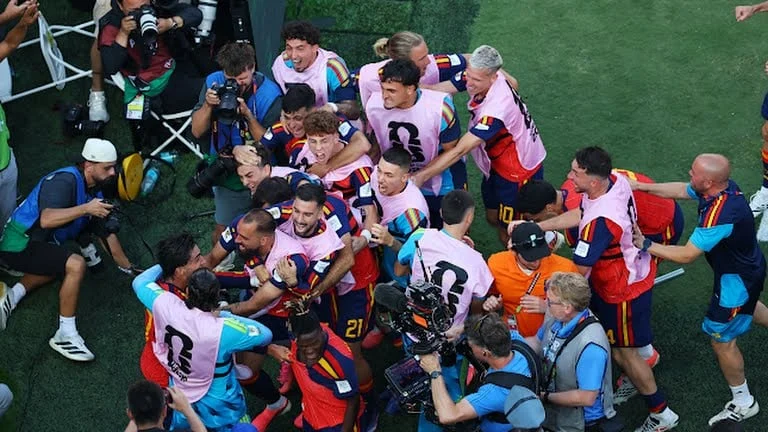
The decisive moment arrived in the 105th minute, just before the brief interval in extra time. A slick passing sequence involving Pedri and Alex Baena sliced through the middle of the park. Baena delivered a perfectly weighted through-ball to Ferran Torres, who had timed his run to perfection. Torres took one touch to settle himself before calmly slotting the ball past an onrushing Emiliano Martínez and into the bottom corner of the net. The Spanish bench erupted as Torres sprinted toward the corner flag to celebrate what would become the most important goal of his career.
Argentina threw everything forward in the final 15 minutes of the second period of extra time. Lionel Scaloni introduced fresh attacking options, and even goalkeeper Emiliano Martínez ventured into the Spanish box for a late corner. However, the Spanish defense held firm, clearing their lines with composure until the referee’s final whistle confirmed their status as world champions.
Statistical Dominance and Key Performers
The final statistics told a story of overwhelming Spanish dominance. Spain ended the match with 20 total shots, 11 of which were on target, forcing Emiliano Martínez into 10 saves. Argentina, by contrast, struggled to test Unai Simón in the Spanish goal, finishing with only 5 shots and 2 on target.
The victory is a testament to the philosophy instilled by Luis de la Fuente. Since taking over the national team, De la Fuente has successfully blended the traditional "Tiki-Taka" roots with a more direct and clinical attacking edge. Spain’s path to the final was equally impressive, as they navigated a difficult knockout stage that included victories over perennial heavyweights.
For Argentina, the loss marks the end of an extraordinary era. Having won the Copa América in 2021 and 2024, and the World Cup in 2022, this final represented a "Last Dance" for several members of their golden generation. While the disappointment was visible on the faces of the Argentine players, their fans remained in the stadium long after the whistle to salute a team that has brought them unprecedented joy over the last five years.
Official Reactions and Post-Match Analysis
Speaking in the post-match press conference, Spanish manager Luis de la Fuente praised the maturity of his squad. "This group of players has shown incredible character. We knew Argentina would be the ultimate test of our resolve, but we stayed true to our identity. Ferran’s goal was a moment of pure quality, but the victory belongs to the collective effort of everyone involved in this journey," De la Fuente stated.
Match-winner Ferran Torres expressed his disbelief at the magnitude of the moment. "To score the winning goal in a World Cup final is something you dream about as a child. This trophy is for all the people in Spain who supported us through the ups and downs. We are world champions, and it feels surreal," Torres said, clutching his winner’s medal.
On the Argentine side, Lionel Scaloni was gracious in defeat. "Football is often decided by the smallest of margins. We gave everything we had, but Spain was the better team tonight. I am immensely proud of my players for what they have achieved over the years. This loss hurts, but it does not diminish the legacy of this group."
Lionel Messi, though visibly emotional, offered a brief message to the fans. "We wanted to give you one more joy, but it wasn’t meant to be. I want to thank everyone for the love and support. This team will always be in my heart."
Broader Impact and the 2026 Legacy
The 2026 FIFA World Cup will be remembered as a landmark tournament for several reasons. As the first edition to feature 48 teams and the first to be hosted across three nations—the United States, Canada, and Mexico—it showcased the truly global reach of the sport. The final in New Jersey served as a fitting conclusion to a month of high-drama football that saw record-breaking attendances and a massive surge in viewership across North America.
Spain’s victory signals a shift in the balance of power back toward Europe, following Argentina’s 2022 win in Qatar. The emergence of young Spanish talents like Lamine Yamal, who at just 19 years old played a pivotal role in the tournament, suggests that La Furia Roja could be set for a period of sustained dominance similar to their 2008-2012 "triple crown" era.
Furthermore, the success of the tournament in the United States is expected to provide a significant boost to the popularity of soccer in the region. With the 2026 World Cup now concluded, the focus of the footballing world will shift toward the qualifying rounds for the 2030 tournament, but for now, the streets of Madrid, Barcelona, and Seville are filled with celebration as Spain basks in the glory of being the best in the world.
The 2026 World Cup final was more than just a game; it was a passing of the torch. While the world said a potential goodbye to the international career of the greatest player of his generation in Messi, it also welcomed a new era of Spanish excellence. Spain’s second star is not just a trophy; it is a validation of a system, a culture, and a relentless pursuit of footballing perfection.