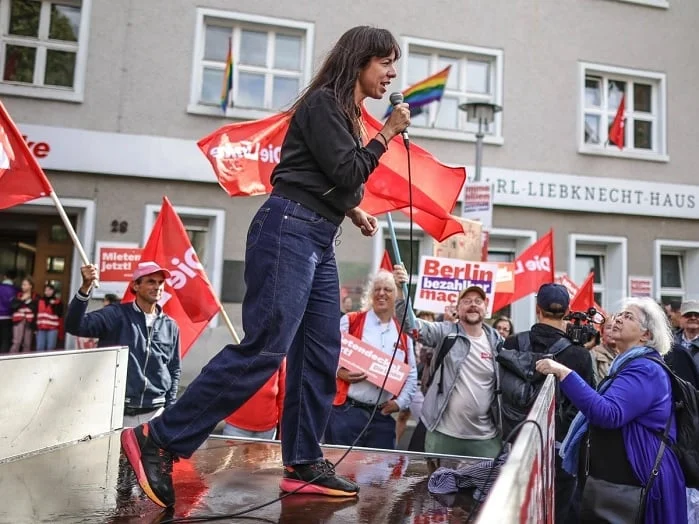
The political landscape of Berlin underwent a seismic shift this past Sunday as voters delivered a historic mandate to Elif Eralp, a human rights activist of Turkish descent representing the socialist Die Linke (The Left) party. Securing 25.7% of the vote, Eralp has effectively positioned herself as the frontrunner to become the first-ever mayor of the city-state with a migrant background. This victory marks a significant departure from traditional political norms in Germany’s capital, signaling a growing appetite among the electorate for grassroots-oriented, progressive policies that prioritize socioeconomic equity over entrenched party-line politics.
The results represent a stunning turnaround for Die Linke. Just months ago, in the spring, the party was polling in the low teens, struggling to find a coherent voice amidst a fracturing national political climate. By more than doubling their support base in under three years, Eralp and her team have demonstrated that their platform—which focuses intensely on the granular, daily struggles of Berliners—has successfully transcended ideological boundaries to capture the spirit of a city grappling with rapid gentrification and economic anxiety.
A Chronology of a Grassroots Surge
The journey to this electoral breakthrough began in earnest late last year, when Eralp transitioned from a career in human rights law to a full-time pursuit of municipal office. Her campaign was characterized by a meticulous, door-to-door strategy that eschewed the top-down communication style favored by established centrist parties.
- Early 2024: Eralp announces her candidacy, focusing her platform on housing affordability and environmental sustainability.
- Spring 2024: Die Linke experiences a polling stagnation, prompting a shift in strategy toward aggressive, neighborhood-level engagement.
- Summer 2024: Eralp explicitly draws parallels between her platform and the populist-progressive success of Zohran Mamdani in New York, focusing on the "kitchen-table" issues that affect working-class families.
- October 2024: The campaign makes a concerted effort to enter areas traditionally dominated by the Alternative for Germany (AfD), challenging the anti-immigrant rhetoric of the far-right on its own turf.
- November 2024: Election Day results confirm a 25.7% share, a historic high for the party in Berlin.
The Influence of the "Mamdani Model"
Central to Eralp’s political identity is her admiration for Zohran Mamdani, the New York politician whose recent successes in the United States have become a template for international progressive movements. During the campaign, Eralp frequently referenced Mamdani’s ability to build multi-ethnic coalitions that prioritize material outcomes.
"I hope that what was possible in Manhattan can be realized here in Berlin," Eralp stated in an interview with Anadolu Agency days before the polls opened. The comparison is not merely rhetorical; it is structural. Like Mamdani, Eralp has centered her platform on the "crisis of the everyday"—specifically the surge in rent prices, the degradation of public transportation infrastructure, and the persistent, unaddressed issues of urban sanitation.
By framing these issues as systemic failures rather than inevitable consequences of urban growth, Eralp has successfully created a "big tent" coalition. She has managed to attract not only the traditional socialist base but also younger, disillusioned voters and immigrant communities who have long felt marginalized by the mainstream political establishment.
Socioeconomic Policy and the Housing Crisis
At the core of Eralp’s mandate is an aggressive housing policy designed to counter the skyrocketing cost of living in Berlin. For years, the city has been the epicenter of a German housing crisis, with rent prices in some districts rising by over 50% in the last decade alone. Eralp’s proposed solutions are bold and have drawn both strong support from tenants’ unions and skepticism from real estate stakeholders.
Her platform includes:
- Rent Capping: Implementing strict, mandatory price ceilings for municipal-owned apartments.
- Anti-Gouging Task Force: The creation of a dedicated governmental agency tasked with auditing and punishing landlords who engage in illegal rent hikes.
- Public Re-acquisition: Reviving long-dormant plans to expropriate or purchase housing stock from massive private real estate conglomerates to bring them back under public control.
These policies are intended to address the displacement of long-term Berlin residents, a phenomenon that has fueled social unrest in neighborhoods like Kreuzberg and Neukölln. By promising to make Berlin "affordable for everyone," Eralp has turned housing into the defining litmus test for her potential administration.
Personal Background and Political Formation
Born in Munich in 1981, Elif Eralp’s personal history is emblematic of the post-migration experience in Germany. Her parents arrived in the country following the 1980 Turkish military coup, seeking stability and a new beginning. Her upbringing, spanning Dortmund and Hamburg before settling in Berlin 16 years ago, gave her a broad perspective on the integration challenges faced by migrant families in Germany.
Her path to politics was forged in the legal field. Having studied law, Eralp spent years documenting and litigating cases of discrimination. She has often spoken of her childhood, specifically the early 1990s, when Germany experienced a wave of far-right extremist violence targeting immigrant communities. These formative experiences instilled in her a commitment to "justice as a baseline for democracy," a phrase she repeated throughout her campaign.
Official Responses and Political Implications
The political establishment in Berlin has reacted with a mix of caution and alarm. While the Green Party and the Social Democrats (SPD) have acknowledged the legitimacy of her win, they remain wary of her proposed economic policies. A spokesperson for a leading business association in Berlin noted, "While we respect the democratic process, any move toward large-scale expropriation or severe market intervention could destabilize investor confidence in the capital."
Conversely, civil society organizations and labor unions have largely celebrated the outcome. The head of a major Berlin-based housing advocacy group described the result as "the first real opportunity in a generation to prioritize people over portfolios."
Broader Impact: The Changing Face of Germany
The implications of Eralp’s rise extend far beyond the borders of Berlin. Her success suggests that the traditional center-left is losing its grip on the electorate, and that voters are increasingly receptive to candidates who combine identity-based empathy with concrete, radical economic solutions.
Furthermore, her success challenges the narrative that the only viable alternative to the status quo in Germany is the rise of the far-right. By winning over voters in districts where the AfD had previously made inroads, Eralp has provided a blueprint for how progressive candidates can reclaim the narrative of "the people" from populist, anti-immigrant platforms.
As the city transitions into a new political era, the eyes of the European Union will be on Berlin. If Eralp can translate her campaign promises into legislative success, she may well provide a model for other European cities facing similar crises of housing, inequality, and social cohesion. For now, however, the immediate task is the formation of a governing coalition—a process that will test her ability to balance her radical platform with the pragmatic realities of municipal governance.
In her victory speech, Eralp remained steadfast in her message: "Together, we are changing Berlin." Whether that change will result in a more equitable capital or a period of protracted political friction remains to be seen. What is clear, however, is that the era of political complacency in Berlin has come to an end.