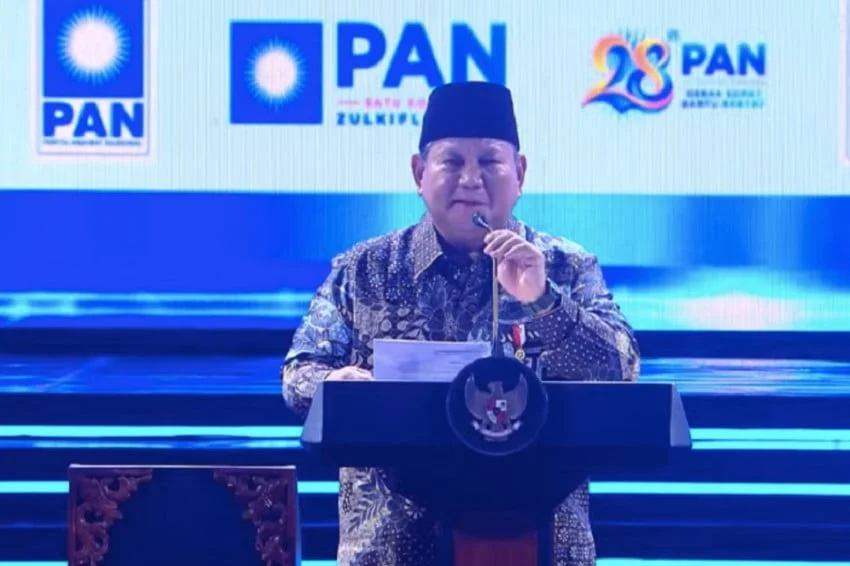
JAKARTA — President Prabowo Subianto has formally announced his intention to convene an imminent limited cabinet meeting, commonly referred to as a ratas, to formulate comprehensive strategies aimed at abolishing tuition fees across all state-run primary schools, secondary institutions, and public universities nationwide. The policy directive, which targets a fundamental restructuring of state funding for public education, is designed to eliminate financial barriers and expand equal access to quality learning environments for millions of Indonesian students.
The head of state revealed this ambitious policy objective during his keynote address at the grand celebration marking the 28th anniversary of the National Mandate Party (PAN). The high-profile political gathering took place at the Jakarta International Convention Center (JICC) located in the Senayan area of Central Jakarta. Addressing party members, government officials, and invited guests, President Prabowo emphasized that universal access to state-funded education is no longer a distant aspiration but an urgent necessity that requires immediate executive action.
The Presidential Directive and Policy Scope
During his address at the anniversary celebration, President Prabowo underscored the absolute necessity of removing financial burdens from families seeking public education for their children. He asserted that the state bears the fundamental responsibility of ensuring that foundational and tertiary education systems remain accessible without economic discrimination.
"I will immediately hold a limited cabinet meeting because, essentially, the cost of public education must be free. The cost of public education for elementary schools, junior high schools, senior high schools, and state universities must be free," President Prabowo stated firmly during the event.
The scope of the proposed policy encompasses all levels of the state-administered educational framework. By targeting not only compulsory basic education—comprising primary and lower secondary levels—but also upper secondary and higher education institutions, the initiative represents one of the most comprehensive overhauls of educational financing in the nation’s history.
Context of the Announcement and Administrative Urgency
The announcement was delivered within the broader context of the administration’s accelerated development agenda. President Prabowo defended the fast-paced nature of government operations over the preceding two years, noting that infrastructural and social welfare demands require rapid intervention rather than prolonged bureaucratic deliberation. He drew attention to various grassroots initiatives, such as the construction of village bridges and the rehabilitation of deteriorating school infrastructure, as evidence of an administration focused on tangible results.
"So, brothers and sisters, our achievements are numerous because we keep working. We have kept working continuously over these past two years. We have reached a point where, yes, we are sometimes accused of lacking communication. We communicate less because we keep working. We are rushing because the people cannot wait any longer. Yes, children cannot wait. Bridges in villages must be built," the President explained.
Furthermore, the President highlighted that the holistic enhancement of the educational ecosystem extends beyond tuition fee elimination. The government’s broader reform agenda encompasses infrastructural upgrades, the modernization of school buildings, the improvement of sanitation facilities, and the elevation of teachers’ welfare to ensure a conducive learning environment nationwide.
Chronology of Educational Reform Commitments
The push toward tuition-free public education builds upon a series of policy statements and administrative reforms initiated since the commencement of the current presidential term.
In preceding months, the administration has consistently prioritized human capital development as a cornerstone of national progress. Education sector reviews have frequently highlighted systemic challenges, including disparities in educational quality between urban and rural areas, infrastructural deficits, and complexities surrounding teacher recruitment and compensation.
Earlier policy interventions focused heavily on rectifying foundational flaws within the educational bureaucracy. Notably, the administration has emphasized that structural improvements must begin at the root of the system, specifically addressing educator recruitment protocols to guarantee that qualified professionals are placed in classrooms across the archipelago. The upcoming limited cabinet meeting represents the next logical step in translating these overarching goals into concrete budgetary allocations and legislative frameworks.
Background Data and Educational Landscape in Indonesia
To contextualize President Prabowo’s initiative, it is essential to examine the existing structure of public education financing and enrollment demographics in Indonesia. The country boasts tens of millions of students enrolled across hundreds of thousands of educational institutions.
While basic education has theoretically benefited from various government assistance programs, such as the School Operational Assistance (BOS) fund, families frequently encounter supplementary costs, including fees for extracurricular activities, uniforms, books, and localized operational contributions. At the tertiary level, tuition fees—known commercially as Uang Kuliah Tunggal (UKT) in state universities—often present significant hurdles for lower-income households, occasionally restricting access to higher education despite academic merit.
Public expenditures on education have historically constituted a mandated minimum of 20 percent of the state budget (APBN), in accordance with the Indonesian Constitution. However, optimizing the distribution and utilization of these funds to achieve zero-tuition models across all public tertiary institutions requires meticulous fiscal planning, revenue reallocation, and enhanced auditing mechanisms to prevent institutional budget deficits.
Stakeholder Reactions and Initial Analyses
The announcement has elicited diverse reactions from educational experts, legislators, civil society organizations, and economic analysts. While the overarching objective of accessible education is widely praised as a progressive stride toward realizing constitutional mandates, experts emphasize the importance of careful implementation and sustainable financing.
Representatives from teacher associations and academic unions have expressed cautious optimism. Many point out that while free tuition removes an immediate financial burden from parents, the systemic success of the policy depends heavily on parallel investments in educational quality. Ensuring that state universities and public schools remain adequately funded—without compromising facility maintenance, laboratory equipment, or educator salaries—remains a primary concern for education watchdogs.
Economic analysts have similarly highlighted the fiscal implications of expanding free education to the tertiary level. State universities rely significantly on tuition revenues to supplement state allocations for research, operational continuity, and campus development. Consequently, any transition toward completely free higher education necessitates robust state subsidization to prevent a decline in academic standards or institutional operational capacity.
Implications for the National Budget and Legislative Coordination
The forthcoming limited cabinet meeting will likely involve coordination among key ministries, including the Ministry of Education, Culture, Research, and Technology, the Ministry of Finance, and the National Development Planning Agency (Bappenas).
The Ministry of Finance faces the complex task of calculating the projected fiscal deficit resulting from lost tuition revenues and designing compensating budgetary mechanisms. This may involve optimizing tax collection efficiencies, reallocating non-essential expenditures, and prioritizing human capital investments within forthcoming state budget drafts.
Concurrently, legislative involvement will be crucial. Implementing systemic tuition elimination across state universities and secondary schools may require adjustments to existing legal frameworks concerning public service agencies (BLU) and regional educational management. The House of Representatives (DPR) is expected to review the policy proposals once the executive branch finalizes the technical roadmap resulting from the cabinet deliberations.
Broader Socio-Economic Impact
If successfully implemented, the policy of free public education from primary school through university could fundamentally alter Indonesia’s socio-economic landscape. By lowering the financial barriers to higher education, the nation can anticipate a gradual rise in gross enrollment rates at the tertiary level, thereby supplying a more highly skilled workforce suited to modern industrial demands.
Furthermore, alleviating educational expenditures for families frees up household disposable income, which can be redirected toward nutrition, healthcare, and other essential domestic needs. This economic relief aligns with broader national objectives aimed at poverty reduction, social mobility, and the alleviation of regional disparities in educational attainment.
As the nation awaits the outcomes of the scheduled limited cabinet meeting, the administration’s resolve to pursue aggressive educational reforms remains evident. The coming weeks will likely provide clearer regulatory frameworks, budgetary projections, and implementation timelines regarding the realization of tuition-free public education across Indonesia.