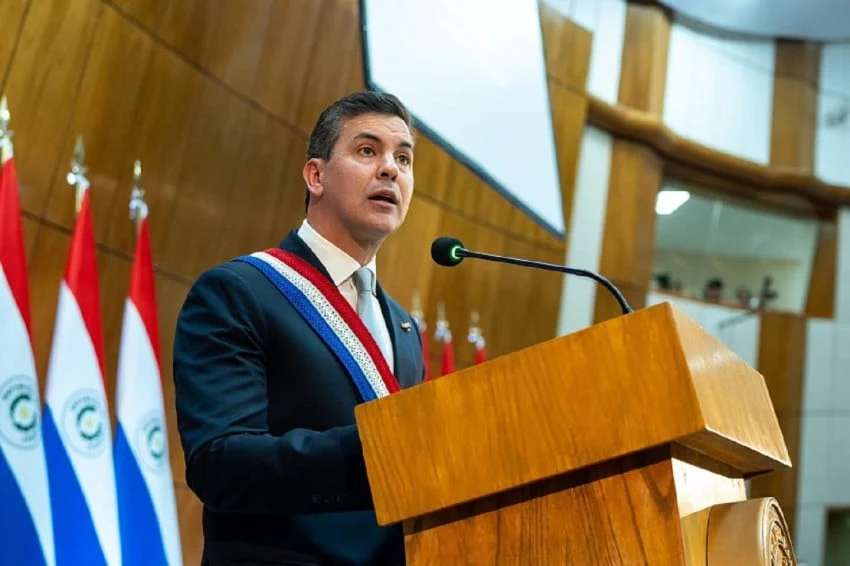
The political landscape of Paraguay has been plunged into an unprecedented crisis as President Santiago Pena faces the final stages of a historic impeachment process, following his transition from a celebrated head of state to a figure under house arrest. The collapse of Ueno Bank, a digital financial institution once hailed as a model of economic modernization, has served as the catalyst for a national uprising that has gripped the capital, Asuncion, and threatens the stability of the entire South American nation. With the savings of nearly three million citizens currently frozen or lost, the scale of the disaster has prompted a rare bipartisan consensus in the Paraguayan Senate to strip the President of his immunity and hold him accountable for alleged systemic corruption.
The swift downfall of the Pena administration marks a stunning reversal for a leader who had previously cemented his international standing through strong alliances with key global figures, including former U.S. President Donald Trump and Israeli Prime Minister Benjamin Netanyahu. His administration, which initially campaigned on a platform of fiscal reform and technological advancement, is now accused of orchestrating a massive misappropriation of public funds, effectively turning the state’s financial infrastructure into a private vehicle for political patronage.
The Anatomy of a Financial Collapse
The crisis centers on the rapid, and ultimately catastrophic, failure of Ueno Bank. While marketed to the public as a secure, high-yield digital banking solution, investigators from the Paraguayan Public Ministry suggest that the bank’s operational model was built on a foundation of precarious financial engineering. According to documents obtained by judicial authorities, the bank benefited from an influx of government deposits and public pension funds, which were allegedly funneled into the institution through directives from the executive branch.
Evidence presented by the prosecution indicates that hundreds of millions of dollars in taxpayer money were transferred to Ueno Bank under the guise of government stimulus programs and infrastructure financing. These funds, however, appear to have been used to cover liquidity gaps created by the bank’s risky lending practices. As public confidence waned and depositors attempted to withdraw their assets, the bank’s inability to meet these demands triggered a systemic run, leading to its insolvency on November 1, 2026.
The social fallout has been immediate and severe. Paraguay, a nation with a population of roughly 6.8 million, now faces a situation where nearly half the population—approximately 3 million people—has been directly affected by the freezing of accounts. Protests have erupted in major cities, with demonstrators demanding the immediate recovery of their savings and the resignation of all government officials involved in the oversight of the financial sector.
Chronology of the Political Crisis
The timeline leading to the current paralysis reflects a rapidly escalating series of events that caught many regional observers by surprise:
- October 25, 2026: Initial reports of liquidity issues at Ueno Bank begin to circulate in financial circles, leading to a surge in withdrawal requests.
- October 28, 2026: President Pena issues a public statement downplaying the bank’s difficulties, assuring citizens that the government is monitoring the situation and that "all savings are guaranteed."
- October 30, 2026: Massive protests begin in Asuncion as ATMs across the country go offline and the bank suspends all mobile operations.
- November 2, 2026: The Central Bank of Paraguay, led by Carlos Carvallo, officially places Ueno Bank under regulatory intervention, revealing a massive deficit in its balance sheet.
- November 5, 2026: Amid mounting pressure from the legislature and street protests, President Pena announces his resignation in a televised address, though he denies any criminal involvement.
- November 6, 2026: The Paraguayan Senate formally rejects the resignation and votes to proceed with an impeachment trial to strip Pena of his post-presidential immunity.
- November 7, 2026: A judge issues a formal arrest warrant for President Pena and former Central Bank Chief Carlos Carvallo, citing risks of flight and tampering with evidence.
- November 8, 2026: President Pena is placed under house arrest, and his legal team signals an intention to challenge the constitutionality of the impeachment process.
Legal Battles and The Question of Immunity
The decision by the Paraguayan Senate to proceed with impeachment despite the President’s attempt to resign highlights the depth of the institutional divide. In many jurisdictions, an executive resignation is accepted as a political exit, but the Paraguayan legislature is determined to ensure that the political departure does not equate to a legal pardon. By continuing the impeachment process, the Senate seeks to remove the constitutional shield that protects sitting and former presidents from criminal prosecution.
The legal defense for Santiago Pena has characterized these actions as a "political witch hunt." His legal counsel, led by senior constitutional experts, argues that the President was not given adequate time to prepare a defense—a request for a 72-hour delay was denied by the Senate leadership. "This is a violation of the fundamental right to due process," the defense stated in a press conference. They have threatened to bring the case before the Inter-American Court of Human Rights, claiming that the legislative proceedings are tainted by the pressure of the street protests rather than a balanced assessment of evidence.
However, the prosecution, led by special prosecutors appointed by the Supreme Court, remains confident. They assert that they possess internal emails and bank records linking the President directly to the decision to move public funds into the failing institution. Furthermore, the arrest of Carlos Carvallo is seen as a strategic move to turn a key witness, as Carvallo previously served as a senior executive at Ueno Bank before his appointment to the Central Bank, creating a direct conflict of interest that prosecutors believe illustrates the "captured" nature of the regulatory body.
Economic and Geopolitical Implications
The collapse of a major financial institution in Paraguay has implications that extend far beyond the country’s borders. For years, Paraguay has been viewed by international investors as a stable market with moderate growth prospects. The Ueno Bank scandal has severely damaged this reputation, leading to a downgrade in the country’s credit rating by major international agencies.
Investors are now looking at the broader Latin American region with increased scrutiny, questioning the independence of central banks and the integrity of financial oversight mechanisms in similar emerging economies. Furthermore, the political realignment caused by this scandal may lead to a shift in Paraguay’s foreign policy. Given Pena’s close ties to the American conservative movement, his ouster could lead to a cooling of relations between Asuncion and Washington, depending on who succeeds him in the upcoming transitional government.
The humanitarian impact is equally concerning. With millions of citizens unable to access their savings, there is an urgent need for an international financial relief package to prevent a surge in poverty levels and social unrest. The International Monetary Fund (IMF) and the World Bank have yet to issue a formal statement, but sources within the regional development banks suggest that a stabilization fund may be necessary to restore confidence in the Paraguayan banking system.
Public Sentiment and the Future of Governance
The streets of Asuncion remain tense, with police maintaining a heavy presence around government buildings. The protesters, a diverse group ranging from retirees who lost their life savings to small business owners whose payrolls were frozen, represent a growing dissatisfaction with the political elite. This incident has reignited the debate over wealth inequality and the influence of private interests in public governance in Paraguay.
For the political class, the lesson of the Pena presidency is clear: public trust is the most fragile currency in a democracy. The attempt to blend public office with private enterprise has resulted in a collapse that will likely define the country’s political agenda for the next decade. As the judicial process against the former President unfolds, the Paraguayan people are demanding more than just accountability; they are demanding a complete overhaul of the institutions that allowed such a massive failure to occur in the first place.
The coming months will be a test of resilience for Paraguay’s democratic institutions. The transition of power, the resolution of the bank’s insolvency, and the criminal proceedings against the former leadership will determine whether the nation can recover its stability or if it will descend into a period of prolonged political uncertainty. As it stands, the nation remains on edge, watching as one of its most prominent leaders faces the consequences of an era that promised prosperity but delivered a total systemic breakdown.