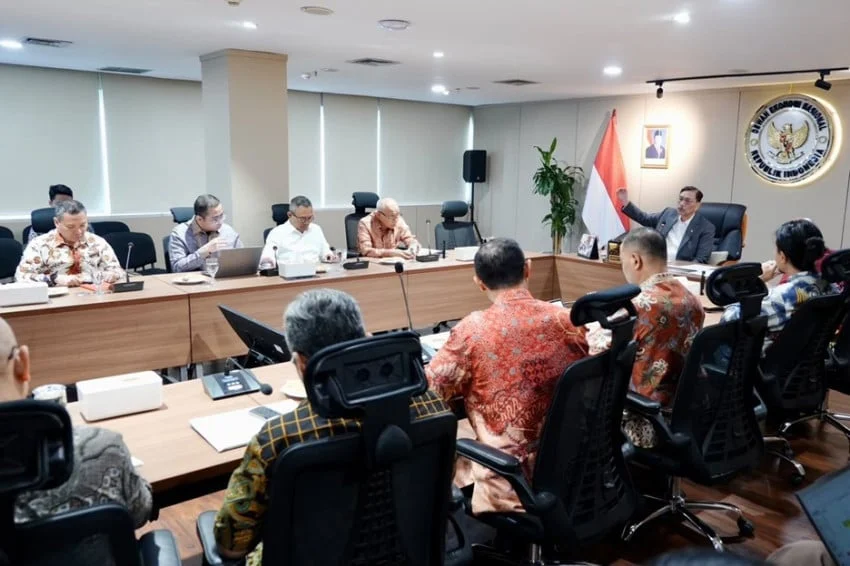
The Indonesian legal landscape regarding anti-corruption measures is facing a critical juncture as professional organizations and academic alumni associations push for a significant overhaul of the existing Corruption Eradication Law (UU Tipikor). During a high-level consultative meeting held at the National Economic Council (DEN) headquarters in Jakarta on Friday, November 6, 2026, representatives from various prestigious university alumni groups—including IKA ITS, ILUNI UI, IA ITB, KAGAMA, IKA UNAIR, and IKA UNPAD—convened with DEN Chairman Luhut Binsar Pandjaitan to deliberate on the future of white-collar crime prosecution in the country.
The primary impetus for this discussion is the growing concern among professionals, particularly those operating within State-Owned Enterprises (BUMN), that the current interpretation of corruption laws has become a bottleneck for national economic development. By advocating for a clearer demarcation between administrative negligence, standard business risks, and criminal corruption, these organizations aim to foster a climate where public servants and corporate leaders can make essential decisions without the constant fear of criminalization.
The Nexus of Legal Ambiguity and Economic Stagnation
The crux of the argument presented by the alumni associations, led by IKA ITS Deputy General Chairman Boy Robyanto, lies in the application of the current corruption statutes. Specifically, the groups are targeting the interpretation of "state losses" and "unlawful acts" as defined under the current legal framework. These provisions, which were traditionally anchored in the Corruption Eradication Law, are now transitioning into the purview of the new Criminal Code (KUHP), specifically Articles 603 and 604.
Boy Robyanto argued that the current legal ambiguity has created a "chilling effect" within the BUMN sector. When professional managers are unable to distinguish between a failed business venture—which carries inherent market risk—and a criminal act of graft, the immediate reaction is paralysis. This risk-averse behavior manifests as delays in procurement, stalled infrastructure projects, and a general decline in the competitiveness of national companies on the global stage.
"The definitions surrounding state losses and criminal intent need to be refined," Robyanto stated during the forum. "Without a clear, objective standard, we risk conflating administrative errors—which should be settled through internal corporate governance or civil courts—with intentional criminal corruption. This creates a volatile environment that discourages the best talent from taking on leadership roles in state-affiliated entities."
Historical Context: From UNCAC to Current Challenges
Indonesia’s commitment to combating corruption was solidified two decades ago with the ratification of the United Nations Convention Against Corruption (UNCAC) via Law Number 7 of 2006. While this marked a monumental step in aligning Indonesian law with international standards, critics argue that the domestic implementation has become overly reliant on rigid, punitive measures that lack the nuance found in other jurisdictions.
Global anti-corruption benchmarks often emphasize the importance of distinguishing between gross negligence and malicious intent. In many advanced economies, the "Business Judgment Rule" serves as a protective mechanism for corporate directors, provided their decisions were made in good faith, with adequate information, and in the best interest of the entity. In Indonesia, however, the concept of "state losses" is often interpreted in a way that ignores the complexity of commercial transactions, leading to legal actions that can jeopardize the careers of public officials who acted in good faith but oversaw projects that did not yield the expected financial returns.
Case Study: The Pelindo Precedent
To illustrate the systemic issues within the judicial approach, the IKA ITS delegation pointed to specific legal cases involving the state-owned port operator, Pelindo. One prominent example cited was the case regarding the dredging of Tanjung Perak Port, executed by a subsidiary, PT APBS.
The case serves as a poignant illustration of the "criminalization of business risk." In this instance, the dredging project was completed, and the port operations derived tangible, measurable benefits from the improved infrastructure. However, the legal system focused on the procurement process, deeming it to have "unlawful elements" that benefited the corporation. The legal impasse arose because, while the court found that the company gained an advantage, it simultaneously acknowledged that the individuals involved did not personally enrich themselves.
This paradox highlights a structural flaw: when the law focuses solely on the result of a business transaction rather than the intent of the actors, it becomes nearly impossible for state-owned entities to conduct business in a dynamic, high-stakes market. The alumni associations argue that if these judicial trends continue, the country will witness a systemic withdrawal of qualified professionals from public service, further stifling economic growth.
Data and Economic Implications
The economic stakes of this reform are substantial. BUMNs act as the backbone of the Indonesian economy, managing assets worth trillions of rupiah and playing a pivotal role in the government’s developmental goals. If the legal framework governing these entities remains a source of personal legal liability for every procurement decision, the resulting bureaucratic inertia could cost the nation billions in lost efficiency.
According to various economic reports, procurement and infrastructure development are the primary drivers of Indonesian GDP. When these sectors slow down due to legal anxieties, the ripple effects are felt throughout the supply chain, impacting private sector contractors, labor markets, and ultimately, consumer prices. The proposal from the alumni organizations is, therefore, not merely a call for legal protection, but an economic imperative to ensure the state remains a competitive participant in the global market.
Official Response and Path Forward
Luhut Binsar Pandjaitan, in his capacity as Chairman of the DEN, acknowledged the gravity of the concerns raised by the alumni representatives. As a figure who has long advocated for efficiency in government and the reduction of red tape, Luhut recognized the necessity of finding a "middle ground" where corruption is ruthlessly punished, but legitimate professional activity is shielded from arbitrary prosecution.
The discussion at the DEN headquarters is expected to be the first of a series of consultative sessions. The goal is to produce a white paper that proposes specific amendments or guidelines for the interpretation of the new KUHP and the existing UU Tipikor. This document would serve as a reference for law enforcement agencies—including the Attorney General’s Office and the Corruption Eradication Commission (KPK)—to ensure that investigations are conducted with a greater emphasis on evidence of criminal intent.
The Future of Anti-Corruption Enforcement
The proposed reforms do not seek to weaken the fight against corruption. On the contrary, proponents argue that by narrowing the focus to genuine, intentional graft, the state can improve the quality of its investigations and secure more convictions against high-level offenders, rather than spending resources on complex business cases that yield little in terms of real justice.
As the government moves forward, the challenge will be to balance the populist demand for strict anti-corruption measures with the technical requirement for a functioning, efficient state bureaucracy. The involvement of academic alumni networks—who represent a significant portion of the nation’s intellectual and professional capital—adds a layer of academic rigor and public scrutiny to the reform process.
In the coming months, the legal community will be watching closely to see if the government adopts these recommendations. If successful, the move could mark a significant maturation of the Indonesian legal system, moving away from a purely punitive regime toward one that fosters accountability, transparency, and economic vitality.
Analysis: The Balancing Act
The tension between "clean government" and "efficient government" is a classic dilemma in developing nations. The Indonesian experience highlights that without clear legal boundaries, the pursuit of transparency can inadvertently become a tool for administrative paralysis.
The recommendation to explicitly define "state losses" to exclude business risks arising from good-faith decisions is a standard practice in many developed legal systems. By introducing a more stringent requirement for proving criminal intent (mens rea), the government could potentially reduce the number of high-profile cases that end in acquittal or are perceived as politically motivated.
However, the path to reform is not without its hurdles. The public perception of corruption remains deeply entrenched, and any attempt to "loosen" the laws—even if scientifically and legally sound—will likely face skepticism from anti-corruption activists. The key for the DEN and the alumni groups will be to articulate the reforms not as a way to "protect the elite," but as a way to "empower the professionals" to work for the public good without fear.
Ultimately, the dialogue initiated by IKA ITS and other alumni groups represents a vital maturation of civil society’s role in policy-making. By leveraging their collective expertise, these organizations are forcing a much-needed conversation on how the state can effectively prosecute the corrupt while simultaneously creating an environment where honesty and efficiency are the standard for those serving the public interest. The outcome of these discussions will likely define the trajectory of the Indonesian economy for the next decade.