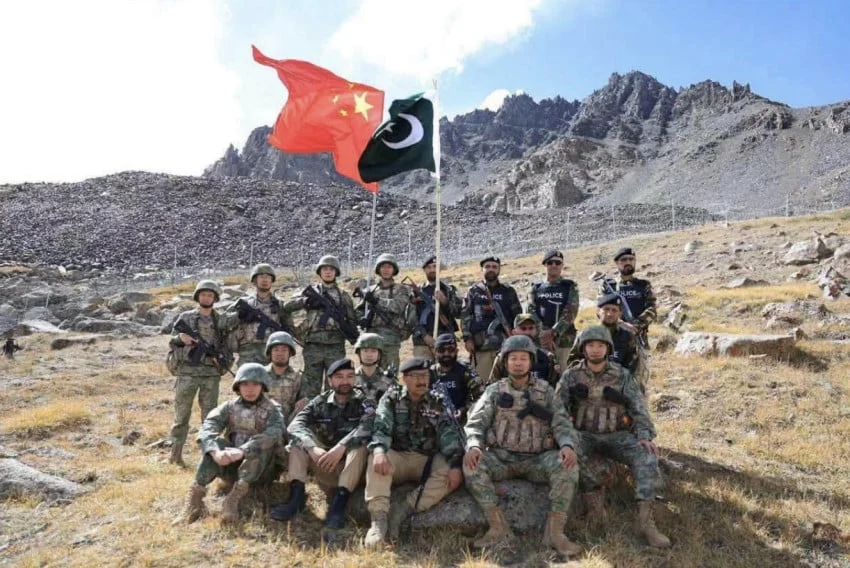
The geopolitical landscape of the Himalayas has shifted significantly following the formalization of a joint border commission between Pakistan and China, a move that has drawn sharp condemnation from New Delhi and intensified long-standing regional friction. For decades, India has maintained a steadfast position regarding its territorial sovereignty in the Ladakh region, consistently refusing to recognize any bilateral agreements between Islamabad and Beijing concerning lands that India claims as part of its integral territory. The recent signing of an agreement to establish the Pakistan-China Joint Border Commission marks a critical juncture in the strategic alignment between the two nations, further complicating India’s security environment.
The Anatomy of the Dispute
At the heart of this renewed diplomatic crisis is the Shaksgam Valley, a rugged and remote expanse covering approximately 5,180 square kilometers. This territory was ceded by Pakistan to China under a 1963 border agreement—a deal that India has viewed as illegal and void since its inception. New Delhi’s position remains that the Shaksgam Valley, along with other portions of the former princely state of Jammu and Kashmir, remains under the illegal occupation of Pakistan. By establishing a formal commission to manage, trade, and improve connectivity across these borders, Pakistan and China are effectively cementing a status quo that India refuses to acknowledge as legitimate.
The Ministry of External Affairs in New Delhi was swift in its response, characterizing the agreement as a violation of sovereignty. Randhir Jaiswal, the official spokesperson for the Indian government, stated categorically that the so-called joint commission lacks any legal basis. According to the Indian government, Pakistan possesses no legal standing (locus standi) to negotiate or manage territories that India considers to be part of its sovereign domain.
Historical Context and Chronology
The roots of this territorial impasse stretch back to the partition of British India in 1947. The status of Jammu and Kashmir became a flashpoint for conflict between India and Pakistan almost immediately. As the two nations consolidated their borders, China began to assert its own interests in the high-altitude regions of the Karakoram and the Himalayas.
- 1947–1948: The first Indo-Pakistani war breaks out over Kashmir, leading to the current Line of Control (LoC).
- 1962: The Sino-Indian War results in a military defeat for India and the solidification of Chinese control over Aksai Chin.
- 1963: Pakistan and China sign the Sino-Pakistan Agreement, where Pakistan cedes the Shaksgam Valley to China to settle border demarcations. India immediately rejects the validity of this treaty.
- 2020: Tensions between India and China escalate significantly following the Galwan Valley clash along the Line of Actual Control (LAC), leading to a prolonged military standoff.
- 2024: Pakistan and China formalize the Joint Border Commission, signaling deeper integration of their border management systems and sparking fresh diplomatic protests from New Delhi.
Strategic Implications: The China-Pakistan Axis
The deepening cooperation between Islamabad and Beijing represents a strategic encirclement challenge for New Delhi. China’s "Belt and Road Initiative" (BRI), specifically the China-Pakistan Economic Corridor (CPEC), already traverses territory claimed by India. The establishment of this new border commission is seen by analysts as an extension of this physical and economic integration.
For India, the concern is twofold: military and diplomatic. Militarily, India must now contend with a coordinated approach to border management by its two primary adversaries. If Pakistan and China synchronize their activities along the northern borders, the Indian Armed Forces face the prospect of a "two-front" logistical and tactical burden. Diplomatic analysts suggest that Beijing is utilizing Pakistan as a proxy to keep India preoccupied on its western and northern borders, thereby constraining India’s ability to project influence in the Indo-Pacific or challenge Chinese hegemony in the South China Sea.
Regional Reactions and Global Perspectives
While the United States and other Western nations have generally remained cautious in commenting on the specifics of the Sino-Pakistani border demarcation, there is an underlying concern regarding the destabilization of the Himalayan region. The international community, particularly within the framework of the United Nations, has historically viewed the Kashmir issue as a bilateral matter to be resolved between India and Pakistan. However, China’s direct involvement in the administration of these disputed lands elevates the conflict from a regional border dispute to a broader geopolitical competition.
Pakistan maintains that its agreement with China is a sovereign right, intended to improve regional connectivity and economic prosperity. Islamabad argues that because it maintains administrative control over these territories, it has the right to enter into bilateral agreements that benefit its national interest. This narrative, however, is diametrically opposed to India’s insistence that the entire territory of Jammu and Kashmir is a sovereign part of India, including areas currently under Pakistani or Chinese administration.
The Economic Dimension of Border Management
The joint commission is tasked with addressing not just security, but also commerce and connectivity. The development of infrastructure in the Shaksgam Valley and surrounding areas is part of a larger plan to link Western China with the Arabian Sea via the port of Gwadar in Pakistan. For China, the ability to bypass the Malacca Strait—a potential bottleneck in the event of a naval blockade—is a vital strategic objective. By consolidating its hold on these border regions, China ensures the security of its energy imports and trade routes.
For India, this infrastructure development represents a direct threat to its territorial integrity. The construction of roads, bridges, and surveillance installations in these disputed areas shifts the "facts on the ground" in favor of the China-Pakistan alliance, making a future resolution of the border dispute increasingly difficult.
Future Outlook and Analytical Insights
The formalization of the Pakistan-China border commission leaves India in a precarious position. The current Indian government, led by Prime Minister Narendra Modi, has emphasized a policy of "territorial assertiveness." The rejection of the commission is consistent with this policy, yet it provides no immediate mechanism to reverse the developments on the ground.
Observers note that the timing of this announcement is particularly sensitive, as India and China are currently engaged in delicate negotiations to de-escalate tensions along the LAC following the 2020 border crisis. The move to deepen China-Pakistan cooperation appears to be a signal from Beijing that it is not prepared to prioritize the normalization of ties with India at the expense of its "all-weather" partnership with Pakistan.
The lack of a legal foundation for this commission, as asserted by India, serves as a diplomatic shield, but it does not address the underlying reality of the power imbalance. As China continues to modernize its military and expand its influence, and as Pakistan leverages its proximity to China to counter India’s regional dominance, the Himalayan border will remain one of the most volatile zones in the world.
In conclusion, the establishment of the Pakistan-China Joint Border Commission is more than a administrative formality; it is a recalibration of power in South Asia. By formalizing their border management, Pakistan and China have effectively signaled a unified stance against India’s claims. For India, the road ahead involves navigating a complex environment where traditional diplomatic protests are increasingly challenged by the reality of military and economic integration between its two neighbors. The stability of the region will continue to depend on whether these territorial tensions can be managed through dialogue or if they will further entrench the division of the Himalayan frontier, potentially leading to further flashpoints in the years to come.