The implementation of national social welfare initiatives often encounters complex operational hurdles, but few challenges carry the immediate gravity of food safety failures involving public health. Recent mass poisoning incidents linked to the distribution of meals under the Free Nutritious Meal (Makan Bergizi Gratis or MBG) program have triggered a rigorous government response, setting a precedent for strict accountability. Authorities have clarified that while administrative penalties have already resulted in hundreds of dismissals and facility closures, the path to criminal prosecution remains open for judicial authorities to pursue.
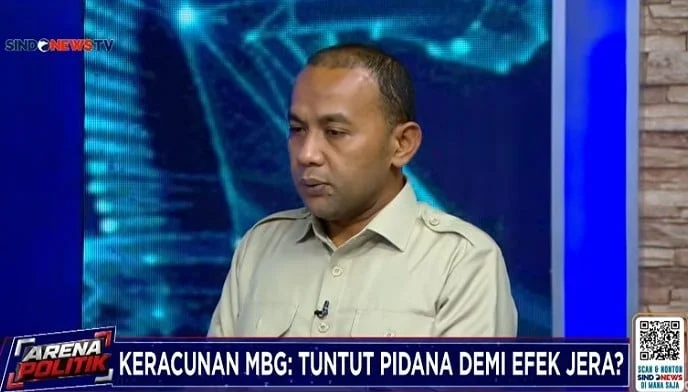
The discourse surrounding accountability intensified following public statements from key government representatives. Hariqo Satria, an Expert Staff Member at the Indonesian Communication Agency (Bakom RI), addressed the legal and administrative dimensions of the crisis during an appearance on the SindoNews YouTube program, Arena Politik. According to Satria, the administration maintains an open stance regarding potential criminal charges against individuals found responsible for the lapses in food safety protocols. The government fully defers the investigative and prosecutorial decisions regarding criminal liability to law enforcement agencies, emphasizing that judicial processes must take their course independently.
Chronology of Events and Escalation of the Crisis
The unfolding crisis surrounding the MBG program began to draw intense public and media scrutiny following a series of localized outbreaks where school children and community members exhibited symptoms of severe foodborne illness shortly after consuming the provided meals. Initial reports of nausea, vomiting, and dizziness prompted immediate medical interventions, with affected individuals rushed to local clinics and hospitals for urgent treatment.
As health authorities collected samples from the affected individuals and the remaining food packages, epidemiological investigations pointed toward contamination within the preparation and distribution chain. The swift spread of the illness across multiple distribution zones highlighted vulnerabilities in the supply chain logistics, hygiene enforcement, and quality control checkpoints. Public health officials worked around the clock to contain the outbreaks, tracing the sources back to specific regional central kitchens and processing units responsible for mass meal preparation.
In response to the mounting pressure and the undeniable evidence of systemic oversights, regulatory bodies and program administrators initiated a comprehensive review of all participating kitchens. The findings revealed alarming gaps in certification, handling practices, and nutritional supervision, prompting the government to escalate its corrective measures from mere warnings to sweeping structural purges.
Administrative Crackdown and Institutional Accountability
While criminal investigations require thorough evidence gathering and judicial due process, immediate administrative measures have been swiftly enforced to restore public trust and penalize negligence. Satria elaborated on the scale of the internal disciplinary actions taken against personnel directly involved in the management and operation of the problematic facilities.
The primary targets of these administrative sanctions include operational leaders, financial administrators, and technical supervisors. Specifically, the heads of the Satuan Pelayanan Pemenuhan Gizi (SPPG)—the local operational units tasked with ensuring nutritional compliance and food safety—alongside accountants and resident nutritionists, often holding civil servant (ASN) status, faced severe employment consequences. According to official figures, approximately 353 kitchen heads have been systematically stripped of their positions and dismissed from civil service due to proven negligence.
In addition to personnel terminations, regulatory authorities have launched a massive campaign to shut down unauthorized or non-compliant facilities. Kitchens operating without complete and up-to-date health and safety certifications have been targeted for immediate closure. To date, nearly 2,000 preparation kitchens failing to meet rigorous administrative and hygienic standards have been shuttered indefinitely, halting their operations until comprehensive audits and compliance verifications can be completed.
Background Context of the Free Nutritious Meal Program
The Free Nutritious Meal (MBG) program stands as one of the most ambitious social infrastructure initiatives introduced to combat malnutrition, stunt growth, and improve the overall dietary intake of vulnerable demographics, particularly school-aged children across the nation. Designed to reach millions of beneficiaries daily, the program requires a vast, decentralized network of food procurement, preparation, and rapid distribution channels.
Scaling a nutrition program of this magnitude inevitably introduces immense logistical complexities. Preparing and packaging hundreds of thousands of meals daily demands stringent adherence to food safety standards, cold-chain management, and rapid turnover times. Historically, public feeding programs of similar scale have faced hurdles related to quality assurance, especially when relying on localized third-party vendors or newly established community kitchens lacking deep institutional experience in industrial-scale catering.
The recent incidents of mass poisoning have thus exposed the tension between the speed of program rollout and the meticulousness required in regulatory oversight. While the primary objective remains the upliftment of public health through proper nutrition, these events underscore the reality that safety protocols cannot be compromised for the sake of administrative expediency.
Legal Frameworks and Perspectives on Culpability
The intersection of public administration, civil service regulations, and criminal law in cases of mass food poisoning presents a multifaceted legal challenge. Legal scholars and public policy experts have weighed in on the appropriate distribution of liability, noting that responsibility spans multiple layers of governance and execution.
Under administrative law, civil servants and contracted personnel involved in public welfare programs are held to a high standard of fiduciary and operational duty. Negligence resulting in public harm triggers internal disciplinary codes, which explain the rapid dismissal of hundreds of kitchen heads and administrative staff. However, legal experts emphasize that administrative sanctions do not preclude criminal liability.
If investigations uncover gross negligence, recklessness, or intentional circumvention of safety standards that directly endangered human lives, prosecutors can invoke relevant articles under the criminal code. This dual-track approach—combining swift administrative purges with rigorous criminal investigations—serves as a deterrent against future administrative laxity. By explicitly stating that the government will not shield negligent personnel, officials aim to demonstrate institutional transparency and a commitment to justice for the affected victims and their families.
Broader Economic, Social, and Political Implications
The fallout from the MBG mass poisoning incidents extends far beyond the immediate medical recovery of the victims, triggering widespread discussions on governance, policy execution, and public confidence.
Economically, the sudden closure of nearly 2,000 preparation kitchens creates localized supply chain disruptions. Vendors, farmers, and local suppliers who rely on contracts with the MBG program face temporary halts in revenue, necessitating government intervention to restructure supply agreements and re-evaluate vendor selection criteria. Furthermore, the financial cost of scaling up oversight, conducting widespread facility inspections, and providing medical compensation places an additional burden on public expenditure.
Socially, the incidents have shaken community trust in state-sponsored feeding initiatives. Parents and guardians who viewed the program as a reliable source of daily nourishment for their children now demand heightened transparency and verifiable safety guarantees before participating kitchens resume operations. Restoring this social capital requires consistent, verifiable reforms and open communication from program administrators regarding the steps taken to prevent recurrence.
Politically, the handling of the crisis serves as a critical test for the administration’s competence and accountability. Opposition figures and civil society organizations have closely monitored the government’s response, using the incidents to advocate for tighter legislative oversight and independent audits of all social welfare projects. The willingness of officials to openly acknowledge shortcomings, support administrative terminations, and leave the door open for criminal prosecution is seen as a strategic effort to mitigate political fallout and demonstrate unwavering accountability.
Future Outlook and Preventive Reforms
As the investigations continue and the legal status of the accused personnel evolves, the long-term trajectory of the Free Nutritious Meal program hinges on the implementation of structural reforms. Policymakers are currently reviewing proposals to overhaul the quality control architecture of the program.
Key reform initiatives under consideration include the establishment of independent food safety inspectorates dedicated exclusively to public feeding programs, the mandatory integration of digital tracking systems for food sourcing and preparation timelines, and the enhancement of continuous training programs for all personnel holding ASN status within the nutritional service units. Additionally, tightening certification requirements and introducing zero-tolerance policies for hygiene violations are expected to become permanent fixtures of the regulatory landscape.
Ultimately, the mass poisoning incidents under the MBG program represent a sobering turning point for national social infrastructure initiatives. By balancing rapid administrative remediation with a cooperative stance toward potential criminal accountability, the government aims to re-establish a secure foundation for a program that remains vital to the nation’s human capital development. The lessons learned from this crisis will undoubtedly redefine how public health safety is monitored, enforced, and protected in large-scale state interventions for years to come.